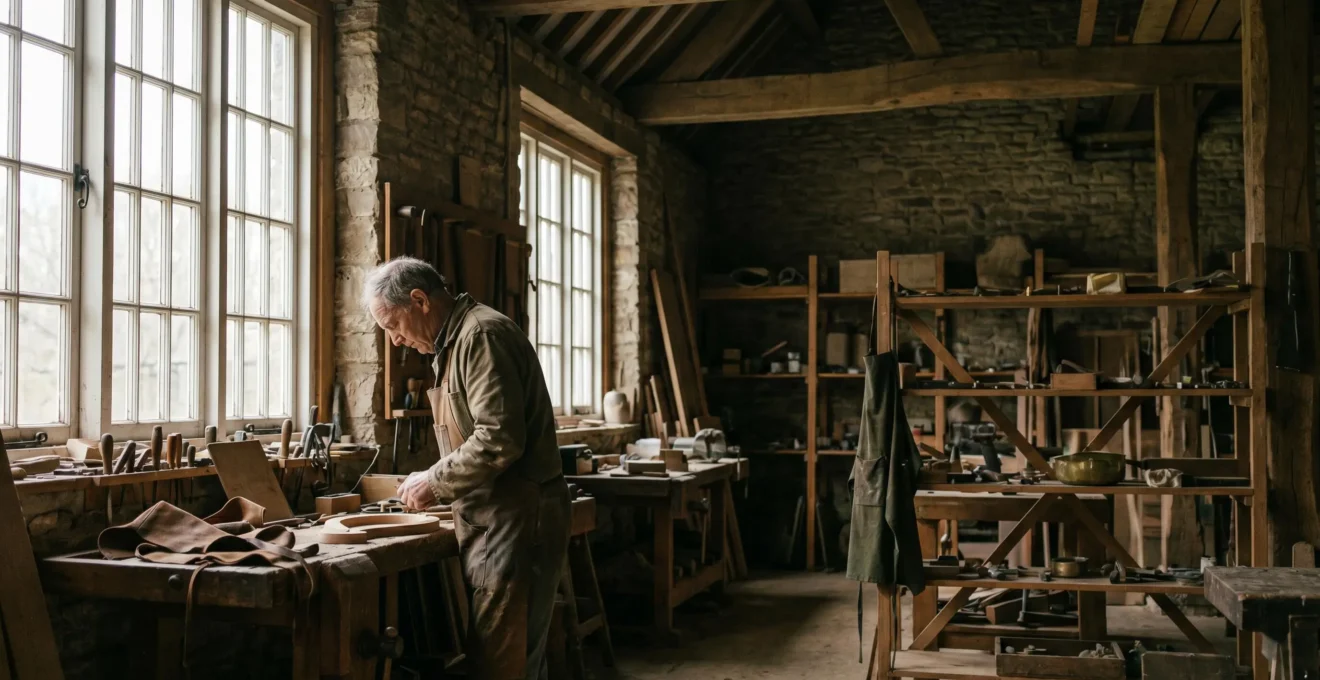
Commissioning British craft isn’t an expense; it’s the creation of a future heirloom.
- It requires shifting your focus from an item’s price to its provenance narrative and material integrity.
- The true value lies in the object’s ability to be repaired, cherished, and passed down through generations.
Recommendation: Adopt a custodian’s mindset. Your role is not merely to buy, but to commission a piece of tangible legacy that embodies a story and a skill worth preserving.
In a world saturated with mass-produced luxury, the discerning buyer often faces a paradox: an abundance of choice, yet a scarcity of true distinction. The default response is to seek out lists of “top artisans” or guides on “how to commission,” but this approach often misses the fundamental point. It treats the act of commissioning as a simple transaction, a purchase to be optimised for price and speed. This perspective overlooks the deeper value proposition offered by Britain’s master craftspeople.
The conversation around high-end craft often gravitates towards generic advice about finding the right maker. But what if the key wasn’t simply finding an artisan, but becoming a patron? What if the goal wasn’t just to acquire a beautiful object, but to initiate a piece of tangible legacy? This is the principle of custodianship. It reframes the commission from a momentary purchase into a long-term investment in skill, story, and generational value. It is the difference between owning an item and becoming the guardian of its history.
This shift in mindset is crucial. It moves the focus from “what it costs” to “what it represents.” The true luxury of British craftsmanship lies not only in the exquisite finish of a piece but in its provenance narrative—the story of its maker, its materials, and the centuries of skill it embodies. This is an investment in an object designed not for a single lifetime, but for many.
This guide will explore how to apply this custodian’s mindset across various disciplines of British craft. We will delve into the practicalities of briefing a cabinet maker for a piece that will anchor a home for a century, deciphering the silent language of hallmarks that guarantees material integrity, and understanding why the philosophy of “slow fashion” is the future of enduring style. This is your manual for commissioning not just an object, but a legacy.
To help you navigate this world of enduring quality, this article explores the key disciplines where British master craftsmanship excels. The following summary outlines the path to becoming a true custodian of skill and style.
Contents: Your Path to Commissioning a Legacy
- Bespoke Furniture: How to Brief a Cabinet Maker for a One-of-a-Kind Table?
- Gold Hallmarks: How to Verify the Purity of British Jewellery?
- Stoke-on-Trent: Why Is It Still the World Capital of Ceramics?
- Savile Row: What Is the Difference Between Made-to-Measure and Bespoke?
- Bookbinding: How to Restore a Rare First Edition Without Devaluing It?
- Heritage Brands: Why Invest in a Barbour or Burberry Trench?
- Statement Pieces: Why One Great Sofa Is Better Than 3 Average Chairs?
- Why Is the Slow-Fashion Paradigm Crucial for the Future of British Style?
Bespoke Furniture: How to Brief a Cabinet Maker for a One-of-a-Kind Table?
Commissioning bespoke furniture is the first step towards creating a tangible legacy for your home. It’s a move away from transient trends and towards a piece that will gather stories and serve generations. The brief you provide is not merely a list of dimensions; it is the genesis of this legacy. A successful brief communicates a vision for the piece’s life within your family, its functional role, and the aesthetic spirit it should embody. Think less about replicating an image from a magazine and more about articulating the feeling and function you desire.
The process begins with a dialogue. You are not just buying a table; you are co-creating it. Be prepared to discuss your lifestyle, the room’s architecture, and the other objects it will live alongside. A master cabinet maker will translate these abstract needs into concrete design solutions, proposing specific timbers for their grain, durability, and how their colour will mature over time. This initial investment in design is critical, as noted by experts in the field. As Neil Stevenson advises in Country Life Magazine:
Separate the cost of manufacture from the design fees and be prepared to invest properly in the design process.
– Neil Stevenson, Country Life Magazine
This highlights a crucial shift: you are paying for expertise and a unique design, not just materials and labour. While the price for a significant bespoke piece can range from £3,000 to over £30,000 according to UK cabinet makers, this cost reflects a commitment to generational value. You are commissioning an heirloom, an item whose structural and emotional worth will far outlast its mass-produced counterparts. The brief is your primary tool in ensuring this vision is realised.
Gold Hallmarks: How to Verify the Purity of British Jewellery?
When commissioning or purchasing fine British jewellery, you are acquiring an object of profound personal and financial significance. Beyond the brilliance of the design, its long-term value is guaranteed by a set of tiny, stamped symbols: the hallmark. A British hallmark is not a brand logo; it is a legally required seal of approval that certifies the type of metal and its purity. For a custodian of fine objects, understanding these marks is non-negotiable. It is the ultimate assurance of material integrity.
Since 1300, the UK’s Assay Offices have provided this consumer protection. A full traditional hallmark comprises several compulsory marks: the Sponsor’s Mark (identifying the maker), the Millesimal Fineness Mark (denoting the metal’s purity), and the Assay Office Mark (a symbol for London, Birmingham, Sheffield, or Edinburgh). For instance, the Leopard’s Head signifies the London Assay Office. The fineness mark is the most crucial for verifying purity; it tells you the proportion of pure gold in the alloy, expressed in parts per thousand. A mark of “750” on an 18ct gold piece means it contains 75% pure gold.
This system provides an unimpeachable guarantee, transforming a beautiful object into a verifiable asset.
As the image above illustrates, these marks are an integral, textured part of the piece itself, a silent testament to its quality. Learning to read them empowers you to invest with confidence, knowing the piece’s intrinsic value is protected by centuries of regulation. It is a crucial part of the provenance narrative, connecting your modern commission to a long history of British quality control.
The following table breaks down the common UK gold standards, helping you align your choice with the piece’s intended use and longevity.
| Carat | Millesimal Mark | Gold Content | Common Uses |
|---|---|---|---|
| 9ct | 375 | 37.5% pure gold | Affordable everyday jewellery |
| 14ct | 585 | 58.5% pure gold | Durable fine jewellery |
| 18ct | 750 | 75% pure gold | Premium jewellery standard |
| 22ct | 916 | 91.6% pure gold | Traditional wedding rings, Asian market |
| 24ct | 999 | 99.9% pure gold | Investment bullion, rare jewellery |
Stoke-on-Trent: Why Is It Still the World Capital of Ceramics?
The name “Stoke-on-Trent” is synonymous with ceramics, a legacy stretching back centuries. Yet, to view it merely as a historical artefact is to miss its vibrant and evolving present. For the modern collector and custodian, Stoke is not a museum; it is a living ecosystem of skill that continues to define global standards in ceramic design and manufacturing. Its endurance is a powerful testament to the commercial and cultural value of a strong provenance narrative.
The region, known as “The Potteries,” earned its title by mastering the industrialisation of ceramic production. Today, that legacy has evolved. While heritage giants like Wedgwood and Portmeirion maintain a global presence, the area is also a hotbed for contemporary artisans and nimble companies that blend traditional techniques with modern design. This combination of established industry and an innovative studio scene creates a unique environment for commissioning. You can access skills passed down through generations, whether for a bespoke dinner service or a unique sculptural piece.
Case Study: Churchill China’s Modern Expansion
In 2024, Churchill China (UK) Ltd. advanced its expansion plans at its Stoke-on-Trent factory. This move was not driven by nostalgia, but by rising orders from luxury hospitality clients across Europe and Asia. This demonstrates the ongoing commercial relevance of Stoke’s specialised manufacturing expertise in fiercely competitive premium global markets, proving that the “Made in Stoke” provenance carries significant commercial weight.
The region’s importance is not just reputational; it’s economic. A 2024 report highlighted that the local ceramics supply chain saw a 35% increase between 2018 and 2024, underscoring its crucial role. As the report states, “Ceramics underpins supply chains in construction, energy, defence, healthcare and advanced manufacturing, while continuing to shape the region’s international reputation for design and quality.” Investing in a piece from Stoke is to buy into this dynamic, living history.
Savile Row: What Is the Difference Between Made-to-Measure and Bespoke?
For anyone serious about style, Savile Row represents the zenith of tailoring. However, the terms used can be confusing. Understanding the distinction between “made-to-measure” and true “bespoke” is crucial, as it marks the difference between a well-fitting garment and a piece of wearable art—a tangible legacy. The choice is not about good versus bad, but about two different philosophies of creation and ownership.
A “made-to-measure” suit begins with a standard, pre-existing pattern or “block.” Your measurements are taken, and this block is adjusted to fit you. The suit is then largely constructed in a factory, with some hand-finishing. It offers a significant step up from off-the-rack in terms of fit and fabric choice but remains an adaptation of a template. In contrast, “bespoke” is a far more profound process. The term itself, said to have originated on Savile Row, implies that the cloth has been “spoken for.” A unique paper pattern is drafted from scratch, exclusively for you. It considers not just your measurements but your posture, gait, and individual asymmetries.
The construction of a bespoke suit is an art form. It involves up to 80 hours of handwork by multiple artisans, from the master cutter to the specialist trouser and waistcoat makers. This meticulous process, involving multiple fittings, is captured in the intimate relationship between the tailor and the cloth.
The table below clarifies the key differences, revealing why a bespoke suit is an investment in unparalleled craftsmanship.
| Feature | Bespoke | Made-to-Measure |
|---|---|---|
| Pattern | Unique hand-cut paper pattern created for each client | Standard base pattern altered to measurements |
| Construction | 50-80+ hours of hand-work by master artisans | Section-based factory production with some hand-finishing |
| Fittings | Minimum 3-4 fittings (basted, forward, final) | Typically 1-2 fittings for adjustments |
| Canvas | Hand-padded floating canvas from natural horsehair | Fused or partial canvas construction |
| Timeline | 10-16 weeks | 4-8 weeks |
| Price Range (UK) | £4,000-£10,000+ | £800-£2,500 |
Bookbinding: How to Restore a Rare First Edition Without Devaluing It?
Owning a rare first edition is the epitome of custodianship. You are the temporary guardian of a fragile piece of history. When such a volume shows signs of age—a loose binding, a detached spine, or brittle pages—the instinct to “fix” it can be dangerous. In the world of conservation, inappropriate restoration is often more damaging than neglect. The goal is not to make the book look “new,” but to stabilise it for the future while preserving its historical integrity.
The key principle is conservation over restoration. A conservator’s primary duty is to halt decay using methods and materials that are both chemically stable and, crucially, reversible. This means any intervention can be undone by a future conservator without harming the original object. This contrasts with older restoration methods that might have used modern, irreversible glues or replaced original boards, inadvertently erasing part of the book’s story and diminishing its value.
A book’s signs of wear—a faded inscription, a well-worn cover, even historical repairs—are part of its provenance narrative. They tell the story of its journey through time and the hands that have held it. An ethical restoration respects this patina. The focus is on strengthening the existing structure, carefully mending torn pages with fine Japanese paper and wheat starch paste, and re-sewing loose sections with linen thread. Finding the right professional is paramount. You need an accredited Conservator-Restorer, not a general bookbinder, who understands the delicate chemistry and ethics involved.
Your Action Plan: Commissioning Ethical Book Conservation
- Assess and Prioritise: Identify the core issue. Is it structural (loose binding) or cosmetic (surface dirt)? Prioritise stabilisation and preventing further decay over aesthetic improvements.
- Source the Right Expert: Seek a Conservator-Restorer certified by a professional body like the UK’s Institute of Conservation (Icon). Verify their specialisation in books and paper.
- Brief for Reversibility: Clearly state that all interventions must use reversible materials (e.g., wheat starch paste, Japanese paper) and respect the book’s original integrity, including historical repairs and patina.
- Demand Full Documentation: Request a detailed provenance report of all actions taken, materials used, and the rationale behind them. This document becomes part of the book’s ongoing history.
- Define the Finish Line: Agree on the end goal. Is it to make the book readable again, or to stabilise it for archival storage? Avoid the temptation to make it look ‘as new’.
Heritage Brands: Why Invest in a Barbour or Burberry Trench?
In the fast-paced world of fashion, few items achieve true iconic status. The Barbour waxed jacket and the Burberry trench coat are two such exceptions. To purchase one is not simply to buy a coat; it is to invest in a piece of British social and cultural history. These are not fashion items but functional classics, designed for longevity and embodying the concept of generational value. Their enduring appeal lies in a commitment to quality and a design that transcends transient trends.
The value proposition of these heritage pieces stands in stark contrast to the disposable nature of fast fashion. A Barbour jacket is designed to be re-waxed and repaired, not replaced. The company actively encourages this, offering a comprehensive repair service that can patch holes, replace zips, and mend linings. A well-worn Barbour with a patchwork of repairs tells a story; it has a character that a new jacket lacks. Similarly, a Burberry trench, originally designed for military officers, is built from durable gabardine with a timeless silhouette that has remained largely unchanged for over a century.
This philosophy of longevity is the antithesis of modern consumer culture. As one analysis of the UK furniture industry notes, the mindset of investing in lasting quality is a conscious choice. “Bespoke furniture is built to last, often lasting decades versus the 3-5 years lifespan of many flat-pack items.” While speaking of furniture, the principle is identical. Investing in a heritage brand like Barbour or Burberry is a commitment to a piece that can be worn, repaired, and passed down, becoming a cherished part of a family’s own provenance narrative.
Statement Pieces: Why One Great Sofa Is Better Than 3 Average Chairs?
When furnishing a space, it is tempting to fill it with multiple, moderately-priced items. Yet, this approach often leads to a room that lacks focus and a collection of furniture destined for a short lifespan. The custodian’s mindset proposes a different strategy: invest in a single, exceptional “statement piece.” One great, handcrafted sofa or armchair can anchor a room, define its character, and serve as a vessel for family life for decades. This is the principle of prioritising generational value over disposable quantity.
A statement piece, by its nature, is a significant commission. It is likely the largest and most-used piece of furniture in a room. Therefore, its quality is paramount. A masterfully crafted sofa is built on a solid hardwood frame with traditional joinery, designed not just for comfort but for endurance. Its construction allows it to be re-upholstered multiple times, adapting to changing tastes and repairing the inevitable wear of a life well-lived. This inherent repairability is the cornerstone of its value, transforming it from a consumable good into a sustainable, long-term asset.
This philosophy directly challenges the “fast furniture” model, where pieces are designed for a few years of use before ending up in landfill. Investing in a single, superior piece is an act of both aesthetic and environmental responsibility.
Case Study: The Long-Term Value of Bespoke Furniture
An analysis from UK bespoke furniture makers reveals a fundamental shift in the purchasing decision. Handcrafted pieces can be disassembled, repaired, and re-upholstered for generations, transforming the choice from short-term consumption to multi-generational custodianship. The use of premium solid woods and FSC-certified timber, combined with traditional joinery techniques, creates furniture that becomes more valuable over time, both financially and emotionally. This stands in stark contrast to mass-produced alternatives destined for landfill within years, as highlighted in a value analysis by Glencairn Furniture. The initial investment secures a future of repair and reuse, not disposal.
A great sofa becomes the backdrop for family memories: conversations, celebrations, and quiet moments. It absorbs the life lived around it, developing a patina that no new object can replicate. It becomes the heart of the home and a true tangible legacy, far more valuable than three anonymous chairs.
Key Takeaways
- Adopt a Custodian’s Mindset: Shift your perspective from buying an object to commissioning a legacy piece that will last for generations.
- Value Provenance and Integrity: The story of the maker and the verifiable quality of the materials are as important as the aesthetic of the piece.
- Invest in Repairability: True luxury lies in an object’s ability to be maintained and repaired, not replaced. This is the core of generational value.
Why Is the Slow-Fashion Paradigm Crucial for the Future of British Style?
The concept of “slow fashion” is more than a trend; it is a return to a value system that has always been at the heart of British craftsmanship. It is a paradigm that champions quality over quantity, longevity over disposability, and storytelling over fleeting trends. For the future of British style, embracing this philosophy is not just an option, but a necessity. It is the commercial and cultural framework that supports the very idea of custodianship and ensures the survival of master craftsmanship.
Slow fashion directly counters the destructive cycle of its “fast” counterpart. It encourages consumers to buy fewer, better things. It places value on the artisan’s time, the quality of the raw materials, and the durability of the final product. This is the world of the Savile Row suit that takes 80 hours to make, the Barbour jacket designed to be repaired, and the handcrafted ceramics that connect a modern home to a centuries-old tradition. These are not just products; they are manifestations of a culture that respects skill and material.
Case Study: Modern Potters Reclaiming Stoke-on-Trent’s Heritage
Contemporary ceramic artists in Stoke-on-Trent exemplify the slow-fashion paradigm. Artisans and innovative companies like 1882 Ltd. are blending five generations of craftsmanship with modern design. By combining centuries-old techniques with new accessibility, they demonstrate how traditional skills can thrive. Individual makers can now reach global audiences through platforms that value authenticity, while events like the British Ceramics Biennial foster knowledge transfer. This ecosystem transforms consumption into an act of cultural preservation, proving the viability of a craft-based, slow-consumption model.
By investing in pieces born of this paradigm, the modern custodian does more than acquire an object of beauty. They participate in a sustainable economic model. They provide patronage that keeps vital skills alive, supports local economies, and preserves a provenance narrative that would otherwise be lost. This conscious choice is what will define the future of British style: a style based not on the constant churn of the new, but on the enduring power of the well-made.
Ultimately, commissioning a piece from a master craftsman is an act of profound optimism. It is a belief that quality endures, that skill has value, and that the objects we choose to live with can carry stories far beyond our own lifetime. To begin this journey, the next logical step is to identify the area of craft that resonates most with you and start a conversation with a maker.