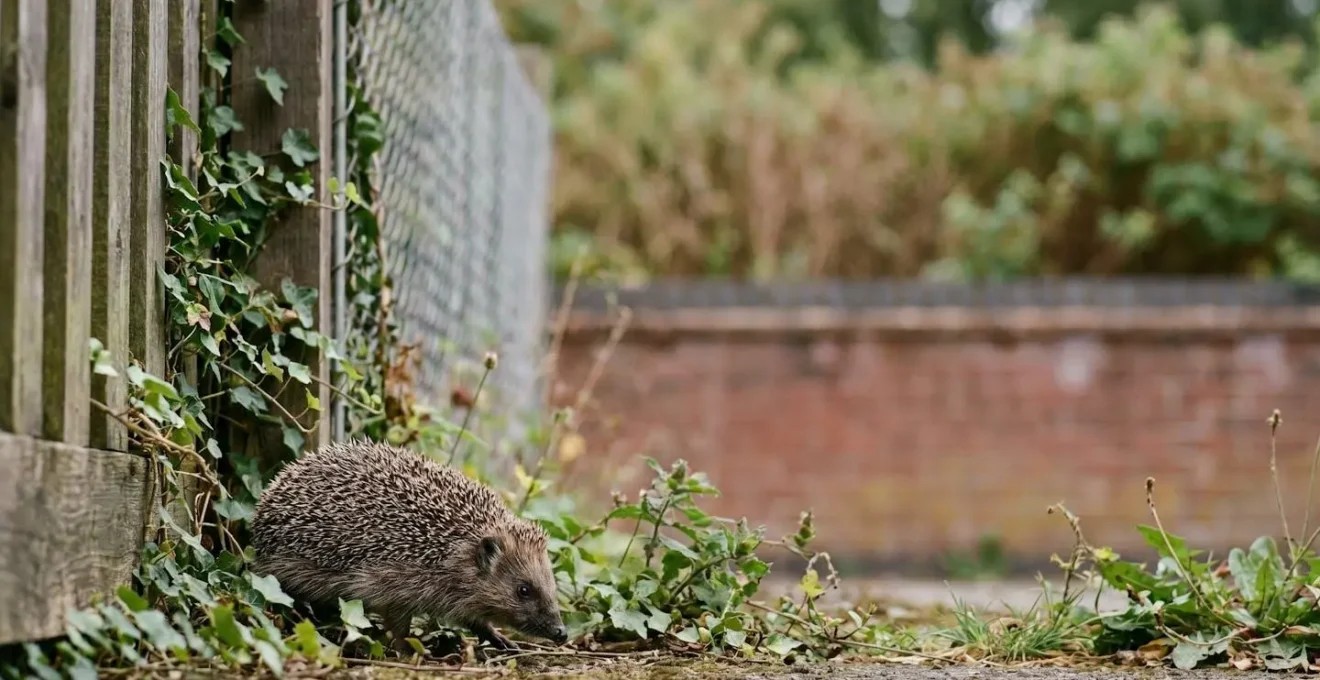
The key to saving local wildlife isn’t creating massive, isolated nature reserves, but strategically connecting our own back gardens and neighborhoods into a functional, permeable landscape.
- Small, intentional actions, like a 13cm fence hole, create vital “micro-corridors” that form a powerful network effect.
- Seemingly harmless elements like solid fences and bright streetlights create impassable “ecological blind spots” for many species.
Recommendation: Start by mapping your street’s barriers and talking to one neighbor about creating a single, shared “hedgehog highway.”
A fox hesitates at the base of a tall garden fence, its nightly patrol cut short. A hedgehog, desperate to find food and a mate, bumps futilely against a solid concrete gravel board. These are not isolated incidents; they are symptoms of a landscape-wide problem: fragmentation. For decades, our urban and rural environments have been carved up by roads, walls, and fences, turning a once-continuous habitat into a series of isolated, ecological islands. This fragmentation is one of the single greatest threats to wildlife, restricting movement, limiting genetic diversity, and making populations vulnerable.
The common advice for helping wildlife often involves improving your own patch—planting native flowers, avoiding pesticides, or adding a small pond. While these actions are valuable, they treat the garden as a destination. They risk creating beautiful, but ultimately isolated, oases that do little to solve the larger problem of a disconnected landscape. An animal trapped in a single garden, no matter how well-stocked, cannot thrive. The real challenge is not just enriching these islands, but building bridges between them.
What if the most powerful action you could take wasn’t about enriching your garden, but about making it permeable? The true key to supporting robust wildlife populations lies in shifting our focus from isolated habitats to landscape connectivity. It’s about thinking like an ecologist and seeing our neighborhoods not as a collection of private lots, but as a single, shared “patchwork ecosystem.” It requires us to identify the “ecological blind spots”—the barriers we take for granted but that are life-or-death obstacles for other species—and systematically dismantle them.
This guide moves beyond simple tips to provide a strategic framework for creating functional wildlife corridors. We will explore how a tiny hole can have a massive impact, why ancient hedgerows hold lessons for modern cities, and how you, as a community, can begin to stitch your fragmented landscape back together into a thriving, connected whole. We will start at the smallest scale and build up, demonstrating how a network of small, intentional actions can collectively create a landscape where wildlife can move freely once again.
This article provides a complete roadmap, from understanding the core principles of ecological connectivity to implementing practical, community-led projects. The following summary outlines the key strategies we will cover to help you transform your local area into a haven for wildlife.
Summary: A Guide to Weaving a Living Landscape
- Hedgehog Highways: How a 13cm Hole in Your Fence Saves Lives?
- Hedgerows: Why Are They the Superhighways of the British Countryside?
- Green Bridges: Do Animal Crossings Over Motorways Actually Work?
- Light Pollution: How Streetlights Block Bat Corridors?
- Citizen Science: How to Map Animal Movement in Your Town?
- Borrowed Landscapes: How to Frame a View of a Tree Even in a City?
- Garden Paths: Why Meandering Paths Make Small Gardens Feel Bigger?
- Why Is Safeguarding Biodiversity as Critical as Fighting Climate Change?
Hedgehog Highways: How a 13cm Hole in Your Fence Saves Lives?
The concept of a wildlife corridor can feel vast and overwhelming, reserved for large-scale conservation projects. Yet, one of the most effective examples begins with a simple, 13-centimeter square hole. For a hedgehog, a modern suburban garden is a paradox: it’s a rich source of food like beetles and slugs, but it’s also a prison. Solid wooden fences and concrete gravel boards, designed for human privacy, have become impenetrable barriers, fragmenting hedgehog territories and contributing to their dramatic decline. A single hedgehog can roam up to 2 kilometers a night in search of food and mates, a journey that is impossible in a landscape of sealed-off gardens.
The “Hedgehog Highway” is the elegant solution to this problem. By creating a small gap at the base of a fence, you don’t just help one animal; you create a crucial point of landscape permeability. You turn an isolated oasis into a functional part of a larger network. The effect is measurable and immediate. For instance, research by Gloucestershire Wildlife Trust found a 39% increase in hedgehog sightings in gardens after highways were created. This isn’t just about access; it’s about survival. Connecting gardens reduces the need for hedgehogs to make perilous road crossings and expands their foraging area and mating opportunities.
The power of this micro-corridor lies in the network effect. One hole is a start, but a street of connected gardens creates a superhighway. The UK has seen a grassroots movement create over 120,000 such highways, connecting an estimated 240,000 gardens. This collective action transforms a patchwork of private spaces into a sprawling, life-sustaining habitat. It’s a powerful demonstration that significant ecological change can start with a very small, very local action.
Your Action Plan: Creating a Hedgehog Highway
- Measure and mark a 13cm x 13cm hole at the base of your fence or wall to allow hedgehogs through but be too small for most pets.
- Choose your method: drill through wooden panels, cut a gap in wire fencing, dig a channel underneath, or carefully remove a single brick from a wall.
- Create multiple holes on different boundaries to contribute to a bigger habitat network and provide multiple escape routes.
- Check what’s on the other side; ensure the destination provides food or shelter and isn’t a hazard like a busy road or an uncovered pool.
- Engage your neighbors: The goal is a connected street-wide network. Talk to them about linking your gardens to create a much larger safe space for wildlife.
This small act of modification is the first step in rewiring our thinking from private, fortified plots to a shared, permeable landscape that welcomes wildlife.
Hedgerows: Why Are They the Superhighways of the British Countryside?
If a hedgehog highway is a local access road, then a hedgerow is a national superhighway. These living walls of trees and shrubs are a quintessential feature of the British countryside, but their value extends far beyond aesthetics. Ecologically, a mature hedgerow is a complex, multi-story ecosystem—a linear corridor that provides food, shelter, and safe passage for an incredible array of species. They are the arteries of the rural landscape, connecting fragmented woodlands and allowing wildlife to move safely between habitats.
The structural complexity of a hedgerow is its genius. The dense base provides cover from predators for small mammals like hedgehogs and bank voles. The main body offers nesting sites for birds like dunnocks and yellowhammers. The blossom and berries feed insects, birds, and mammals throughout the year, while the canopy can be a commuting route for bats. The scale of this biodiversity is staggering; Hedgelink identifies 130 priority species in the UK Biodiversity Action Plan that are associated with or dependent on hedgerows. They are, in effect, a ‘basement to penthouse’ apartment block for wildlife, packed into a linear form.
This concept of a layered, linear habitat is a vital lesson for urban and suburban settings. While you may not plant a 100-meter-long hawthorn hedge, you can replicate its function. A continuous line of dense shrubs along a fence, a green wall, or even a row of connected planters can act as a micro-hedgerow. The principle remains the same: create a linear feature that provides both cover and resources, allowing smaller, more timid creatures to move through the exposed environment of a garden with a sense of security.
As this image reveals, the value is in the detail—the mossy bark, the decaying leaf litter, the tangled stems. Each layer is a microhabitat, a link in the chain. By thinking of our garden boundaries not as empty lines but as opportunities for linear habitats, we can begin to weave these vital superhighways into the very fabric of our towns and cities, connecting the green spaces one shrub at a time.
They are a living blueprint for how to build connectivity, proving that the route is just as important as the destination.
Green Bridges: Do Animal Crossings Over Motorways Actually Work?
While small-scale corridors are vital for neighborhood connectivity, some barriers are simply too large for a hedgehog hole to solve. Motorways and major roads are like great, impassable rivers of tarmac and steel, causing immense habitat fragmentation and countless wildlife deaths. This raises a crucial question: can we build effective corridors over these most formidable of barriers? The answer is yes, in the form of green bridges and wildlife underpasses, and the evidence shows they are remarkably effective.
The primary function of these structures is to reduce wildlife-vehicle collisions, and the results are dramatic. When combined with fencing that funnels animals towards them, research shows crossings can lead to an 85 to 95 percent reduction in collisions with large animals. This not only saves countless animal lives but also improves human safety and reduces costly vehicle damage. These bridges are not just for charismatic megafauna; they are used by a surprisingly wide range of species, from deer and wild boar down to foxes, badgers, and even smaller mammals and amphibians.
A compelling case study from Turkey’s Zeytinler Ecological Bridge illustrates this perfectly. Over a 2.5-year period, camera traps recorded 686 instances of wild mammals using the bridge. While wild boars were the most frequent users, foxes accounted for 10% of all crossings. Critically, the study found that most crossings occurred at night, between 10 PM and 2 AM, a time when these animals would otherwise be attempting to cross a dangerously busy motorway. After the bridge was built, no wild boar fatalities were recorded in the area. This demonstrates that if you build it correctly—wide, vegetated, and with quiet approaches—they will come.
For a community group, these large-scale projects may seem out of reach. However, their success validates the core principle of connectivity at every scale. They prove that with intentional design, even the most imposing barriers can be made permeable. Your role might be to advocate for a simple underpass beneath a new local road or to support campaigns for larger green bridges on major highways, knowing that the science firmly supports their effectiveness.
They are the ultimate proof that where there is a will to reconnect the landscape, there is a way, even across six lanes of traffic.
Light Pollution: How Streetlights Block Bat Corridors?
Not all barriers are made of concrete or steel. Some of the most effective and insidious blockades for wildlife are entirely invisible to the human eye. We call these ecological blind spots, and chief among them is artificial light at night. For nocturnal creatures, especially bats, a brightly lit street or garden can be as impassable as a solid wall. This is because light pollution functions as a “fence of fear,” creating a barrier that many species are unwilling to cross.
Many bat species have evolved to hunt in complete darkness, using echolocation to navigate and find prey. They are highly sensitive to light, and slower-flying species like the brown long-eared bat will simply not enter brightly lit areas, fearing predators like owls that can see them. This effectively severs their commuting routes. A line of streetlights along a hedgerow can render that entire corridor useless for bats, cutting them off from their traditional feeding grounds. The devastating impact is confirmed by scientific research. A study on light pollution’s impact on bats, cited by Dr. Chad Seewagen, found that:
Little brown bat foraging activity was significantly reduced by lighting at 75 meters, where it averaged only 43% of dark-night activity.
– Dr. Chad Seewagen, Global Ecology and Conservation study on light pollution impacts to bats
The problem is compounded by light’s effect on insect populations—the primary food source for bats. Artificial lights act as a fatal lure for night-flying insects, who exhaust themselves flying around lamps or are picked off by predators. This contributes to a terrifying decline; some studies have found a catastrophic 76% decline in flying insect biomass over 27 years. For bats, this means their corridors are not only blocked by fear, but their destinations—the feeding areas—are becoming barren.
Tackling this barrier is a critical part of creating functional corridors. It means questioning the necessity of every light. Does that security light need to be on all night? Could it be replaced with a motion-activated one? Can its angle be adjusted to point down, reducing sky glow? Creating “dark corridors” is as important as creating green ones, ensuring the landscape is permeable for all the creatures that call it home, day and night.
By managing our use of artificial light, we can remove these invisible fences and reopen the night sky for wildlife.
Citizen Science: How to Map Animal Movement in Your Town?
Understanding the principles of wildlife corridors is one thing; applying them to your specific neighborhood is another. Where are the key routes for foxes? Where are hedgehogs getting stuck? Where is light pollution creating a barrier for bats? Answering these questions doesn’t require a team of professional ecologists. It requires the collective eyes, ears, and knowledge of the community—it requires citizen science.
Citizen science empowers local groups to become the researchers of their own environment. Using simple, low-tech methods, you can gather incredibly valuable data to map how animals move through your town and, more importantly, where they can’t. This can be as simple as establishing a community wildlife logbook for residents to record sightings, or using patches of flour at the base of fences to check for footprints. The most powerful approach is often barrier mapping: instead of just looking for animals, you actively document the obstacles—the solid walls, the fences without holes, the dangerously designed curbs that trap amphibians, the brightly lit alleys.
This community-led approach has proven to be incredibly effective. The Gloucestershire Wildlife Trust’s hedgehog highway project is a prime example of this in action. By mobilizing the local community, they were able to create and log hundreds of new access points, effectively networking entire streets for wildlife.
Case Study: Gloucestershire’s Community-Powered Hedgehog Network
The Gloucestershire Wildlife Trust engaged residents through community events and training sessions, empowering them to create their own hedgehog highways. This grassroots effort resulted in nearly 200 new highways being logged, with a demonstration video on making holes viewed over 5,000 times, suggesting a much larger, unrecorded impact. The project led to a 21% increase in gardens with hedgehog access points within the project area. Crucially, it shifted the mindset, encouraging residents to see their combined green spaces not as isolated plots but as a shared network for wildlife to wander through, demonstrating the profound power of coordinated community action.
By gathering this local data, your group can move from guesswork to a targeted strategy. You can identify the single fence that, if a hole were made, would connect a dozen gardens. You can approach the council with a map showing a clear light-pollution hotspot that needs addressing. Citizen science turns a community into a team of ecological detectives, providing the evidence needed to make real, effective change.
This collaborative approach builds knowledge and community spirit, turning conservation into a shared local mission.
Borrowed Landscapes: How to Frame a View of a Tree Even in a City?
The creation of wildlife corridors requires a shift in perspective. We must learn to see the landscape not just for what it is, but for what it could be. This involves the concept of the “borrowed landscape,” a principle from garden design that encourages framing and incorporating elements outside your property’s boundary into your own view. An ecologist applies this same principle, but with a focus on function, not just form. A single tree in a neighboring park, a churchyard yew, or even a strip of unkempt verge can be “borrowed” to become a vital part of a larger corridor.
This mindset helps us see potential everywhere. A flat roof is not just a roof; it’s a potential green roof, a “stepping stone” for insects and birds. A wall is not just a boundary; it’s a potential vertical garden, a trellis for climbing plants that provide nectar and shelter. This thinking liberates us from the constraints of our own small plots and encourages us to see our actions as part of a connected whole. As the conservation group Wild Ideas notes, this makes conservation accessible to everyone:
Wildlife corridors can be large, or very small. Which means that anyone can help in their creation!
– Wild Ideas, Wildlife Corridors in Urban Habitats
In a dense urban environment, this might mean coordinating with neighbors to plant a series of small, nectar-rich trees in a line, creating a “pollinator path” across several gardens. It could involve ensuring that a row of balconies all have planters with similar vegetation, creating a miniature aerial corridor. The key is to look beyond your own fence and ask: “What is the next green space, and how can my own patch help wildlife get there?”
By borrowing the landscape, we become strategic planners. We are no longer just passive gardeners but active weavers of the urban ecosystem. We learn to see the value in a neighbor’s overgrown ivy, a patch of council-owned grassland, or the canopy of a distant tree, and we design our own spaces to connect to them, strengthening the entire ecological fabric of the city.
It’s a creative and empowering approach that finds opportunity for nature in every nook and cranny of the built environment.
Garden Paths: Why Meandering Paths Make Small Gardens Feel Bigger?
The potential locked within our private gardens is colossal. While often overlooked in large-scale conservation plans, the collective green space of our backyards represents one of the largest and most significant habitat networks in the country. To truly grasp this, consider the scale: studies show residential garden space in urban Great Britain totals 520,000 hectares. This is a vast, distributed nature reserve, a “patchwork ecosystem” waiting to be connected. The way we design and manage this space has a profound impact on its ecological function.
Consider the humble garden path. A straight, direct path is efficient for human movement, but it often slices a garden into two simple, uniform sections. A meandering path, however, does more than just create an illusion of space. It increases the “edge habitat”—the boundary between different environments, like lawn and flowerbed. Edge habitats are incredibly rich in biodiversity, offering a variety of conditions that support a wider range of plants and insects. The curves of the path create sheltered nooks and sunny pockets, providing the microclimates that so many species need.
This principle of creating complexity applies to the entire garden. Instead of a single, uniform lawn, a mosaic of different habitats—a patch of long grass, a dense shrubbery, a log pile, a small pond—maximizes the garden’s value as a corridor component. Each of these features acts as a “service station” for wildlife moving through. The long grass provides cover for a fox, the log pile offers a daytime refuge for a hedgehog, and the pond is a vital drinking spot. A garden designed as a mosaic of microhabitats is not just a destination; it’s a supportive and resource-rich segment of a much larger corridor.
Realizing the immense collective power of these private spaces is the final piece of the puzzle. As a community group, your mission is not just to improve individual gardens but to evangelize the idea of the garden as a connected, functional habitat. When an entire street starts managing its gardens—even a portion of them—with connectivity in mind, the result is a landscape transformed, capable of supporting wildlife in a way that isolated parks and reserves never could.
It is in these millions of small design choices, made across thousands of gardens, that the fate of our urban wildlife will be decided.
Key Takeaways
- Connectivity is more important than size: A connected network of small gardens is more ecologically valuable than one large, isolated park.
- Identify and remove barriers: Focus on removing walls, solid fences, and excessive light pollution—the ‘ecological blind spots’ that fragment habitats.
- Start small and local: A 13cm hedgehog hole is a powerful first step that can inspire a neighborhood-wide network and create a significant impact.
Why Is Safeguarding Biodiversity as Critical as Fighting Climate Change?
The work of creating wildlife corridors—of stitching back together our fragmented landscapes—can sometimes feel like a small, local concern. It is anything but. Safeguarding biodiversity is not a separate, lesser issue to tackling climate change; the two are deeply and inextricably linked. In fact, building robust, connected ecosystems is one of our most powerful tools in the fight for a stable climate and a resilient future.
Healthy, connected ecosystems are more resilient. They are better able to adapt to the pressures of a changing climate, such as extreme weather events. For example, interconnected woodlands and wetlands can better regulate water flow, reducing the risk of both floods and droughts. The EcoWatch organization highlights this synergy, stating that “Healthy, connected ecosystems sequester more carbon, provide buffers against extreme weather, and build soil health, making our communities more resilient.” When we build a corridor, we are not just helping a fox cross the road; we are strengthening the entire system’s ability to absorb shocks.
Furthermore, there is a strong economic case for this work. Wildlife-vehicle collisions are costly, both in human terms and financial ones. By ensuring safe passage for animals, we reduce these costs. US research indicates one wildlife crossing can save as much as $443,000 annually in collision-related costs. This demonstrates that investing in ecological infrastructure is not an expense, but a prudent investment that pays dividends in safety, resilience, and ecosystem services.
Therefore, every hedgehog highway created, every dark corridor preserved, and every hedgerow planted is an act of climate resilience. It is a declaration that we choose to build a future where human and natural systems are not in conflict, but are integrated and mutually supportive. This work moves beyond simple conservation and becomes an essential act of stewardship for the health of our communities and our planet.
Your first step as a community is to come together and map the barriers and opportunities in your own neighborhood—to begin the process of weaving your patch of the world back together.