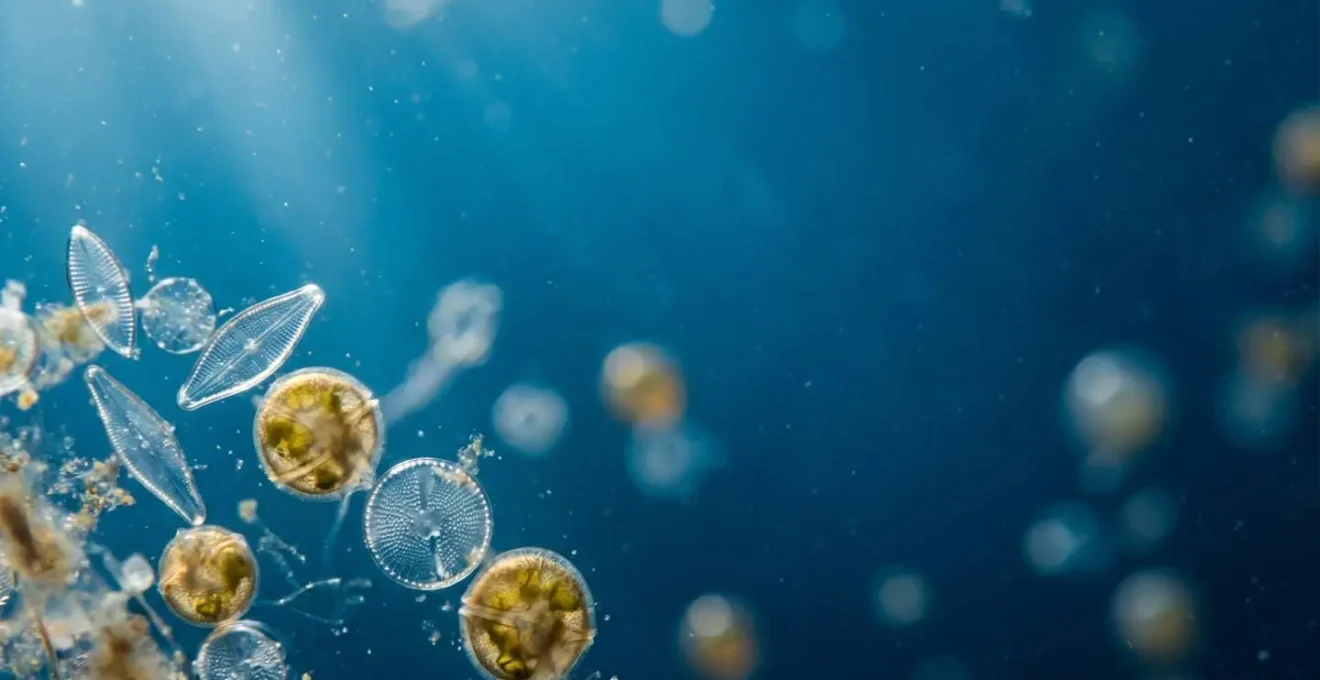
The importance of phytoplankton extends far beyond oxygen production; they are the central, fragile engine of the planet’s climate and life-support systems.
- They form the base of the entire marine food web, and their collapse can trigger ecosystem-wide disasters.
- They are key players in the global carbon cycle, but their overgrowth or contamination can be catastrophic.
Recommendation: Understanding their complexity is the first step to protecting them from threats like pollution and critically evaluating the risks of climate geoengineering.
When you gaze out at the vast, blue expanse of the ocean, it’s easy to perceive it as a uniform wilderness. Yet, teeming within every drop of sunlit water is an invisible, vibrant forest. This forest is composed of phytoplankton, microscopic organisms that, collectively, form the foundation of life in the sea. As a marine biologist, I’ve spent my career studying these tiny powerhouses, and I can tell you they are far more than just “plants.” While technically most are single-celled protists, their photosynthetic ability makes them the planet’s primary producers, alongside terrestrial forests.
Many people have heard that phytoplankton produce a large portion of the oxygen we breathe or that they are “whale food.” These statements are true, but they are only a fraction of the story. They are the simple headlines for a deeply complex and interconnected system, one that is now facing unprecedented pressures from climate change, pollution, and even our own well-intentioned but potentially risky attempts to fix the climate. The reality is that the fate of these microscopic organisms and the fate of our planet are inextricably linked.
But if the simple facts are not enough, what do we need to understand? The key is not to just know *what* phytoplankton do, but *how* their functions create a delicate balance. This balance can be tipped, with devastating consequences. In this article, we will move beyond the common knowledge. We will explore the nuances of their role in oxygen production, witness what happens when a food web collapses, examine the dual nature of plankton blooms, and dive into the controversial world of oceanic geoengineering. Understanding this complex reality is the first crucial step toward becoming responsible stewards of our blue planet.
To navigate this complex underwater world, this guide explores the critical functions, threats, and potential of phytoplankton, moving from their role in our atmosphere to the very real challenges posed by human activity.
Summary: Why Are Phytoplankton the Most Important Lifeforms You Can’t See?
- The 50% Myth: Do Plankton Really Produce Half the World’s Oxygen?
- The Food Web: What Happens to Whales If Plankton Disappear?
- Algal Blooms: When Does Too Much Plankton Become Deadly?
- Iron Fertilization: Can We Dump Iron in the Sea to Boost Plankton and Cool the Earth?
- Ocean Colour: How Do Satellites Count Plankton from Orbit?
- Microplastic Shedding: Why You Should Wash Your Synthetic Clothes Less Often?
- Ocean Alkalinity Enhancement: Is It Safe to Change Ocean Chemistry?
- How Can We Effectively Remove Atmospheric Carbon Dioxide Beyond Just Planting Trees?
The 50% Myth: Do Plankton Really Produce Half the World’s Oxygen?
The most famous claim about phytoplankton is that they produce half the oxygen we breathe. The truth is both more complex and more astounding. It’s not a fixed 50%; in fact, scientific estimates vary widely. Depending on the season, location, and methodology, scientists estimate that phytoplankton produce between 50% to 85% of Earth’s oxygen at any given moment. This vast range highlights the dynamic and ever-changing nature of the ocean’s invisible forests. Unlike a terrestrial forest, the entire global population of phytoplankton can be replaced in about a week, leading to massive fluctuations in productivity.
This oxygen production is a byproduct of photosynthesis, the same process used by land plants. Using sunlight, phytoplankton convert carbon dioxide and nutrients into organic compounds for energy. Oxygen is the “waste” product. The most abundant photosynthetic organism on Earth is a type of phytoplankton called Prochlorococcus. Billions of these single-celled bacteria live in the ocean, and while each one is minuscule, their collective contribution to global oxygen is immense.
However, it’s crucial to understand that most of the oxygen produced by phytoplankton stays in the ocean, where it is consumed by marine life. The oxygen in our atmosphere is the result of a net surplus accumulated over geological time. The real significance isn’t a specific percentage, but the fact that this massive, decentralized, and highly responsive biological system is a primary regulator of our planet’s atmospheric composition. Any significant, long-term disruption to phytoplankton health could have profound impacts on the delicate balance of gases that makes our planet habitable.
So, while the “50% rule” is a useful simplification, the reality of a dynamic, fluctuating system responsible for the bulk of our planet’s primary production is far more impressive.
The Food Web: What Happens to Whales If Plankton Disappear?
Phytoplankton are the literal base of the marine food web. They are the grass of the sea’s pastures. They are consumed by zooplankton (microscopic animals), which are then eaten by small fish and crustaceans. This energy is transferred up the chain to larger fish, seabirds, and marine mammals, including the largest animal on Earth, the blue whale. A collapse of phytoplankton wouldn’t just mean whales go hungry; it would trigger a catastrophic failure of the entire system, a phenomenon we biologists call a trophic cascade.
This isn’t just a theoretical concept. We have witnessed such collapses in the real world. A stark example occurred in the Black Sea, where a combination of factors, including overfishing of plankton-eating fish, triggered a massive ecosystem shift. A 2007 study in PNAS detailed how the removal of key predators led to a boom in gelatinous plankton and a collapse of the anchovy fishery, with economic losses reaching $16.8 million from that fishery alone. This case study demonstrates that disrupting the phytoplankton-based food web doesn’t just harm wildlife; it has severe economic and social consequences.
As the illustration above depicts, the connections are intricate. The health of the apex predators, like whales and sharks, is directly tied to the abundance and diversity of the microscopic life at the very bottom. The disappearance of phytoplankton would not be a slow starvation but a rapid, system-wide implosion, turning vast, productive ocean regions into marine deserts.
Therefore, when we talk about protecting whales or sustainable fisheries, the conversation must begin with the health and preservation of phytoplankton populations.
Algal Blooms: When Does Too Much Plankton Become Deadly?
While phytoplankton are essential for life, there can be too much of a good thing. When an excess of nutrients—primarily nitrogen and phosphorus from agricultural runoff and wastewater—enters the water, it can trigger explosive growth of phytoplankton. This event is known as an algal bloom. While some blooms are harmless, others, termed Harmful Algal Blooms (HABs), can be devastating. Certain species of phytoplankton produce potent toxins that can kill fish, shellfish, marine mammals, and even humans who consume contaminated seafood.
Even non-toxic blooms can be lethal. As the massive amount of algae in a bloom dies and sinks, it is decomposed by bacteria. This decomposition process consumes huge amounts of dissolved oxygen in the water, creating hypoxic (low oxygen) or anoxic (no oxygen) conditions. These areas, known as “dead zones,” can no longer support most marine life, forcing mobile creatures to flee and killing those that cannot. The scale of this problem is growing; a recent study of Long Island’s waters found a record-breaking 36 distinct dead zones during the summer of 2024.
Climate change is exacerbating the issue. Warmer water temperatures favor the growth of many harmful algae species and intensify the process of oxygen depletion. As Dr. Christopher Gobler, a leading expert in the field, stated in relation to the 2024 study:
Climate change threatens to make all of these events worse in the future. Beyond warmer temperatures intensifying dead zones and prolonging warm-water HABs, climate change is bringing more intense rainfall events that deliver high levels of nitrogen.
– Dr. Christopher Gobler, Stony Brook University harmful algal blooms study 2024
This creates a dangerous feedback loop where our pollution fuels blooms, and climate change makes those blooms more frequent, intense, and deadly, turning productive coastal waters into barren zones.
Ultimately, algal blooms serve as a stark, visible warning of an ecosystem pushed beyond its limits by human activity.
Iron Fertilization: Can We Dump Iron in the Sea to Boost Plankton and Cool the Earth?
Given phytoplankton’s immense power to absorb carbon dioxide, a tantalizing and controversial idea emerged: could we intentionally trigger blooms to fight climate change? This is the core concept behind iron fertilization, a form of geoengineering. In vast regions of the ocean, phytoplankton growth is limited not by major nutrients but by the scarcity of the micronutrient iron. The “iron hypothesis” suggests that by adding iron to these areas, we could stimulate massive phytoplankton blooms, which would absorb atmospheric CO2. As these plankton die, they would sink to the deep ocean, sequestering that carbon for centuries.
The late, brilliant, and provocative oceanographer John Martin famously summarized this bold idea. His confidence, and the sheer scale of the proposal, is captured in a quote that has echoed through the halls of ocean science for decades:
Give me half a tanker of iron, and I’ll give you an ice age.
– John Martin, Late director of Moss Landing Marine Laboratory
While small-scale experiments have confirmed that adding iron does indeed cause phytoplankton to bloom, the effectiveness and safety of this approach remain highly debated. The deep concern among many scientists, myself included, is the potential for unintended consequences. Could we trigger massive, persistent harmful algal blooms? What would be the effect on deep-sea ecosystems unaccustomed to such a massive influx of organic matter? Could we create vast new dead zones? The complexity of the biological carbon pump—the process of moving carbon from the surface to the deep sea—is not fully understood, and manipulating it on a global scale is a monumental risk.
The prospect of artificially stimulating the base of the food web to alter the planet’s climate is a perfect example of the high-stakes predicament we are in. It represents a potential tool, but one whose side effects could be as damaging as the problem it seeks to solve.
This highlights a critical need for more research and a global consensus on the ethics of large-scale planetary engineering before such schemes are ever considered for deployment.
Ocean Colour: How Do Satellites Count Plankton from Orbit?
Understanding the health and distribution of phytoplankton on a global scale would be impossible from ships alone. The ocean is simply too vast. Fortunately, we can monitor these microscopic organisms from space. Satellites don’t see individual plankton, but they can detect their collective presence by measuring the color of the ocean. Phytoplankton contain chlorophyll, the same green pigment found in land plants. This pigment absorbs red and blue light and reflects green light. By analyzing the spectrum of light reflecting off the ocean’s surface, scientists can estimate the concentration of chlorophyll, which serves as a proxy for the amount of phytoplankton present.
Areas with high concentrations of phytoplankton appear green or blue-green, while “ocean deserts” with very few plankton appear deep blue. This technology of remote sensing allows us to create global maps of phytoplankton productivity, track the movement of blooms, and monitor long-term changes in ocean health. However, this technology is continually evolving to provide more detailed information.
Case Study: The NASA PACE Mission
NASA’s PACE (Plankton, Aerosol, Cloud, ocean Ecosystem) mission, launched in 2024, represents a quantum leap in this field. Unlike older satellites that measure a few broad color bands, PACE uses an advanced hyperspectral instrument. This allows it to see the ocean in hundreds of different colors, providing a far more detailed spectral “fingerprint.” This unprecedented detail enables scientists not just to quantify the amount of plankton, but to begin differentiating between different types of phytoplankton from space. This is critical because different species play different roles in the ecosystem, from their position in the food web to their efficiency in sequestering carbon.
The ability to distinguish a bloom of harmless diatoms from a developing harmful algal bloom of dinoflagellates, all from orbit, is a game-changer. It provides a powerful tool for fisheries management, public health warnings, and, crucially, for validating and monitoring the complex climate models that depend on understanding the ocean’s biological activity.
Ultimately, these “eyes in the sky” are essential for taking the pulse of our planet’s largest and most vital ecosystem.
Microplastic Shedding: Why You Should Wash Your Synthetic Clothes Less Often?
While large-scale threats like climate change and nutrient pollution are well-documented, a more insidious and pervasive threat to phytoplankton has emerged: microplastics. These tiny plastic particles, less than 5 millimeters in size, are entering the ocean in staggering quantities. A primary source is the washing of synthetic clothing, such as fleece jackets and athletic wear, which shed thousands of microscopic fibers with every cycle. These fibers, along with fragments from larger plastic debris, are now found in every corner of the ocean, from the surface to the deepest trenches.
For an organism as small as a phytoplankton cell, a microplastic fiber is a colossal and foreign object. Research is rapidly uncovering the multiple ways these plastics harm phytoplankton. First, they can cause physical damage, blocking sunlight needed for photosynthesis or causing internal damage if ingested by certain species. Second, plastics can act as sponges for other pollutants, concentrating toxic chemicals like pesticides and industrial byproducts on their surfaces and delivering them directly into the marine food web. There is growing evidence that zooplankton that consume these plastic-laden phytoplankton can suffer reduced reproductive success, a threat that then ripples up the trophic levels.
The sheer scale of the problem is what is most alarming to us in the field. Unlike an oil spill, there is no way to clean up this plastic “smog.” It is a permanent alteration of the ocean’s very makeup. We are effectively introducing a new, artificial, and often toxic component into the foundational pasture of the sea. The long-term consequences of this global experiment are unknown, but the initial findings are a cause for significant concern for the entire marine ecosystem.
Reducing our plastic footprint, starting with simple actions like washing synthetic clothes less often or using filter bags, is no longer just an option but a critical step in protecting the base of marine life.
Ocean Alkalinity Enhancement: Is It Safe to Change Ocean Chemistry?
Beyond iron fertilization, another major geoengineering strategy focused on the ocean is gaining attention: Ocean Alkalinity Enhancement (OAE). The principle is straightforward. As we pump CO2 into the atmosphere, about a third of it is absorbed by the ocean, causing ocean acidification. This makes it harder for organisms like corals and certain phytoplankton, such as coccolithophores, to build their calcium carbonate shells and plates. OAE proposes to counteract this by adding crushed alkaline minerals, like olivine or limestone, to the ocean. This would increase the water’s pH, directly fighting acidification and, as a secondary benefit, enhancing the ocean’s ability to absorb more CO2 from the atmosphere.
On paper, OAE appears to address two problems at once. It could protect vulnerable marine ecosystems while also serving as a carbon dioxide removal technique. However, like all forms of geoengineering, the potential for unintended consequences is enormous. What are the effects of dumping massive quantities of crushed rock into the ocean? These minerals contain trace metals, which could be toxic to marine life in high concentrations. How would this rapid, artificial change in chemistry affect the delicate metabolisms of the vast diversity of phytoplankton species, many of which have adapted to specific pH ranges over millennia?
While some evidence suggests that certain phytoplankton populations might adapt to pH changes over time due to their rapid generation times, this is far from a guarantee for the entire, complex community. We are proposing to alter the fundamental chemistry of the global ocean. This is an even more profound intervention than iron fertilization. Before we can even consider OAE as a viable solution, we need years, if not decades, of small-scale, highly controlled research to understand its full ecosystem-level impacts.
The allure of a simple solution is powerful, but in a system as complex as the ocean, there are rarely simple answers, only a series of difficult trade-offs.
Key Takeaways
- Phytoplankton are the foundation of the marine food web; their collapse means the collapse of the entire system.
- While vital, phytoplankton overgrowth fueled by pollution creates toxic blooms and “dead zones” that kill marine life.
- Geoengineering proposals like iron fertilization aim to use phytoplankton to absorb CO2 but carry massive, unknown ecological risks.
How Can We Effectively Remove Atmospheric Carbon Dioxide Beyond Just Planting Trees?
As the climate crisis deepens, the focus has expanded from simply reducing emissions to actively removing carbon dioxide from the atmosphere. While planting trees is a vital strategy, the ocean—and specifically phytoplankton—represents the largest and most powerful carbon removal system on the planet. This natural process, the biological carbon pump, already moves immense quantities of carbon from the atmosphere to the deep sea. The central question for scientists is: can this natural process be safely and effectively enhanced?
The biological carbon pump is an elegant, multi-stage process. It begins with photosynthesis at the surface. When phytoplankton die or are consumed, that carbon is packaged into particles (dead cells, fecal pellets) that sink. A portion of this sinking carbon is remineralized and consumed on its way down, but a fraction of it reaches the deep ocean, where it can be sequestered for hundreds to thousands of years. This pump is incredibly powerful; research shows this biological carbon pump transfers about 10 gigatonnes of carbon from the atmosphere to the deep ocean each year.
Enhancing this pump is the ultimate goal of strategies like iron fertilization. However, as a comprehensive 2018 study on the topic highlights, the pump’s efficiency is not a simple matter. It depends on which species of phytoplankton are blooming, the temperature of the water, and the zooplankton community that grazes on them. As research in the journal Sustainability emphasizes, the pump’s future capacity as a carbon sink is uncertain because its efficiency is highly dependent on physical and chemical conditions that are themselves changing due to climate change.
Action Plan: Critically Evaluating Ocean-Based Carbon Removal Proposals
- Efficacy Assessment: Scrutinize the data. How much carbon is actually sequestered in the deep sea long-term, versus simply recycled in the upper ocean? Demand verified, long-term measurements, not just models of surface blooms.
- Ecosystem Impact: Inventory the potential side effects. What is the risk of triggering harmful algal blooms, creating dead zones, or disrupting the local food web? Look for comprehensive environmental impact studies.
- Permanence and Leakage: Confront the long-term view. For how many centuries will the carbon remain sequestered? What is the risk that changes in ocean currents or chemistry could release it back into the atmosphere?
- Governance and Ethics: Assess the human factor. Who has the right to perform these large-scale experiments in the global commons? Is there a robust, transparent, and enforceable international framework for monitoring and verification?
- Alternative Pathways: Compare against other solutions. Is this proposal more effective, safer, and more equitable than investing in emission reductions, terrestrial reforestation, or direct air capture?
The next great challenge is not just to understand the ocean’s invisible forests, but to develop the wisdom to protect them. This means prioritizing emissions reductions and supporting scientific research that fills the critical gaps in our knowledge before we embark on large-scale interventions. The fate of the ocean’s most important plants—and the climate they help regulate—depends on our caution and our respect for complexity.