The true difference between a DIY setup and a professional domotics system is not the devices you see, but the engineered reliability of the infrastructure you don’t.
- A professional system is built on a hardwired network backbone for flawless, interference-free performance, unlike Wi-Fi-dependent consumer gadgets.
- It offers a single, masterfully curated interface for all subsystems—from multi-room audio to security—that is immediately intuitive for family, guests, and staff.
Recommendation: Approach your smart home integration not as a technological expense, but as a core architectural system to be planned from the blueprint stage, just like plumbing or electricity.
When embarking on the creation of a luxury property, every decision is an investment in quality, longevity, and experience. You meticulously select the finest materials for countertops and flooring, and partner with architects to ensure every sightline is perfect. Yet, when it comes to the home’s central nervous system—its technology—a tempting narrative emerges, fueled by consumer electronics: the “Do-It-Yourself” smart home. This approach promises convenience through a collection of clever gadgets from various brands, all manageable from a smartphone.
However, for a property where performance is non-negotiable, this path often leads to a disjointed and unreliable ecosystem. A high-end home doesn’t run on a patchwork of apps and Wi-Fi signals. It demands an integrated, invisible infrastructure. The fundamental distinction lies here: a DIY smart home is an assortment of products, whereas a professional domotics system, from a specialist like Crestron or Control4, is an engineered, centralized utility. It’s the difference between a collection of portable space heaters and a silent, zoned HVAC system.
This article will not compare gadget features. Instead, we will explore the foundational principles that separate a truly smart, luxury residence from a house filled with smart devices. We will deconstruct the core subsystems—from the data network to lighting design—to reveal why a professional, integrated approach is the only one that delivers on the ultimate promise of luxury: a life simplified, not complicated, by technology.
To understand these critical distinctions, this guide explores the core components of a truly integrated home. The following sections break down exactly how a professional approach transforms key aspects of daily life, from the network foundation to the user experience.
Summary: DIY vs Professional Domotics: What Is the Real Difference in a Luxury Smart Home?
- CAT6 vs Wi-Fi: Why Do You Need Hardwired Data Points for a Reliable Smart Home?
- Multi-Room Audio: How to Distribute High-Res Music to 8 Zones Without Lag?
- Zoned Heating: How to Control Underfloor Heating in Every Room Individually?
- Video Intercoms: How to Answer the Front Gate from Your Phone Anywhere?
- Wall Panels vs Apps: Why Physical Keypads Are Better for Guests?
- UK vs EU Data Centers: Where Should You Store Customer Data Post-Brexit?
- Architectural Lighting: How to Light a Room Without Seeing the Fixtures?
- How to Plan a Smart Home Integration That Actually Simplifies Your Life?
CAT6 vs Wi-Fi: Why Do You Need Hardwired Data Points for a Reliable Smart Home?
The foundation of any high-performance system is its network, and this is the first and most critical point of divergence. DIY systems almost exclusively rely on Wi-Fi, a shared and often congested medium susceptible to interference from everything from neighbours’ networks to microwave ovens. For a luxury residence, relying on Wi-Fi for critical systems is equivalent to building a skyscraper on a sand foundation. Engineered reliability begins within the walls, with a dedicated, hardwired network.
A professional integrator will specify a structured cabling plan using CAT6a or even fiber optic cables run to key locations. This isn’t just for computers; it’s for touch screens, security cameras, audio/video distribution, and lighting control processors. This physical infrastructure guarantees performance that wireless cannot. For instance, a single CAT6a cable ensures dedicated 10 Gbps speeds up to 100 meters, free from the lag, dropouts, and security vulnerabilities of a shared wireless network. This creates a private, high-speed digital highway for your home’s essential functions.
As the image above illustrates, this is a matter of precision engineering. Just as you wouldn’t accept intermittent water pressure, you shouldn’t accept intermittent data flow for your home’s core operations. The invisible infrastructure of a hardwired network provides the robust, unwavering performance necessary for a seamless luxury experience, ensuring your 4K video stream doesn’t buffer while security cameras upload footage and music plays in three different zones.
Multi-Room Audio: How to Distribute High-Res Music to 8 Zones Without Lag?
The dream of whole-home audio is to have flawless, high-resolution music in any room, or every room, at the touch of a button. While consumer wireless speakers offer a taste of this, they quickly falter at scale. Attempting to synchronize eight zones of uncompressed audio over a standard Wi-Fi network creates significant network strain, leading to lag, dropouts, and a degraded experience. It also consumes bandwidth needed for other critical tasks like home security or video conferencing.
A professional system addresses this not with more wireless repeaters, but with a centralized architecture. This approach moves the workload off the Wi-Fi network and onto the dedicated wired backbone we discussed previously. It provides a robust, lag-free experience that is simply unattainable with DIY solutions.
Case Study: Centralized Audio Matrix vs. Wireless Mesh Systems
Professional multi-room audio installations utilize a centralized Audio Matrix system, typically housed in a dedicated equipment rack. This device acts as a traffic controller, taking multiple audio sources (e.g., streaming services, vinyl, TV audio) and routing them to dedicated, hardwired speakers in any zone. This architecture ensures every room can simultaneously play different uncompressed, high-resolution sources without affecting network performance for other home functions. The system delivers unwavering power and fidelity, all controlled through a single, elegant app or keypad, maintaining the reliability that consumer wireless systems cannot guarantee, especially in large, multi-level properties with dense construction materials.
This isn’t just about avoiding lag; it’s about delivering a curated audio experience. Imagine hosting a party where mellow jazz plays in the lounge, upbeat pop by the pool, and the game’s audio in the media room—all perfectly synchronized and managed from one interface. This level of granular, reliable control is the hallmark of a professionally engineered system.
Zoned Heating: How to Control Underfloor Heating in Every Room Individually?
Effective climate control in a luxury property goes beyond a single smart thermostat. It requires granular control over distinct zones, especially with systems like hydronic underfloor heating where each manifold controls multiple rooms. DIY solutions often involve placing individual, disconnected smart thermostats in each room, leading to an array of competing apps and a lack of holistic intelligence. The master bedroom might be fighting the living room, wasting energy and creating discomfort.
A professional domotics system integrates climate control into the home’s central processor. It doesn’t just read the temperature in a room; it manages the entire HVAC ecosystem. This includes the boiler, pumps, and individual zone valves for the underfloor heating. This allows for intelligent, coordinated scheduling. For instance, a “Good Night” scene can set back the temperature in the living areas while gently warming the master suite just before bedtime. This centralized intelligence ensures optimal comfort and efficiency, something a collection of disparate thermostats cannot achieve.
Furthermore, the value of a professional system extends to proactive maintenance and system longevity, a crucial aspect for any property owner. As experts from Automated Living LLC note, this goes far beyond simple temperature adjustments:
Professional domotic systems can monitor the performance of the HVAC equipment itself. They can detect anomalies and automatically notify the integrator, often before the homeowner even perceives a problem, ensuring continuous comfort and preventing costly failures.
– Automated Living LLC, Professional vs DIY Smart Home Automation Analysis
This transforms the system from a reactive convenience to a proactive asset management tool, protecting a significant investment and ensuring operational continuity of the home’s most essential comfort system.
Video Intercoms: How to Answer the Front Gate from Your Phone Anywhere?
The ability to see and speak with a visitor at the front gate or door from anywhere in the world is a modern security expectation. DIY video doorbells offer this promise, but their performance is often hampered by the very things we’ve discussed: reliance on home Wi-Fi and cloud servers. A weak Wi-Fi signal at the gate can cause significant lag between a button press and the notification on your phone, and an internet outage can render the entire system useless.
A professional video intercom system is engineered for near-instantaneous connection and unwavering reliability. These systems are hardwired, both for power and data, directly into the home’s network backbone and automation processor. This direct connection ensures there are no Wi-Fi signal drops or lag. Crucially, professional systems often use a local processor. This means that even if the home’s internet connection goes down, the intercom still functions perfectly within the property, ringing on all internal touch panels as a self-sufficient security system.
The integration goes deeper, creating a truly curated experience. When a visitor rings the gate, a professional system can be programmed to automatically pause the movie you’re watching, display the camera feed on the nearest TV or touch panel, and present on-screen controls to speak, open the gate, and turn on the driveway lights. This seamless orchestration of multiple subsystems is impossible with a standalone DIY doorbell that lives in its own app. It demonstrates the profound difference between a device that alerts you and a system that manages a complete event for you.
Wall Panels vs Apps: Why Physical Keypads Are Better for Guests?
The modern allure of “an app for everything” is a central pillar of the DIY smart home. However, relying solely on a smartphone to control essential home functions creates significant friction, especially for guests, children, or household staff. Must a guest download an app, connect to Wi-Fi, and navigate an unfamiliar interface just to dim the lights in their room? This is the opposite of a luxury experience.
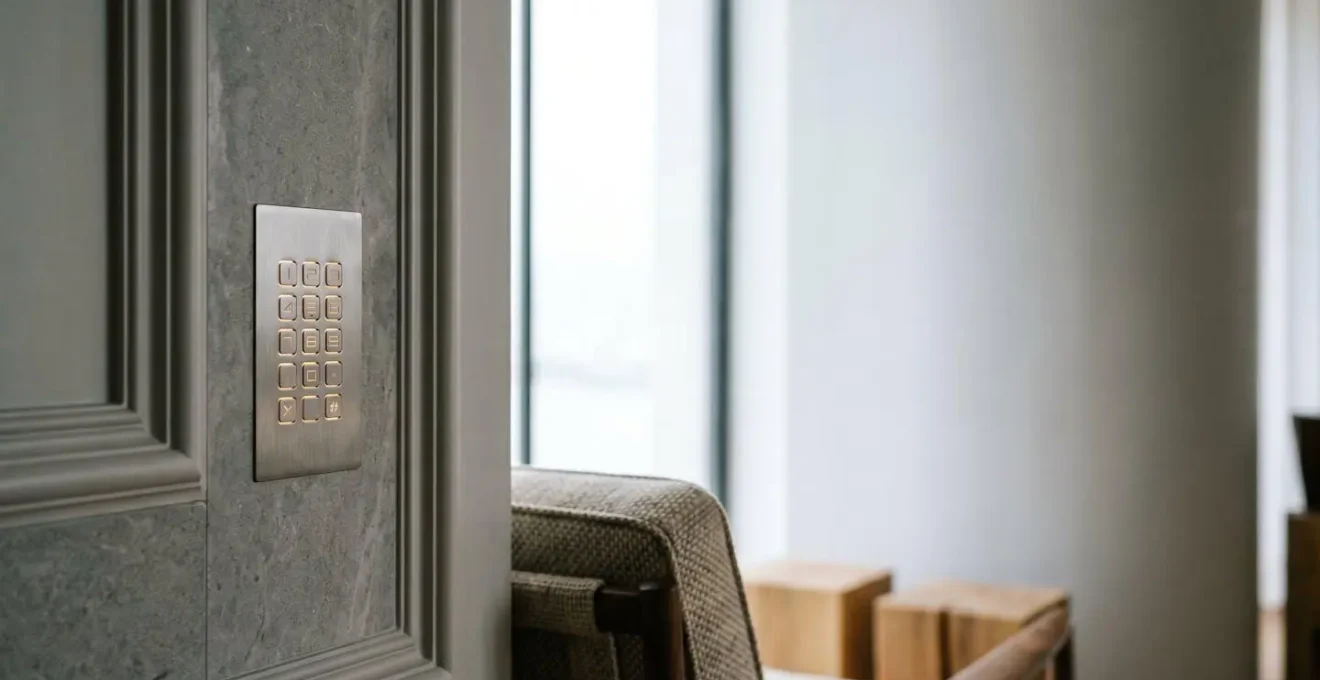
Professional integrators understand that the most frequent and essential commands deserve a dedicated, physical interface. Elegant, custom-engraved wall keypads are a cornerstone of a well-designed system. A button labeled “Welcome” can activate a pathway of lights and play a specific music playlist. A “Goodnight” button by the bedside can turn off all lights, lower the shades, and adjust the thermostat. As automation design principles confirm, for core actions, a physical keypad is always faster and more reliable than fumbling for a phone.
These keypads are not just functional; they are part of the home’s interior design. They can be finished in materials that match the decor, with engraving that is clear and intuitive. This provides a universally understandable method of control that requires no explanation. It ensures that anyone in the home can operate its basic functions effortlessly. The app still exists, offering deep control and remote access for the homeowner, but it is not the primary or only method of interaction. This layered approach provides both power and simplicity.
UK vs EU Data Centers: Where Should You Store Customer Data Post-Brexit?
In the world of consumer smart devices, questions about data privacy and server location are increasingly relevant. Since most DIY gadgets rely on cloud services to function, your voice commands, video recordings, and usage patterns are often processed and stored on servers in unknown locations. Concerns about where this data resides, particularly in a post-Brexit world with differing UK and EU data regulations, are valid.
However, within the context of a professional domotics system, this question is largely a red herring. A core principle of high-end integration is to minimize or eliminate reliance on external cloud servers for core operations. The “brain” of the system—the central processor like a Crestron CP4-R or a Control4 Core 5—is a physical piece of hardware located securely within your property. This approach, known as local processing, is fundamental to both privacy and reliability.
Your commands to dim the lights, adjust the heat, or start a music playlist are processed internally, on your own network. The system continues to function perfectly even if the internet connection is completely severed. While some features, like remote access from your phone or streaming from services like Spotify, naturally require an internet connection, the home’s fundamental operations do not. This design choice sidesteps the entire debate about data sovereignty because your primary operational data never leaves the premises. This is why professional automation systems eliminate cloud dependency for critical functions.
Architectural Lighting: How to Light a Room Without Seeing the Fixtures?
Lighting in a luxury home is not about screwing in a few smart bulbs. It’s an architectural discipline. The goal is to create mood, highlight features, and define spaces using light itself as a material. This often involves advanced techniques where the light source is completely concealed, such as cove lighting, wall grazing, and integrated shelf lighting. These effects require precise control over dimming curves, color temperature, and the coordination of dozens of fixtures into unified “scenes.”
DIY solutions are simply not equipped for this level of sophistication. A Wi-Fi-controlled smart bulb cannot be integrated into a centralized, architectural lighting panel that controls multiple types of low-voltage LED drivers. Professional lighting control systems, such as Lutron HomeWorks, are designed specifically for this purpose. They operate on their own robust, hardwired communication network and allow for the programming of complex scenes that transform a room with a single button press. A “Dinner” scene might dim perimeter lights to 20%, bring a spotlight over the dining table to 50%, and activate a warm glow from a ceiling cove.
This level of control is not a novelty; it is a primary demand in high-end design. In fact, an industry survey from the National Kitchen & Bath Association (NKBA) found that 40% of designers cite lighting control as the most in-demand feature from clients. They understand that a perfectly executed lighting design is one of the most impactful elements of an interior. A professional domotics system provides the underlying control infrastructure necessary to bring an architect’s or lighting designer’s vision to life, creating an experience that is emotionally resonant and visually stunning.
Key Takeaways
- A professional system is a long-term asset built on a reliable, hardwired infrastructure, not a temporary collection of wireless gadgets.
- True luxury is simplicity. A single, intuitive interface for all systems is vastly superior to juggling multiple, disconnected apps.
- The best systems are invisible, both in their seamless operation and their physical integration into the home’s architecture.
How to Plan a Smart Home Integration That Actually Simplifies Your Life?
We’ve established that a professional domotics system is a fundamentally different class of investment from a DIY setup. It is a core utility and a lifestyle asset. Therefore, planning its integration must be approached with the same rigor as the home’s architecture or structural engineering. The key to a system that truly simplifies life is to involve a professional integrator at the blueprint stage, long before the walls are closed.
This early engagement allows the integrator to work alongside the architect and interior designer to ensure the technology is seamlessly woven into the fabric of the home. This includes planning for a dedicated equipment rack, specifying structured wiring pathways, and positioning keypads and speakers for optimal aesthetics and performance. This holistic approach prevents costly retrofitting and ensures the final result is cohesive and elegant. The investment reflects this scope; industry reports show that homeowners allocated an average of $41,000 to smart home technology in new luxury builds, viewing it as a critical component of the property’s value.
The following table provides a clear, high-level comparison of the long-term implications of choosing a DIY path versus a professional installation, as detailed in a comparative analysis of smart home approaches.
| Installation Type | Initial Cost | Long-Term Value | Support Model | Integration Capability |
|---|---|---|---|---|
| DIY Smart Home | $500-$1,500 (starter kit) | Replacement cycle every 3-5 years, multiple subscriptions | Self-managed, YouTube tutorials, Reddit forums | Limited to compatible brands, cloud-dependent |
| Professional Installation | $5,000-$50,000+ (full-home system) | 10+ year lifespan, single support contract, energy savings, resale value +3-5% | Dedicated integrator, ongoing maintenance, remote updates | 14,000+ devices from hundreds of manufacturers, local processing |
| Hybrid Approach | $2,000-$10,000 (phased installation) | Scalable infrastructure, professional backbone with DIY additions | Professional for core systems, self-managed for accessories | Professional foundation allows future expansion |
Action Plan: Your Smart Home Blueprint Audit
- Core Systems Inventory: List the non-negotiable systems that must be 100% reliable (e.g., lighting, HVAC, security, primary audio/video zones).
- User Experience Mapping: Define who uses the home (family, guests, staff). For each user group, identify the top three most frequent actions they will need to perform.
- Reliability Stress Test: What happens if the internet goes down? Which of your core systems must remain fully operational without an external connection?
- Architectural Integration: Where will the central equipment be housed? How will wiring be concealed? Are keypads, speakers, and screens coordinated with the interior design?
- Long-Term Support Plan: Who is the single point of contact for maintenance, upgrades, and troubleshooting for the entire integrated system for the next 10+ years?
Ultimately, the choice is not about which gadgets are “best.” It is about deciding whether you want to be a system administrator for a collection of disparate products or the owner of a property with a single, coherent, and professionally managed technology infrastructure. The ultimate luxury is not the technology itself, but the peace of mind that comes from its flawless and simple operation.
To ensure your property achieves this level of seamless integration, the next logical step is to engage a professional home automation integrator early in your design process. They can translate your lifestyle aspirations into a detailed, engineered plan that will serve your home reliably for decades to come.