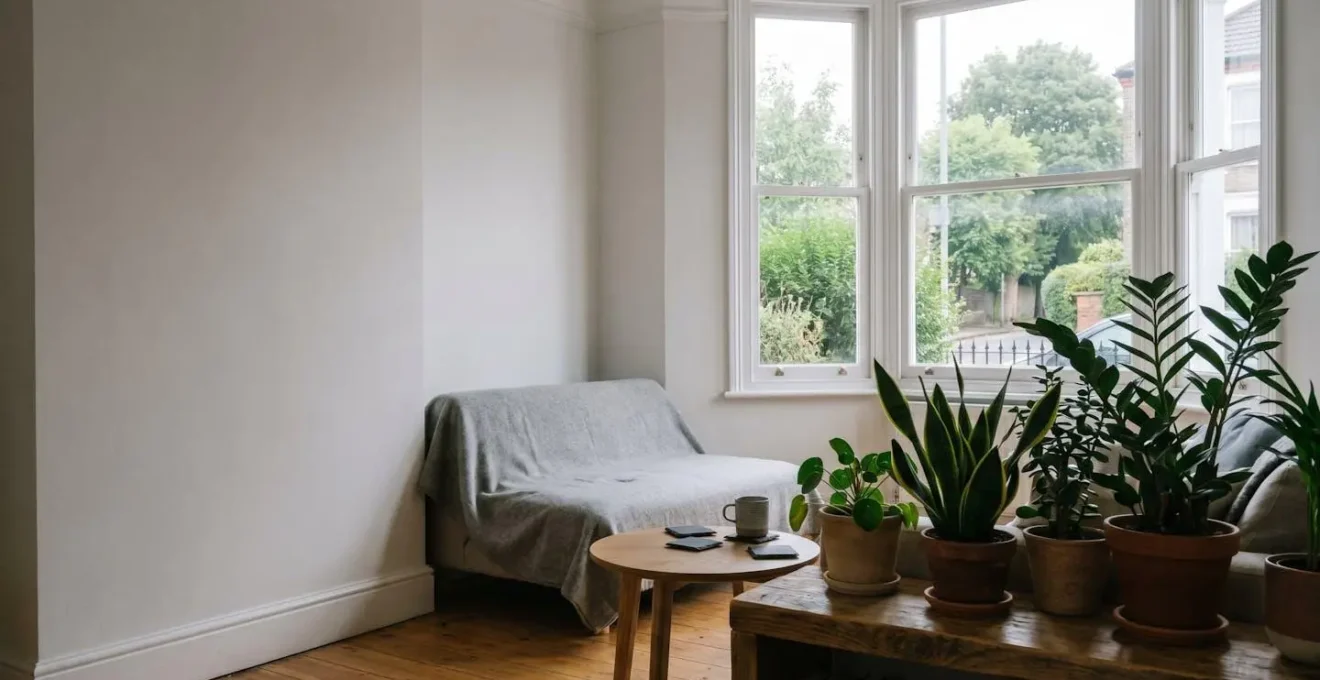
Contrary to popular belief, you don’t need a jungle of houseplants or a complete renovation to bring restorative biophilic design into your UK flat.
- The real benefits come from strategically integrating specific natural *cues* that trigger our innate stress-reduction responses.
- Tactile textures, fractal patterns found in nature, and ‘borrowed’ views are often more powerful than simply adding more green.
Recommendation: Focus on small, high-impact interventions—like a wool throw, a fern, or a single well-placed mirror—to create moments of connection that fit your urban lifestyle.
Living in a London apartment, or any dense UK city, often means being surrounded by brick, glass, and the constant hum of traffic. The craving for a connection to nature is a deep, primal one, yet it can feel impossible to satisfy when your only outdoor space is a small balcony or a windowsill. The common advice—”just add some houseplants”—often falls short, leading to a collection of wilting greenery and the persistent feeling of being disconnected from the natural world.
This approach mistakes the symptom for the cause. The issue isn’t a simple lack of plants; it’s the absence of the specific sensory cues our brains are wired to find restorative. True biophilic design goes beyond aesthetics. It’s a science-backed discipline focused on recreating the physiological and psychological benefits of being in nature, within the built environment. But what if the key wasn’t about recreating a forest in your living room, but about understanding the precise mechanisms that make nature so calming and strategically embedding those triggers into your home?
This guide moves beyond the generic. We will explore how to hack our innate responses to nature by focusing on specific, high-impact strategies that work even in the most constrained urban settings. From the science of why touching wood can lower your blood pressure to the art of ‘borrowing’ a view of a single tree, we will provide a blueprint for weaving genuine, restorative natural connection into the fabric of your UK urban home.
This article explores eight distinct principles of biophilic design, each adapted for the realities of urban living in the UK. Discover how to transform your space from a simple dwelling into a sanctuary that nurtures your well-being.
Summary: How to Integrate Biophilic Design Principles into a UK Urban Home?
- NASA Plants: Which Houseplants Actually Clean the Air in Your Bedroom?
- Wood and Stone: Why Touching Natural Textures Lowers Your Blood Pressure?
- Daylight Analysis: How to Position Windows to Capture Morning Sun?
- Borrowed Landscapes: How to Frame a View of a Tree Even in a City?
- Fractals in Design: Why Does Looking at Leaf Patterns Reduce Stress?
- Mushroom Leather vs PU Leather: Which Is Truly Biodegradable?
- Micro-Rewilding: Can You Rewild a Garden or Just a 5-Acre Field?
- How to Install a Vertical Garden on a Small Balcony or Indoor Wall?
NASA Plants: Which Houseplants Actually Clean the Air in Your Bedroom?
The famous 1989 NASA Clean Air Study is often cited as the primary reason to fill our homes with plants. It suggested that species like the Snake Plant and Peace Lily could filter out common household toxins. However, this appealing idea has been widely misinterpreted. The study was conducted in a sealed laboratory chamber, a stark contrast to a drafty London flat. More recent analysis reveals the truth: for plants to significantly purify the air in a typical home, you would need an almost impossible density. According to the American Lung Association, it would require somewhere between 10 to 1,000 plants per square meter to match the air-purifying capacity of a standard ventilation system.
So, should you abandon your houseplants? Absolutely not. Their true value lies not in their limited air-filtering capacity but in their profound psychological benefits. As a biophilic consultant, I advise clients to see plants as tools for mental well-being. Studies confirm that their presence improves our perceived comfort, reduces stress, and increases feelings of well-being, especially in urban settings. A Spider Plant on your desk won’t scrub the air clean, but the simple act of seeing its green, arching leaves provides a vital visual connection to nature that reduces mental fatigue.
The key takeaway is to shift your focus. Choose plants not for their mythical purifying powers, but for their form, texture, and the feeling they evoke. A lush fern or a sculptural succulent serves as a powerful biophilic cue, a daily reminder of the natural world that supports your psychological restoration in the heart of the city.
Wood and Stone: Why Touching Natural Textures Lowers Your Blood Pressure?
In our screen-dominated lives, the sense of touch is often neglected. Yet, our connection to the world is profoundly haptic. Biophilic design leverages this by incorporating natural textures that our bodies are evolutionarily programmed to respond to positively. The cool, solid feel of stone or the warm, varied grain of wood provides a grounding sensory input that synthetic materials like plastic and laminate simply cannot replicate. This isn’t just a feeling; it has measurable physiological effects. The simple act of touching these materials can lower stress responses, including blood pressure and heart rate.
This is because our nervous system associates these textures with safety, permanence, and the natural environment. As research into therapeutic interventions notes, touch is a powerful modality for well-being. A synthesis of studies highlights this point:
Touch, through techniques like massage therapy or gentle pressure, has been shown to reduce anxiety, promote mindfulness, and foster a sense of security and comfort.
– Research synthesis from therapeutic VR interventions study, Beyond Sight and Sound
For a London renter, introducing these elements doesn’t require a full renovation. It’s about small, tactile interventions. A heavy Welsh slate coaster under your morning coffee, a reclaimed timber chopping board in the kitchen, or a soft Herdwick wool throw on the sofa all create daily moments of sensory connection. These objects serve as ‘haptic anchors’ in your day, providing a non-visual link to the natural world.
As the image above illustrates, the micro-details of these materials—the layered texture of slate, the intricate patterns of oak grain—offer a rich sensory experience. Focusing on integrating these textures is a high-impact, low-effort strategy for embedding biophilic principles into a rented urban home, providing a constant, subtle source of calm and grounding.
Daylight Analysis: How to Position Windows to Capture Morning Sun?
Natural light is arguably the most critical element of biophilic design. It governs our circadian rhythms, affecting everything from sleep quality to mood and productivity. In the UK, however, daylight can be a scarce commodity. With the UK Met Office reporting an average of just 3.8 hours of daily sunlight in 2024, maximizing every moment of it is crucial, especially in urban apartments where buildings can cast long shadows. The goal isn’t just to get *more* light, but to get the *right kind* of light at the right time—specifically, the blue-rich light of the morning sun, which is most effective at setting our internal clocks.
For those in existing properties, you can’t move your windows, but you can strategically enhance what you have. The first step is to perform a simple ‘daylight analysis’. Observe how light moves through your flat throughout the day. Where does the morning sun fall? This is your prime biophilic real estate. Position your breakfast nook, your desk, or a comfortable reading chair in this spot to soak up that vital morning light. This simple act can have a significant impact on your energy levels and focus for the rest of the day.
Beyond positioning, you can use several techniques to amplify and diffuse the light you have. This isn’t about stark, open windows but about creating dynamic and gentle light patterns that mimic nature. Here are some strategies for fixed UK windows:
- Use light-reflective surfaces: Paint walls in warm whites with a high Light Reflectance Value (LRV) to bounce daylight deeper into a room.
- Position mirrors strategically: Place a large mirror opposite a window to double its perceived brightness and reflect the view, however limited.
- Install sheer or cellular blinds: These diffuse harsh light and soften the often-grey UK light, creating dappled patterns that recall light filtering through a forest canopy.
- Clear window reveals: Opt for recessed blinds that sit inside the window frame. This makes the frame ‘disappear’ architecturally, maximizing the visual connection to the sky.
By treating light as a precious resource and actively managing its flow, you can transform even a north-facing flat into a brighter, more energizing space.
Borrowed Landscapes: How to Frame a View of a Tree Even in a City?
The concept of a ‘borrowed landscape’ (shakkei in Japanese garden design) is a powerful biophilic tool for urban dwellers. It involves framing and incorporating a view outside your property—whether it’s a distant hill, a neighbour’s tree, or even just a patch of sky—to make it feel like part of your own space. For a Londoner whose view might be a brick wall, this can seem challenging. However, the principle can be adapted. It’s about finding and celebrating *any* connection to the natural world, no matter how small.
Your ‘borrowed landscape’ might be the single London plane tree visible between two buildings. Instead of ignoring it, frame it. Position a chair or a desk to face it. Use minimalist window treatments that don’t obscure the view. This act of intentional framing transforms a random tree into *your* tree, a deliberate and cherished natural feature of your home. The key is to create a ‘prospect’ view—a sense of an unimpeded outlook, which our brains associate with safety and control.
When a direct view of greenery is impossible, you can borrow other natural elements. Research confirms that even indirect or symbolic nature connections have restorative effects. For instance, studies on urban environments have found that the presence of a water feature can decrease stress and create a sense of calm by masking traffic noise. This demonstrates that a ‘borrowed soundscape’ can be just as effective as a borrowed landscape. Opening a window to hear birds from a nearby park or the rustle of leaves can be a powerful connection. Similarly, a mirror placed perpendicular to a window can capture and reflect a slice of sky or a sliver of green, multiplying its presence within your home.
If all else fails, create an internal ‘psychological window’. A large, high-quality photograph of a specific UK landscape, like the Peak District or the Scottish Highlands, hung on a prominent wall can serve as a powerful focal point, providing a symbolic escape and a connection to a beloved natural place.
Fractals in Design: Why Does Looking at Leaf Patterns Reduce Stress?
Have you ever found yourself mesmerized by the intricate veins of a leaf, the branching of a tree, or the unfurling of a fern frond? What you’re experiencing is an innate appreciation for fractal patterns—complex, self-repeating shapes that are the building blocks of the natural world. Biophilic design recognizes that our visual system has evolved to process these patterns with remarkable efficiency. This ‘fractal fluency’ means that looking at them is not just pleasing; it’s physiologically relaxing.
The effect is surprisingly potent. Neuroscience research from the University of Oregon used EEG and skin conductance to measure physiological responses and found that viewing nature’s fractal patterns can trigger a 60% reduction in stress levels. This is because they induce a specific state in the brain, engaging our attention effortlessly while simultaneously promoting a relaxed, wakeful state. As neuroscientist Richard Taylor explains, our brains are essentially hardwired for this response:
Through exposure to nature’s fractal scenery, people’s visual systems have adapted to efficiently process fractals with ease.
– Richard Taylor, Neuroscientist, The Conversation
This is a game-changer for urban apartment dwellers. You don’t need a forest view to benefit from this phenomenon; you just need to integrate these patterns. This can be done easily and without major expense. A single houseplant like a fern (a classic example of a fractal) on your desk provides a constant source of this restorative pattern. You can also look for fractals in materials: the grain of a wooden tabletop, the crystalline structure in a piece of stone, or the patterns in a wool rug. Even artwork or textiles with nature-inspired, non-repeating patterns can evoke the same response.
By consciously incorporating these stress-reducing patterns into your decor, you are embedding a powerful, passive wellness tool into your environment. It’s a subtle but profound way to bring the restorative logic of nature indoors, one pattern at a time.
Mushroom Leather vs PU Leather: Which Is Truly Biodegradable?
As we seek to bring natural materials into our homes, the sustainability of those choices becomes paramount. The rise of vegan leathers offers an alternative to animal hides, but not all are created equal. Polyurethane (PU) leather, a common synthetic, is a petroleum-based plastic that offers durability but poses a significant environmental problem at the end of its life. In contrast, innovative biomaterials like mushroom leather, derived from mycelium (the root structure of fungi), are gaining attention as a more natural and potentially biodegradable alternative.
However, the term ‘biodegradable’ requires careful examination, especially in a UK context. While mycelium itself is a natural material, turning it into a durable ‘leather’ often involves treatments and backers that can affect its ability to break down. For an urban dweller, the key question is: what happens when I dispose of it? Most mycelium-based leathers are not suitable for a home compost bin; they require the specific high-temperature conditions of an industrial composting facility. Access to such facilities varies by UK council, meaning that without the correct disposal route, it may still end up in general waste.
PU leather’s fate is much clearer: it is non-biodegradable and will persist in a landfill for over 500 years. It cannot be recycled through standard UK council services. The following table provides a clear comparison of their properties and end-of-life considerations, crucial for making an informed choice for your biophilic interior.
| Property | Mushroom Leather (Mycelium-Based) | PU Leather (Polyurethane) |
|---|---|---|
| Base Material | Mycelium (fungal root structure) grown on agricultural waste | Petroleum-based polyurethane coating on fabric backing |
| Biodegradability | Biodegradable in industrial composting conditions (requires specific temperature and moisture) | Non-biodegradable; can take 500+ years to break down in landfill |
| UK Home Composting | Not suitable for home compost bins; requires industrial composting facility | Not compostable |
| UK Council Disposal | Check with local authority for industrial composting programs; otherwise general waste | General waste collection; cannot be recycled through standard UK council services |
| Tactile Quality | Natural texture variation, breathable, warm to touch | Uniform texture, non-breathable, cool synthetic feel |
| Durability | Moderate (improving with technology); requires care against moisture | High durability; water-resistant; easy to clean |
| UK Innovation Examples | Research at Imperial College London, Central Saint Martins material futures labs | Established manufacturing; widely available |
From a biophilic perspective, mushroom leather offers a superior tactile quality—it’s more breathable, warmer, and has natural variations that connect us to its organic origin. While PU leather is a practical and durable choice, it lacks this essential sensory link. The best choice depends on your priorities: the natural feel and potential circularity of mycelium, or the proven durability and lower maintenance of PU.
Micro-Rewilding: Can You Rewild a Garden or Just a 5-Acre Field?
The concept of ‘rewilding’—letting nature take its course to restore ecosystems—often evokes images of vast estates and sprawling national parks. But the core principle of stepping back and allowing natural processes to unfold can be applied at any scale. For the urban apartment dweller, this translates to ‘micro-rewilding’: transforming a balcony, windowsill, or even a single pot into a dynamic, living ecosystem that supports local biodiversity.
This is not about creating a perfectly manicured garden. It’s about a shift in mindset from control to collaboration. It means choosing native UK wildflowers that support pollinators, providing a water source for bees, and allowing plants to complete their natural life cycles—letting them go to seed to feed birds in the winter rather than deadheading for aesthetics. Even these small acts can have a significant impact, creating vital stepping-stones for wildlife navigating the urban landscape. The importance of this connection to nature, even on a small scale, is backed by compelling research. For example, a Danish study found that children with more exposure to nature have 55% fewer mental health problems in adulthood, highlighting the foundational role of nature in our well-being.
Here are some practical steps for micro-rewilding a UK urban space:
- Create a ‘pollinator service station’: Plant a sequence of flowers in pots to provide a year-round food source: crocuses for spring, lavender for summer, and sedum for autumn.
- Source native UK wildflower seeds: Use species like Red Campion or Ox-eye Daisy from reputable suppliers like Kew Gardens or RHS-approved retailers.
- Install a ‘bee bath’: A simple, shallow dish filled with pebbles and fresh water provides a crucial drinking spot for urban pollinators.
- Let it go wild: Allow a section of your planter to complete its natural cycle. The seedheads of faded flowers provide essential food for finches and other birds over winter.
- Become a citizen scientist: Install a small bird feeder visible from your window and participate in the annual RSPB Big Garden Birdwatch.
Micro-rewilding turns your small space from a static display into a dynamic habitat. It’s a deeply rewarding practice that not only benefits local wildlife but also deepens your own connection to the rhythms of the natural world.
Key Takeaways
- Focus on psychological cues: The true power of biophilic design lies in triggering innate stress-reduction responses, not just in aesthetics.
- Tactile and visual patterns are potent tools: Materials you can touch and fractal patterns you can see are high-impact, low-space ways to connect with nature.
- Small-scale actions have real benefits: Micro-rewilding a balcony or windowsill creates vital habitats and deepens your personal connection to natural cycles.
How to Install a Vertical Garden on a Small Balcony or Indoor Wall?
For many urbanites, going horizontal with gardening isn’t an option. A vertical garden is the ultimate space-saving solution, transforming a bland wall or balcony railing into a lush, living feature. It’s a direct and immersive way to introduce a significant biophilic element into your home. However, for UK renters, concerns about drilling, damp, and choosing the right plants for our often-overcast climate are valid. The key is to select the right system and the right species for your specific conditions.
Forget complex, professionally installed living walls. The market is now full of renter-friendly modular systems. These are typically freestanding units that lean against a wall or pocketed fabric panels that hang from a rail, requiring no permanent fixtures. When choosing a system for indoor use, prioritize models explicitly marketed as ‘drip-free’ or those with sealed reservoirs and integrated drainage trays. This is critical to prevent water damage and damp issues, a common concern in UK properties.
Plant selection is equally important and must be tailored to the light your space receives. A south-facing balcony that gets full sun requires drought-tolerant Mediterranean herbs like rosemary and thyme, while a north-facing indoor wall is perfect for shade-loving ferns. Understanding the specific microclimate of your space is the secret to a thriving vertical garden.
Your Action Plan: Renter-Friendly Vertical Garden Installation
- System Selection: Choose freestanding modular systems (from UK retailers like Crocus or Patch Plants) that lean against a wall without drilling, respecting tenancy agreements. Prioritise hydroponic or sealed-reservoir models to prevent damp.
- Location Test: Before planting, place the empty system in your chosen spot for two weeks. Monitor its stability, light exposure throughout the day, and check for any potential water leakage issues with a test run.
- Plant Choice (Light-Dependent): Select plants for your specific UK microclimate. For North-facing walls/balconies, use shade-tolerant ferns (Asplenium, Dryopteris) and hostas. For South-facing, use hardy herbs (rosemary, sage) and sedums. For East/West, choose plants that suit morning or afternoon sun respectively.
- Soil and Planting: Use a high-quality, lightweight potting mix designed for containers to ensure good drainage and prevent the system from becoming too heavy. Gently place your selected plants into the pockets or pots.
- Watering & Maintenance: Follow the system’s instructions for watering. Most sealed systems require topping up a reservoir every 1-2 weeks. Regularly check for pests and trim any dead leaves to keep the garden healthy and looking its best.
A vertical garden is more than just decoration; it’s a living, breathing part of your home that changes with the seasons. It offers a powerful, daily connection to nature right at your fingertips.
Your journey into biophilic design starts not with a major renovation, but with a single, mindful choice. Begin today by identifying one small change you can make to invite a natural cue into your home and experience the restorative benefits for yourself.