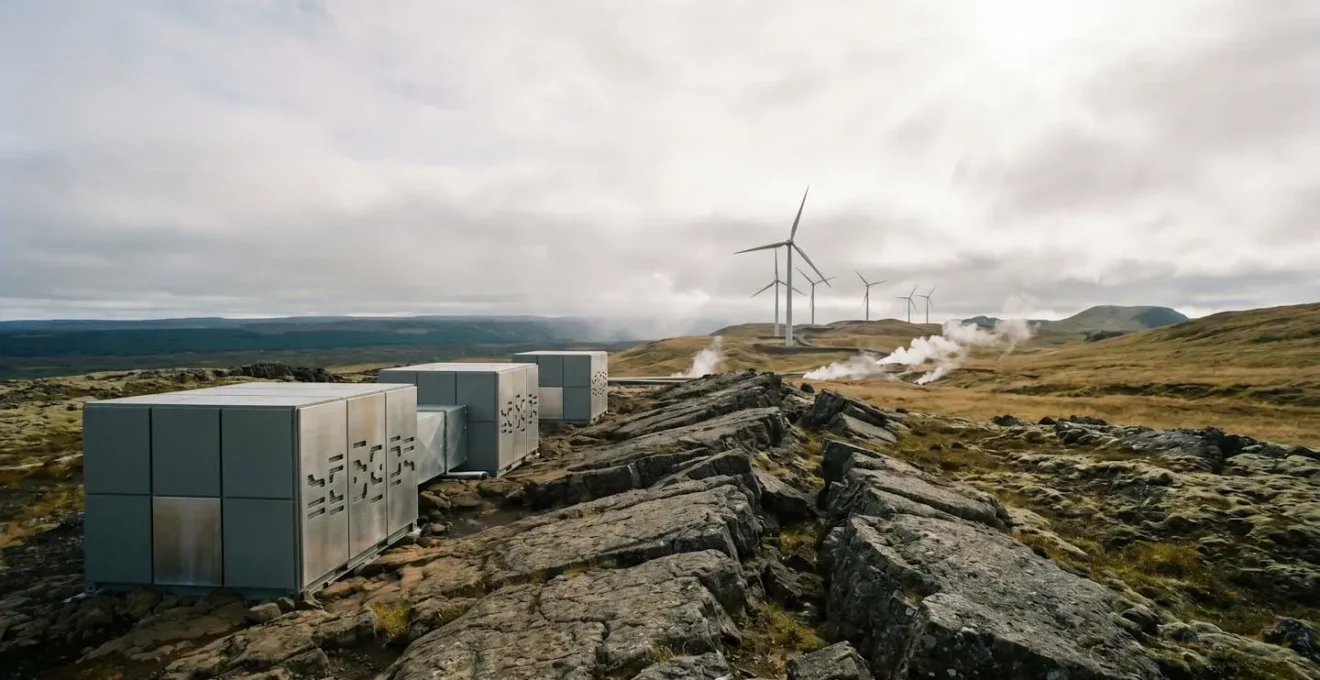
Novel Carbon Dioxide Removal (CDR) technologies represent a potential gigaton-scale market, but are currently defined by immense energy requirements, unproven scalability, and critical measurement challenges.
- Engineered solutions like Direct Air Capture (DAC) face a massive ‘energy penalty,’ with realistic scenarios consuming significant fractions of national power grids.
- Nature-based methods such as Enhanced Weathering and Biochar show promise but face profound MRV (Monitoring, Reporting, and Verification) and permanence hurdles.
Recommendation: Focus investment on a diversified portfolio, prioritizing technologies with clear, physics-based pathways to energy efficiency, verifiable MRV, and multi-century carbon permanence.
The climate crisis presents a dual challenge: we must both drastically reduce emissions and actively remove historical carbon dioxide from the atmosphere. While afforestation is a vital part of the solution, its limitations in scale, land use, and permanence mean it cannot be the only answer. The scientific consensus is clear: to meet climate goals, we will need to remove billions of tons of CO2 per year using a suite of new technologies.
This has opened a multi-trillion-dollar market opportunity for Carbon Dioxide Removal (CDR). However, for a climate tech investor, the landscape is littered with hype and unproven claims. The common discourse often glosses over the fundamental scientific and engineering hurdles that determine a technology’s true viability. The critical questions aren’t just about whether a technology works in a lab, but whether it can scale efficiently and verifiably in the real world.
This analysis moves beyond the headlines to provide a scientist’s perspective. Instead of simply listing methods, we will dissect the core challenges that govern success: the non-negotiable energy penalties, the complexities of monitoring, reporting, and verification (MRV), and the crucial question of permanence. Understanding these first principles is the only way to distinguish a fleeting promise from a sound, scalable investment.
This article provides a rigorous, science-based assessment of the leading CDR technologies. By examining each method through the lens of its physical limits and operational risks, we can build a clearer picture of the path toward effective, large-scale atmospheric carbon removal. The following sections break down the core science, the critical challenges, and the investment implications for each major pathway.
Summary: How Can We Effectively Remove Atmospheric Carbon Dioxide Beyond Just Planting Trees?
- DAC (Direct Air Capture): Is Sucking CO2 from the Air Energy Efficient?
- Enhanced Rock Weathering: Can Spreading Dust on Fields Cool the Planet?
- Ocean Alkalinity Enhancement: Is It Safe to Change Ocean Chemistry?
- Biochar: How to Turn Farm Waste into Permanent Soil Carbon?
- The Keeling Curve: How Do We Know CO2 Levels Are Rising Faster Than Ever?
- Nuclear Fusion: How Close Is the UK’s STEP Programme to Commercial Power?
- Recyclability: Will Solid-State Batteries Be Easier or Harder to Recycle?
- How to Reduce Landfill Mass Through Circular Economy Principles?
DAC (Direct Air Capture): Is Sucking CO2 from the Air Energy Efficient?
Direct Air Capture (DAC) is the archetypal engineered solution to climate change: large industrial facilities that use chemical processes to literally pull CO2 from the ambient air. The technology generally falls into two camps: solid sorbents, which act like chemical sponges, and liquid solvents, which wash CO2 out of the air. While technically proven, the central question for any investor is its staggering energy consumption.
This isn’t a minor detail; it’s a function of thermodynamics. CO2 in the atmosphere is extremely dilute (about 420 parts per million). Separating it requires a colossal amount of energy. To put this in perspective, one analysis estimated that removing just 2 gigatons of CO2 annually with DAC—a fraction of what’s needed—would require more than half of the 2024 U.S. electricity generation. This is the “energy penalty” in its starkest form. The feasibility of DAC is therefore inextricably linked to the deployment of massive, cheap, and clean energy sources.
The materials themselves, as seen in the contrasting sorbent structures, are at the heart of the efficiency battle. Solid sorbents offer potential advantages in heat requirements, while liquid systems can offer continuous operation. However, both require significant thermal and electrical inputs to release the captured CO2 for sequestration. For an investor, this means a DAC project is fundamentally an energy project. Its success hinges not just on the capture chemistry but on securing long-term, low-cost, zero-carbon power. Without it, a DAC plant risks becoming a stranded asset or, worse, a net emitter when its lifecycle is considered.
Enhanced Rock Weathering: Can Spreading Dust on Fields Cool the Planet?
Enhanced Rock Weathering (ERW) aims to accelerate a natural process that has regulated Earth’s climate for millennia. When rain falls on certain types of rocks, particularly silicate rocks like basalt, a chemical reaction occurs that draws CO2 from the atmosphere and converts it into stable bicarbonate ions, which eventually wash into the ocean. ERW proposes to speed this up by mining, crushing, and spreading vast quantities of these rocks onto agricultural lands.
The core chemistry is well-understood and offers significant co-benefits, such as improving soil pH and providing nutrients for crops. As a research team studying the process noted, the mechanism is direct and measurable on a micro level.
Fresh basalt increases soil pH via rapid H+ neutralization during olivine dissolution, releasing soluble Mg2+ and increasing bicarbonate alkalinity
– Research team studying basalt weathering dynamics, Balancing Organic and Inorganic Carbon Dynamics in Enhanced Rock Weathering study
However, for an investor, the primary risks are not in the chemistry but in logistics and MRV (Monitoring, Reporting, and Verification). To be climatically significant, ERW requires deploying billions of tons of rock dust. This involves a massive mining, grinding, and transportation supply chain, each with its own energy costs and carbon footprint. More critically, how do you verify the precise amount of CO2 removed? Measuring changes in soil chemistry and water runoff across millions of diverse acres, while accounting for natural variability, is an immense scientific and data challenge. Without robust MRV, generating high-quality, sellable carbon credits is nearly impossible.
Ocean Alkalinity Enhancement: Is It Safe to Change Ocean Chemistry?
Ocean Alkalinity Enhancement (OAE) operates on a similar principle to ERW but applies it directly to the ocean, the planet’s largest carbon sink. By adding alkaline materials—such as olivine or manufactured quicklime—to surface waters, OAE aims to increase the ocean’s capacity to absorb atmospheric CO2 and counteract ocean acidification. The theoretical potential is enormous, given the vast surface area of the seas.
However, the ocean is a dynamic, complex, and interconnected system. This presents the single greatest barrier to OAE as an investable technology: verification. Proving that a specific deployment of alkalinity has resulted in a measurable and permanent removal of atmospheric CO2 is extraordinarily difficult. As carbon credit analysis firm Sylvera points out, this is not a controlled environment.
Unlike a geological reservoir or a controlled land-based system, the ocean is never still
– Sylvera carbon credit rating analysis, Ocean Alkalinity Enhancement: How It Works, Risks, and MRV Best Practices
This inherent dynamism, with its complex mixing patterns and biological activity, makes it hard to track the impact of an intervention. While a pioneering 2023 field study showed it was possible to detect a signal, demonstrating a 4 µatm surface fCO2 increase over 36 hours, this only translated to a fraction of the total potential removal. Beyond MRV, the risk of unintended ecological consequences is high. Changing local ocean chemistry could impact phytoplankton and marine ecosystems in unpredictable ways, creating significant reputational and regulatory risks for any project. For an investor, OAE remains one of the highest-risk, highest-reward frontiers in CDR.
Biochar: How to Turn Farm Waste into Permanent Soil Carbon?
Biochar is a form of charcoal produced by heating biomass (such as agricultural waste, wood chips, or manure) in an oxygen-limited environment, a process called pyrolysis. This process transforms rapidly decaying organic carbon into a highly stable, solid form that can resist decomposition for hundreds or even thousands of years. When added to soil, it acts as a long-term carbon sink.
Compared to more speculative technologies, biochar is relatively mature and offers a suite of verifiable co-benefits, including improved soil structure, water retention, and nutrient availability for crops. The main investment question for biochar revolves around two key issues: the true permanence of the carbon storage in different soil types and the scalability of sustainable feedstock. Not all biochar is created equal, and its stability depends heavily on the production temperature and the biomass used.
One innovative model sidesteps the soil permanence debate entirely by changing the end-product.
Case Study: Charm Industrial’s Bio-Oil Sequestration
Charm Industrial represents an innovative departure from traditional biochar soil application. The company uses pyrolysis to convert biomass into a carbon-rich liquid called bio-oil, then injects this liquid deep underground into geological formations for permanent sequestration. This approach offers faster deployment, more easily quantifiable outcomes based on injection volumes, and eliminates concerns about biochar’s potential decomposition in soil over centuries, thus ensuring higher permanence.
Your Action Plan: Assessing a Biochar Project’s Viability
- Feedstock Analysis: Identify and quantify all available, sustainable biomass streams, ensuring they do not compete with food production or drive deforestation.
- Pyrolysis Technology: Evaluate the chosen technology for its energy efficiency, temperature control precision, and ability to utilize co-products like syngas.
- Permanence & MRV: Confront the project’s methodology for measuring carbon stability and verifying long-term sequestration against a scientifically valid baseline.
- Co-benefit Quantification: Audit all claimed co-benefits (e.g., soil health, yield increase) with specific, measurable metrics and control plots.
- Economic & Logistical Plan: Map the full supply chain, from the cost of biomass collection to the logistics of char application and the market for carbon credits.
The Keeling Curve: How Do We Know CO2 Levels Are Rising Faster Than Ever?
The Keeling Curve, the iconic graph showing the continuous rise of atmospheric CO2 concentrations since 1958, is the foundational evidence of our climate predicament. It visualizes the accumulation of greenhouse gases resulting from human activity. It is this ever-rising line that defines the market for Carbon Dioxide Removal. To understand the investment case for CDR, one must first grasp the sheer scale of the historical emissions that created this problem.
Since the Industrial Revolution, humans have been transferring vast quantities of carbon from the ground (as fossil fuels) into the atmosphere. To date, it is estimated that more than 2,000 gigatonnes of carbon dioxide have been added to the atmosphere through human activities. The planet’s natural sinks—forests and oceans—absorb about half of our annual emissions, but the rest accumulates, driving global warming. The Keeling Curve is the ledger of that accumulation.
This is where CDR becomes a strategic necessity. Emissions reductions alone can only stop the problem from getting worse; they do not address the vast quantity of CO2 already in the air. CDR is the only tool we have to manage that historical legacy and, eventually, bring the Keeling Curve back down. The Intergovernmental Panel on Climate Change (IPCC) framework makes this role explicit.
CDR is what puts the net into net zero emissions
– IPCC Assessment Framework, Carbon dioxide removal Wikipedia synthesis
For an investor, this context is crucial. The demand for CDR is not speculative; it is a scientific and political necessity embedded in global climate targets like the Paris Agreement. Every technology discussed in this article exists to address the challenge quantified by the Keeling Curve. Its upward trajectory is the primary driver of the entire CDR market.
Nuclear Fusion: How Close Is the UK’s STEP Programme to Commercial Power?
While not a direct method of carbon removal, the pursuit of commercial nuclear fusion, exemplified by the UK’s STEP (Spherical Tokamak for Energy Production) programme, is profoundly relevant to the CDR landscape. The success of energy-intensive CDR methods, particularly Direct Air Capture, is contingent upon the future availability of abundant, clean, and low-cost energy. Fusion represents the ultimate ambition for such a power source.
The scale of the CDR challenge underscores this dependency. To have a meaningful impact on the climate, we need to remove staggering amounts of CO2. Projections from leading scientific bodies set a clear target. For example, the National Academy of Sciences has estimated that meeting the Paris Agreement’s goals will require scaling up to 10 gigatons of CO2 removal annually by 2050.
Powering a 10-gigaton CDR industry with today’s energy systems is untenable. This is where breakthrough energy technologies like fusion become critical long-term enablers. While commercial fusion remains decades away, its potential to provide baseload power without carbon emissions would fundamentally change the economics of DAC. It would transform DAC’s greatest weakness—its energy penalty—into a manageable operational cost. Different assumptions about future energy systems lead to vastly different outlooks on DAC’s viability. For instance, while some models show massive energy draws, a World Resources Institute analysis suggests that reaching 8 million tonnes per year of DAC in the U.S. by 2030 would use the equivalent of 0.4% of the country’s current electricity generation—a significant but not impossible figure that depends heavily on the chosen technology and location.
From an investment perspective, this creates a symbiotic relationship. A portfolio focused on deep decarbonization might include both long-term energy bets like fusion and more immediate CDR technologies, recognizing that the ultimate success of the latter may depend on the former.
Recyclability: Will Solid-State Batteries Be Easier or Harder to Recycle?
The challenges of developing and scaling new climate technologies are not unique to the Carbon Dioxide Removal sector. The field of energy storage, particularly the race to develop solid-state batteries, faces parallel hurdles in material science, manufacturing scale-up, and end-of-life management. The question of whether these advanced batteries will be easier or harder to recycle highlights a common theme for climate tech investors: the gap between a technology’s theoretical promise and its practical, lifecycle reality.
This gap is a critical lens through which to view the entire CDR industry. While proponents may highlight gigaton-scale ambitions, the current reality is far more modest. It is essential for investors to ground their expectations in the data of what has been achieved to date, not just what is promised for the future. The historical performance of the entire Direct Air Capture industry serves as a sobering but necessary data point.
Across all companies, all technologies, and all years of operation combined, it is estimated that DAC has so far achieved a cumulative total of less than 20,000 tons of CO2 removed from the atmosphere. This is an important technological achievement, but it represents less than 0.00005% of a single year’s global emissions. It starkly illustrates the chasm between the current state of the art (Technology Readiness Level 4-6) and the gigaton-scale deployment required to make a climatic difference.
Just as with solid-state batteries, the path from a working prototype to a globally significant, economically viable, and sustainable industry is long and fraught with non-linear challenges. Understanding this “kilotons-to-gigatons” gap is perhaps the single most important piece of due diligence for a prospective CDR investor.
Key Takeaways
- Energy is the master variable for engineered CDR like DAC; its cost and carbon intensity will determine DAC’s viability.
- MRV (Monitoring, Reporting, and Verification) is the primary risk and value driver for nature-based solutions like ERW and OAE.
- The current scale of novel CDR is orders of magnitude below what’s needed, representing both immense risk and a massive market opportunity.
How to Reduce Landfill Mass Through Circular Economy Principles?
The principle of a circular economy—transforming waste streams into valuable inputs—offers a powerful framework for climate solutions. Rather than viewing CO2 as solely a pollutant to be disposed of, we can see it as a feedstock for a new carbon economy. This approach, known as Carbon Capture, Utilization, and Storage (CCUS), creates products and revenue streams, providing an economic incentive for carbon removal that pure sequestration lacks.
This model directly addresses the challenge of reducing industrial waste, including what ends up in landfills, by creating durable goods from atmospheric carbon. The construction industry is a prime example of where this can be applied at a massive scale.
Case Study: Carbon Utilization in Construction Materials
Companies like Solidia and CarbonCure exemplify circular economy principles by embedding captured CO2 directly into concrete during its curing process. This approach transforms a gaseous waste product into a solid, stable mineral locked within our built environment for centuries. This not only permanently sequesters the CO2 but also can improve the strength of the concrete. Given the concrete industry’s massive global scale, widespread adoption of this technology offers a potential pathway to gigatonne-level sequestration, turning buildings, roads, and bridges into a distributed, long-term carbon sink.
From an investment standpoint, carbon utilization business models are attractive because they have two potential revenue streams: the sale of the value-added product (e.g., low-carbon concrete) and the sale of the associated carbon credit. This de-risks the investment compared to “pure-play” sequestration models that rely solely on volatile carbon markets. By creating a tangible product, these companies are building a market for carbon itself, turning the abstract goal of reducing atmospheric CO2 into a concrete—quite literally—and profitable enterprise.
The road to gigaton-scale carbon removal is a marathon, not a sprint. As this analysis shows, there is no single “silver bullet.” The immense energy requirements of DAC, the profound MRV challenges of nature-based solutions, and the nascent scale of the entire industry demand a sober, scientific, and diversified approach. For an investor, the key is not to pick one winner, but to build a portfolio that strategically balances high-cost, high-permanence engineered solutions with lower-cost, higher-risk land and ocean-based methods. The most promising ventures will be those that are relentlessly focused on driving down energy consumption, solving the MRV puzzle, and demonstrating a clear, scalable path to durable sequestration. The next essential step for any serious investor is to move beyond the headlines and conduct rigorous, first-principles due diligence on the energy, verification, and permanence claims of any potential CDR opportunity.