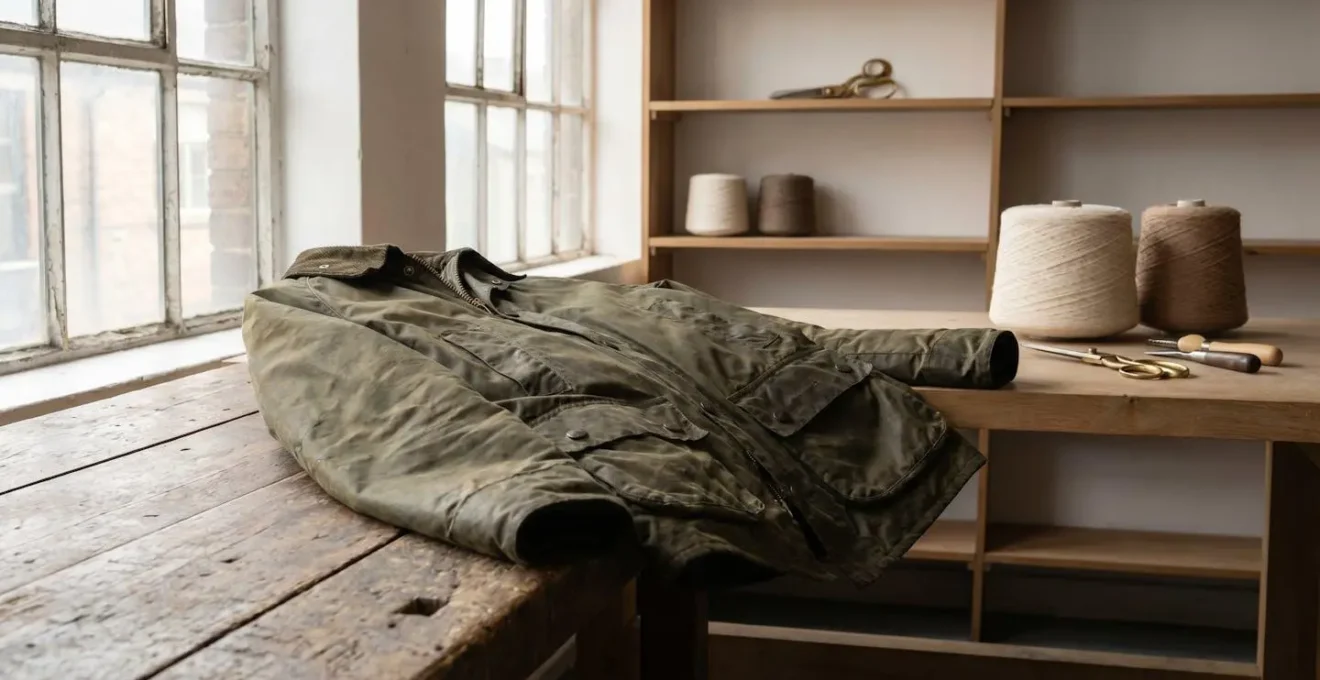
Embracing slow fashion is less about restriction and more about becoming a custodian of a garment’s story. By prioritising heritage craftsmanship, intentional care, and viewing wear as part of a piece’s biography, you can build a truly sustainable and deeply personal wardrobe. This approach transforms consumption into curation, where each piece, from a repaired jacket to a bespoke suit, becomes a timeless part of British style identity.
In the relentless churn of fleeting trends, the modern wardrobe often feels disposable. We are encouraged to buy more, wear it less, and discard it without a second thought. This cycle, the engine of fast fashion, has not only created an environmental crisis but has also diluted the very essence of personal style. Many of us are looking for an alternative, a way to dress that feels both authentic and responsible. The common advice—”buy less, choose well”—is a starting point, but it barely scratches the surface of a much richer philosophy.
The real shift happens when we move beyond simply purchasing sustainable items and begin to engage with the entire lifecycle of our clothes. This involves understanding the value of a Barbour jacket not just for its quality, but for its ability to be repaired and passed down. It means appreciating the artistry of a Savile Row suit or the provenance of a Harris Tweed cloth. But what if the true key to a lasting wardrobe wasn’t in pristine perfection, but in the stories our clothes tell through their imperfections? What if a tear wasn’t a tragedy, but an opportunity for creative expression?
This is the core of the slow-fashion paradigm in the context of British style. It’s a return to a philosophy of garment custodianship, where we value not just the object but its material biography. This article will guide you through this mindset, exploring not just what to buy, but how to care for, repair, and commission pieces that will form the backbone of a wardrobe that lasts for decades. We will explore the art of visible mending, the logic behind investing in heritage brands, and the quiet revolution of pre-order models, giving you the tools to build a wardrobe with permanence and personality.
To help you navigate these principles, this guide breaks down the essential pillars of the slow-fashion movement as it applies to contemporary British style. Below, you will find a detailed exploration of the key concepts and practical skills needed to curate a wardrobe that is both timeless and sustainable.
Summary: Why Is the Slow-Fashion Paradigm Crucial for the Future of British Style?
- Visible Mending: How to Turn a Tear into a Design Feature?
- Heritage Brands: Why Invest in a Barbour or Burberry Trench?
- Pre-Order Models: Why Waiting 6 Weeks for a Dress Reduces Waste?
- Wool Care: How to Wash and Store Knitwear So It Lasts a Lifetime?
- Resale Value: Which Brands Hold Their Value Best on Depop or Vestiaire?
- Savile Row: What Is the Difference Between Made-to-Measure and Bespoke?
- Harris Tweed: Why Does the “Orb Mark” Matter for Authenticity?
- Where to Find and Commission Master Craftsmen in the UK Today?
Visible Mending: How to Turn a Tear into a Design Feature?
The first principle of garment custodianship is to reject the idea that damage equals disposal. Visible mending is a philosophy that treats a tear, a hole, or a stain not as a flaw, but as a moment in the garment’s history—an opportunity to add a new layer of story and personality. Far from being a discreet fix, it’s a bold design choice that celebrates longevity and creativity. Techniques like Japanese Sashiko stitching or colourful darning transform a simple repair into a unique piece of embroidery, making your garment entirely your own. It is a quiet rebellion against the throwaway culture, making a powerful statement about your values.
This practice reframes our relationship with our clothes from passive consumers to active participants in their evolution. An elbow patch on a favourite jumper or a colourful stitch on a pair of jeans becomes what some call an “honourable scar,” a mark of affection and use. It’s a tangible way to showcase your commitment to sustainability while creating a piece that is utterly unique. As author and mending advocate Kate Sekules eloquently puts it in a Nylon Magazine article on the movement:
It’s a scar and a badge of honor at the same time because you’re displaying to the world your intention to preserve and improve and personalize all those things in one
– Kate Sekules, Nylon Magazine article on visible mending
Case Study: Celia Pym’s Artistic Mending Practice
British textile artist Celia Pym exemplifies this philosophy, elevating repair to a primary artistic medium. As documented in Harvard Magazine, her work explores damage and mending with profound narrative depth. She has repaired a Norwegian fisherman’s sweater with darning that washes across the fabric “like a tide” and mended one of Vivien Leigh’s dresses with white stitching that “spiderwebs across the fabric.” Pym’s public mending events, where people bring their own damaged garments, turn the act of repair into a shared, intimate story of loss, love, and preservation.
Heritage Brands: Why Invest in a Barbour or Burberry Trench?
Investing in a piece from a British heritage brand like Barbour or Burberry is not an extravagant expense; it’s a calculated decision in favour of long-term value. These brands represent the pinnacle of garment custodianship, built on a foundation of quality materials, timeless design, and, crucially, a commitment to repair. A Barbour waxed jacket is not designed to be discarded when it shows wear. It is designed to be sent back, re-waxed, and repaired, ready for another decade of service. This changes the economic equation entirely. While the initial outlay is higher than a fast-fashion equivalent, the cost-per-wear plummets over the garment’s lifespan.
This is where the true economy of quality reveals itself. A cheap coat might last a season or two before seams fray and zippers break, ending up in a landfill. A heritage piece is a lifelong companion. Detailed cost-per-wear analysis suggests a Barbour jacket can cost as little as £0.23–£0.34 per wear over 10-15 years, a figure unattainable by its disposable counterparts. This isn’t just about saving money; it’s about investing in an item that accrues personal history and develops a patina that is uniquely yours. The faded shoulders of a trench or the softened collar of a waxed jacket are not signs of decay but markers of a life well-lived.
These brands are signifiers of a certain British sensibility—pragmatic, enduring, and quietly confident. Owning such a piece is an entry into a story that predates you and will likely outlast you. It’s an understanding that true style isn’t about the shock of the new but the reassurance of the proven. Choosing a heritage brand is an investment in a piece of material history that you get to inhabit for a time, before passing it on to the next generation.
Pre-Order Models: Why Waiting 6 Weeks for a Dress Reduces Waste?
The pre-order model is a radical and necessary antidote to modern fashion’s biggest problem: overproduction. The conventional retail system is a guessing game where brands produce massive quantities of clothing in anticipation of demand. When those guesses are wrong—which they often are—the result is catastrophic waste. In fact, some estimates suggest the fashion industry overproduces by about 30-40%. This unsold inventory is often discounted, sent to landfill, or incinerated, all of which has a devastating environmental and economic cost.
A pre-order model completely flips this script. By ordering a garment before it’s made, you are participating in a system where production is directly matched to demand. There is no guesswork and, therefore, virtually no waste. A six-week wait for a dress is not an inconvenience; it is a guarantee that your garment is being made specifically for you and that no resources have been wasted on an identical dress that will never be worn. This fosters a more mindful approach to purchasing, replacing the dopamine hit of instant gratification with the deeper satisfaction of intentional waiting and conscious acquisition.
This model also empowers smaller, independent designers across the UK who may not have the capital to risk a large production run. It allows them to offer a wider variety of designs and sizes without the fear of crippling financial losses from unsold stock. For the consumer, it means access to unique, artisan-made pieces that you won’t see everywhere. It’s a return to a more traditional relationship between maker and wearer, built on mutual respect and a shared commitment to quality over quantity. The wait becomes part of the value, a period of anticipation that makes the final garment all the more cherished.
Wool Care: How to Wash and Store Knitwear So It Lasts a Lifetime?
Possessing a beautifully crafted wool sweater is only the beginning of the journey. To ensure it lasts a lifetime, you must become a proficient custodian of its fibres. Proper care is not a chore; it’s a ritual that preserves the integrity, softness, and shape of your knitwear. The most common mistake is over-washing. Wool is naturally anti-bacterial and odour-resistant, meaning it requires far less frequent washing than synthetic materials. Often, simply airing a jumper out is enough to refresh it.
When a wash is necessary, heat and agitation are the enemies. Machine washing on a standard cycle can cause felting and shrinkage, irreversibly damaging the garment. The gold standard is hand-washing in cool water with a pH-neutral, wool-specific detergent. Gently squeeze the suds through the fabric—never rub, twist, or wring it. After rinsing, press out excess water by rolling the jumper in a clean towel. To dry, lay it flat on a fresh towel or a mesh drying rack, away from direct sunlight or heat, and gently reshape it. Never hang a wet wool jumper, as the weight of the water will stretch it out of shape.
Storage is equally critical. Moths are drawn to natural fibres, so protection is key. Ensure garments are clean before storing, as food or sweat residue can attract pests. Store knitwear folded flat in a drawer or on a shelf—never on a hanger, which can cause stretching and shoulder distortion. For long-term storage, breathable cotton bags are preferable to plastic, which can trap moisture. The use of natural moth repellents like cedar blocks or lavender sachets is a time-honoured British tradition that is both effective and aromatic, adding the final touch to your care ritual.
Your Lifetime Knitwear Care Checklist
- Assess necessity: Before washing, air the garment for 24 hours. Wash only when genuinely dirty.
- Prepare for washing: Turn the garment inside out. Use a wool-specific, pH-neutral soap in a clean basin of cool water (under 30°C).
- Gentle submersion: Fully submerge the garment and let it soak for 10-15 minutes. Gently squeeze suds through the fabric. Do not rub or wring.
- Rinse and press: Drain the soapy water and rinse with cool, clean water until soap is gone. Gently press the garment against the side of the basin to remove excess water, then roll it in a thick towel.
- Dry flat and store: Reshape the garment and lay it flat on a drying rack or fresh towel, away from direct heat. Once completely dry, fold and store with cedar blocks or lavender.
Resale Value: Which Brands Hold Their Value Best on Depop or Vestiaire?
A key indicator of a garment’s true quality and timeless appeal is its performance on the resale market. While a fast-fashion item becomes virtually worthless the moment it’s purchased, a well-made piece from a reputable brand is an asset. This concept of “economic equity” is a cornerstone of the slow-fashion paradigm. When you invest in quality, you’re not just buying a piece of clothing; you’re acquiring an object that retains, and in some cases, even appreciates in value. Platforms like Depop, Vinted, and Vestiaire Collective have become the modern-day stock market for discerning fashion consumers in the UK.
Unsurprisingly, British heritage brands perform exceptionally well. A classic Burberry trench coat, particularly in a timeless beige, is a perennially sought-after item. Even vintage models from decades past can command high prices, especially if they are in good condition. Similarly, Barbour’s waxed cotton jackets are a resale staple, with specific models like the Bedale or Beaufort being consistently popular. Their known durability means buyers are confident in purchasing them second-hand.
Beyond the heritage giants, certain contemporary British designers known for their quality craftsmanship also maintain strong resale value. Think of the iconic bags from Mulberry or the whimsical dresses of a brand like Molly Goddard. The key characteristics these brands share are a strong design identity, high-quality materials, and a reputation for durability. When considering a significant purchase, a quick search on a resale platform can be a powerful research tool. If you see many items from the brand being sold for a significant fraction of their original price, it’s a strong signal that you are making a wise and sustainable investment, one that you can enjoy for years and then pass on, recouping a substantial part of your initial outlay.
Savile Row: What Is the Difference Between Made-to-Measure and Bespoke?
The terms “made-to-measure” and “bespoke” are often used interchangeably, but on London’s iconic Savile Row, the distinction is a matter of profound importance, representing two different tiers of craftsmanship. Understanding this difference is key to appreciating the highest echelons of British menswear and the slow-fashion philosophy. The core distinction lies in the creation of the pattern—the template from which the suit is cut.
A made-to-measure (MTM) suit starts with a pre-existing pattern or “block.” A tailor will take your measurements and then alter that standard block to fit your body as closely as possible. It’s a significant step up from an off-the-peg suit, allowing for adjustments in sleeve length, waist suppression, and trouser break. However, the fundamental shape of the suit is dictated by the original block. It is a process of adaptation. MTM offers a good degree of customisation in fabric and some details, but is limited by its foundational template.
A bespoke suit, in contrast, is the zenith of tailoring. Here, there is no pre-existing pattern. The tailor creates a unique pattern from scratch, based on a comprehensive set of 20-30 measurements, as well as observations about your posture, stance, and movement. The term itself, originating from “be spoken for,” means the cloth is reserved for a unique creation. This process involves multiple fittings (typically three or more) where a “basted” garment is progressively refined on your body. The result is a garment that is not just adapted to you, but is a complete and unique extension of your form. It is a dialogue between client and craftsman, resulting in a piece of wearable art.
The following table summarises the key differences for clarity.
| Feature | Made-to-Measure (MTM) | Bespoke |
|---|---|---|
| Pattern | An existing “block” pattern is altered. | A unique pattern is drafted from scratch for the client. |
| Fittings | Typically one or two fittings. | Multiple fittings (3+) are standard. |
| Customisation | Good customisation of fabric and some details. | Virtually unlimited control over every detail. |
| Time & Cost | Less time-intensive and more affordable. | A significant investment of both time and money. |
Harris Tweed: Why Does the ‘Orb Mark’ Matter for Authenticity?
The Harris Tweed “Orb Mark” is far more than just a brand logo; it is a legally protected certification of authenticity, provenance, and quality that is unique in the world of textiles. To understand its importance is to understand the soul of this iconic British fabric. The mark guarantees that the tweed in your hands adheres to a strict set of standards defined by the Harris Tweed Act of Parliament of 1993. It is the only fabric in the world to be protected by its own Act of Parliament.
Specifically, the Orb Mark certifies that the tweed has been “handwoven by the islanders at their homes in the Outer Hebrides of Scotland, finished in the Outer Hebrides, and made from pure virgin wool dyed and spun in the Outer Hebrides.” Every single part of this definition is crucial. It means the fabric you are holding is not a factory-produced imitation but a piece of cultural heritage, woven on treadle-powered looms by individual artisans in their crofts on the Isles of Lewis, Harris, Uist, and Barra. It is a direct link to a community and a landscape.
Without the Orb Mark, there is no guarantee of this provenance. A fabric might look like Harris Tweed, but it could be made anywhere, from inferior materials, and on industrial power looms. The mark is your assurance against imitation and your guarantee of quality. It represents a sustainable and ethical production process that has supported a remote island community for generations. When you choose a garment bearing the Harris Tweed Orb, you are not just buying a piece of durable, beautiful cloth; you are investing in a piece of Scottish history and supporting a unique, artisan-based economy. It is the ultimate expression of the slow-fashion principle of knowing where your clothes come from.
Key Takeaways
- True sustainability is about garment custodianship, not just consumption.
- Wear and tear should be celebrated as “honourable scars” and opportunities for creative mending.
- Investing in heritage brands and bespoke craftsmanship offers superior long-term value, both economically and emotionally.
Where to Find and Commission Master Craftsmen in the UK Today?
While Savile Row and Harris Tweed represent famous pinnacles of British craftsmanship, the UK is rich with master craftsmen working across a huge range of textile and apparel disciplines. Finding and commissioning work from these artisans is perhaps the most profound way to engage with the slow-fashion paradigm, resulting in a piece that is truly unique and imbued with a personal connection to its maker. Moving beyond established brands requires a little more research, but the rewards are immense.
A great place to start is with organisations dedicated to preserving and promoting these skills. The Heritage Crafts Association (HCA) is an invaluable resource. They publish the “Red List of Endangered Crafts,” which highlights skills at risk of being lost, and their directory can help you find artisans from leatherworkers to lacemakers. Similarly, guilds and associations specific to a craft, such as the Worshipful Company of Weavers or the Guild of Shoemakers, are hubs of exceptional talent. Many of these artisans now have a strong online presence, using platforms like Instagram to showcase their process and connect directly with clients.
Commissioning a piece is a collaborative process. It begins with a conversation where you discuss your needs, ideas, and budget. This dialogue is central to the experience. Whether you are commissioning a hand-knitted Aran sweater from a knitter in the Scottish Isles, a pair of bespoke leather shoes from a Northampton cobbler, or a unique piece of jewellery from a silversmith in Birmingham’s Jewellery Quarter, you are participating in a tradition of making that values skill, time, and human connection above all else. This is the ultimate luxury: owning something made with exceptional skill, just for you, that tells a story from its very inception.
By embracing this paradigm of care, repair, and commissioning, you don’t just build a better wardrobe; you become an active patron of the arts, helping to ensure that these vital British skills thrive for generations to come. Start your journey today by exploring the directories of craft associations and finding a local artisan whose work resonates with you.