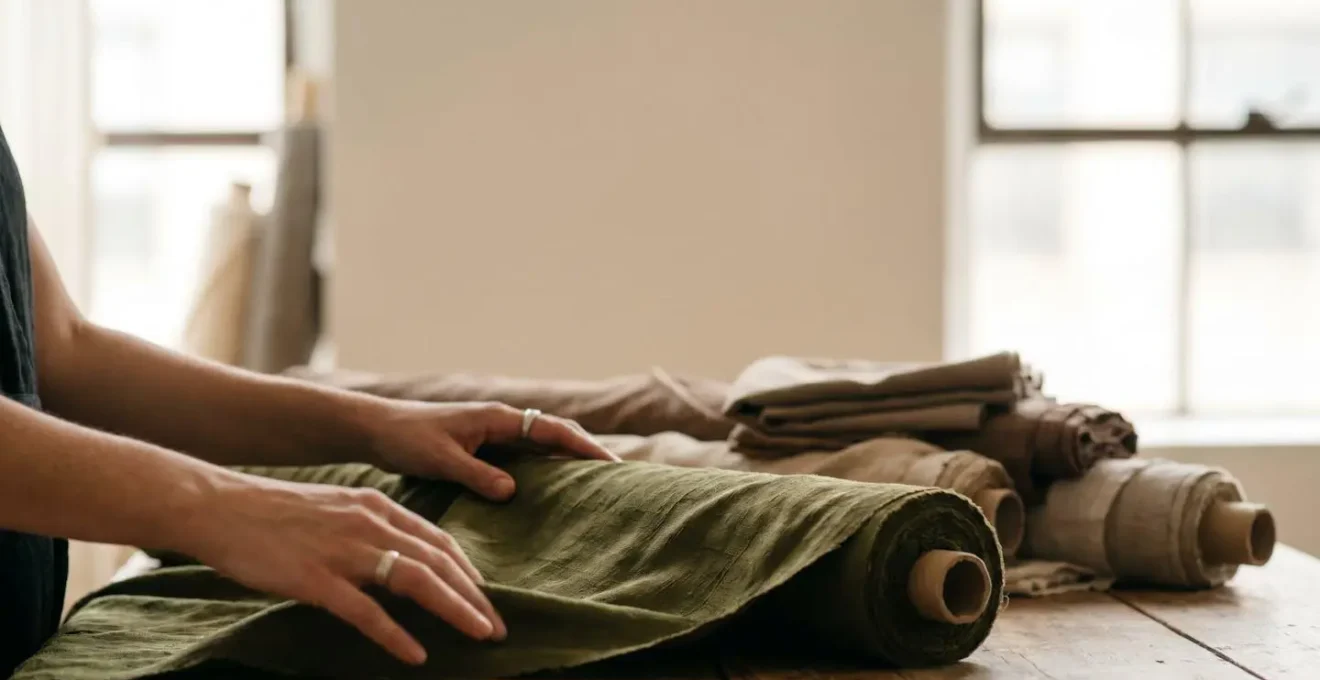
Upcycled luxury isn’t about compromise; it’s about elevating design by treating a material’s history and constraints as the ultimate creative brief.
- Deadstock and vintage fabrics aren’t “leftovers”; they’re treated as limited-edition canvases with built-in narratives that drive value.
- Techniques like zero-waste cutting and visible mending transform production limitations and “flaws” into signature, coveted design features.
Recommendation: Shift your design process from a top-down concept to a material-first dialogue, letting the fabric’s story and limitations guide your creation.
The term “upcycling” often conjures images of patchwork tote bags and craft market creations. For decades, the prevailing wisdom in fashion has been that newness equals value, and waste is an unfortunate but unavoidable byproduct. We are told to use less, recycle more, and perhaps buy a few “eco-friendly” pieces. But this conversation barely scratches the surface. It positions sustainability as a restriction, a set of rules to follow. What if this entire framework is outdated?
The most forward-thinking designers are not merely tolerating waste; they are hunting it. They are operating from a different creative philosophy, one where the supposed constraints of using pre-existing materials become the very source of innovation and desirability. This isn’t about slapping a “green” label on a product. It is about a fundamental shift where material provenance—the story embedded within the fabric—is the new definition of luxury. This article will deconstruct the creative strategies that turn deadstock, vintage garments, and even production errors into the most compelling fashion today.
This guide delves into the specific techniques and mindsets redefining value in the luxury space. We will explore the art of sourcing deadstock, modernizing vintage silhouettes, and mastering crafts that celebrate imperfection, providing a blueprint for a new, circular design ethos.
Summary: How Are Designers Using Upcycled Fabrics to Create Luxury Fashion?
- Deadstock Fabric: What Is It and Why Is It Limited Edition?
- Reworked Vintage: How to Modernize Old Silhouettes for Gen Z?
- Zero-Waste Pattern Cutting: How to Use 100% of the Fabric?
- Boro and Sashiko: How Japanese Mending Techniques Became High Fashion?
- Bespoke Furniture: How to Brief a Cabinet Maker for a One-of-a-Kind Table?
- Visible Mending: How to Turn a Tear into a Design Feature?
- Biodegradable Fibers: Which Fabrics Can Actually Be Composted at Home?
- The Scalability Challenge: Can Upcycling Ever Work for Mass Market?
Deadstock Fabric: What Is It and Why Is It Limited Edition?
Deadstock is the industry term for the fabric that goes unused by the brand that originally commissioned it. It’s not “waste” in the sense of being flawed; it’s surplus, often the result of over-ordering, a cancelled collection, or minor color discrepancies. For years, these high-quality materials were a hidden liability, destined for landfill or incineration. Today, they are a treasure trove. Working with deadstock is less like shopping and more like an archaeological dig, where each find is a finite resource with a hidden history. The value of this market is growing, with some estimates placing the global deadstock fabric market at USD 1.2 billion and growing at a 12.5% CAGR.
The appeal lies in the creative constraint. Unlike ordering thousands of yards of a new textile, a designer might only find 50 meters of a specific deadstock silk. This limitation forces a shift in thinking: the material dictates the design, not the other way around. The result is an inherently limited-edition collection that cannot be replicated, a powerful selling point in a world of mass production. It’s a narrative that resonates deeply with conscious consumers.
64% of Gen Z buyers prefer brands using upcycled or deadstock materials, citing authenticity and eco-consciousness as top motivators.
– Deloitte, 2024 Consumer Survey on Sustainable Fashion
Case Study: Nona Source, LVMH’s Deadstock Revolution
Launched in 2021 by luxury conglomerate LVMH, Nona Source is the first B2B platform reselling exceptional deadstock materials from its own prestigious houses like Dior, Fendi, and Louis Vuitton. By making these surplus luxury fabrics accessible to other designers at competitive prices with low minimums, LVMH has legitimized deadstock as a prime resource. The platform not only provides access to unparalleled quality but also champions a “creative circularity,” proving that one house’s excess can be another designer’s masterpiece, all without production lead times.
Ultimately, using deadstock transforms a garment’s story. It’s no longer just a new dress; it’s a dress made from a forgotten roll of couture jacquard from a 2010 collection, given a second life. This narrative garment is imbued with a history that new fabric can never possess.
Reworked Vintage: How to Modernize Old Silhouettes for Gen Z?
Reworking vintage is about more than just altering a hemline. It is a process of sartorial deconstruction and re-contextualization. The designer acts as both a historian and a futurist, identifying the enduring qualities of a vintage piece—the cut of a shoulder, the drape of a specific fabric—and reinterpreting them for a contemporary audience. This requires a deep understanding of garment construction and cultural trends. The goal is not to erase the garment’s past, but to create a dialogue between its original era and the present moment.
This process often begins with dissecting the garment to understand its architecture. A 1980s power-shoulder blazer might be taken apart, its exaggerated silhouette softened, and its proportions adjusted to align with today’s fluid aesthetics. The original fabric, often of a quality and weave no longer common, becomes the star. For Gen Z, a generation that values authenticity and individuality, a reworked vintage piece offers a unique story that fast fashion cannot replicate.
As the image above illustrates, seeing the garment in its component parts reveals its logic and potential. This is where the creative work happens: combining elements, altering shapes, and creating a hybrid that honors its origins while feeling entirely new. It’s a surgical approach to design that treats history as a tangible, malleable material.
Case Study: Gucci’s Continuum Program
Gucci’s “Continuum” initiative elevates reworking to a high-concept art form. The house redistributes its own archival fabrics and hardware to other independent designers, from Collina Strada to Vans. These designers then transform the materials into unique micro-collections sold on Gucci’s Vault platform. Each piece is tagged with details of the material’s origin and original collection year, making material provenance a transparent and desirable feature. These limited drops often sell out instantly, with their value rooted not in newness, but in the documented story of creative reinterpretation.
Modernizing vintage is ultimately an act of curation. The designer selects a piece from the past, edits its story, and presents it to a new audience, proving that great design is timeless, but its expression is always evolving.
Zero-Waste Pattern Cutting: How to Use 100% of the Fabric?
Traditional pattern cutting is a puzzle with a frustrating outcome: waste. In a standard layout, pattern pieces for a garment are arranged on a length of fabric like cookies on a dough sheet, and the offcuts are discarded. Shockingly, up to 15% of fabric (60 billion m²) ends up on cutting room floors annually. Zero-waste pattern cutting challenges this norm by treating the entire piece of fabric as sacred. It’s a design philosophy that integrates the pattern-making process into the initial creative concept, forcing the designer to think in terms of complete material utilization.
Instead of creating a design and then figuring out how to cut it, the zero-waste designer starts with the dimensions of the fabric. The design emerges from a puzzle-like process where every single piece has a purpose. What would have been a negative space offcut becomes a gusset, a pocket, a facing, or a design detail. This method often leads to innovative and unconventional silhouettes, where geometric lines and clever folding replace traditional seams and darts.
Case Study: Timo Rissanen’s Methodological Approach
As a pioneer in the field, designer and researcher Timo Rissanen has demonstrated that zero-waste is not just a theoretical ideal but a practical, high-fashion methodology. While at Parsons, he developed garments like a kimono-style coat that uses an entire rectangle of fabric. By relying on straight lines and a layout where sleeves, body, and collar emerge from one continuous plan, the “waste” simply ceases to exist. His work proves that tailored outerwear can be both intellectually rigorous and completely resource-efficient.
This approach demands a higher level of skill and planning, but the result is a garment that is not only environmentally superior but also intellectually elegant. It carries a hidden story of its own intelligent making, a testament to a design process that honors its materials down to the last thread.
Action Plan: Auditing Your Design for Zero-Waste Potential
- Points of contact: List every pattern piece and where it touches another on the fabric layout. Are there gaps?
- Collecte: Inventory the negative space shapes created by your current pattern. Can these “offcuts” be re-integrated as style lines, pockets, or facings?
- Cohérence: Confront your pattern with your core design. Does the need for a curved seam justify the waste it creates, or can a straight seam achieve a similar effect?
- Mémorabilité/émotion: Where can you turn a zero-waste seam into a signature detail? Can a triangular offcut become a graphic yoke?
- Plan d’intégration: Redraw your pattern layout, prioritizing the elimination of negative space. Test this with a small-scale paper model first.
Adopting zero-waste thinking is a paradigm shift, moving from a mindset of subtraction to one of holistic and ingenious integration.
Boro and Sashiko: How Japanese Mending Techniques Became High Fashion?
Long before “sustainability” became a buzzword, the rural communities of Edo-era Japan practiced a philosophy of radical resourcefulness out of necessity. This gave rise to *boro* and *sashiko*. *Sashiko* is a form of functional embroidery, using a simple running stitch to reinforce points of wear or quilt layers of fabric for warmth. *Boro*, which translates to “rags” or “tattered cloth,” is the resulting textile—a fabric patched and repaired over generations, with each layer of indigo-dyed cotton telling a story of its family’s history.
What was once a symbol of rural poverty has been re-contextualized by contemporary fashion as the ultimate expression of authenticity and tangible history. The visible, often contrasting, sashiko stitches and the multi-layered texture of boro are now celebrated as markers of craftsmanship and soul. It is the perfect antidote to the sterile perfection of mass-produced goods.
Boro was never intended as an aesthetic. The word translates to ‘rags’ or ‘tattered cloth,’ and that’s what it was—layers of worn fabric, patched over time until the original garment was almost unrecognizable.
– Carryology, How Boro Became Art: The Quiet Survival of Japan’s Patched Cloth
This quote captures the essence of boro’s journey: its aesthetic value was an accidental byproduct of its functional necessity. Today, luxury brands emulate this look, but the most authentic expressions come from those who understand its philosophical roots.
Case Study: Kapital’s Boro Philosophy
Based in Japan’s denim heartland of Okayama, the brand Kapital has built a global cult following by reimagining boro as both form and philosophy. Their patchwork denim jackets and jeans, meticulously hand-stitched with indigo and ivory threads, are wearable art pieces. Using their own proprietary damage processing technology, Kapital creates new fabrics that have the soul and texture of hundred-year-old boro textiles, ensuring each garment has unique variations in color and pattern, making every piece a one-of-a-kind.
The rise of these techniques signals a cultural shift. We are moving away from valuing disposability and towards cherishing evidence of a product’s life and the human hand that repaired it.
Bespoke Furniture: How to Brief a Cabinet Maker for a One-of-a-Kind Table?
The philosophy of material-first design is not confined to apparel. To truly grasp its potential, we must look to adjacent crafts, like bespoke furniture making, where the grain of the wood dictates the form of the table. A master cabinet maker doesn’t fight the knots and inconsistencies in a slab of oak; they feature them. This same principle is now a guiding force in luxury fashion, where designers brief their “material”—be it deadstock silk or vintage denim—with the same reverence.
This approach inverts the traditional design hierarchy. Instead of starting with a sketch and demanding the material conform, the designer begins by “interviewing” the fabric. What is its weight? Its drape? What history is embedded in its weave or print? This dialogue between creator and material is where true innovation occurs. It’s a slower, more intuitive process that stands in stark contrast to the fast-paced, top-down directives of mainstream fashion.
Case Study: Gabriela Hearst’s 30% Deadstock Rule
Designer Gabriela Hearst has made a powerful studio mantra: at least 30% of any collection must be made from deadstock. She argues that the “memory in material” is the ultimate expression of luxury restraint. This philosophy leads to garments with a palpable emotional charge. Silk left over from a 2000s couture house finds new life as a robe coat, while surplus cashmere is recut into languid bias dresses. This cross-pollination of materials mirrors the way a furniture craftsman might use heirloom wood, applying a philosophy of material-first creation to create objects of lasting value and narrative depth.
By adopting the mindset of a cabinet maker, the fashion designer learns to see fabric not as a passive canvas, but as an active collaborator in the creative process. This respect for the material’s inherent qualities and history is the foundation of a more thoughtful and sustainable form of luxury.
Visible Mending: How to Turn a Tear into a Design Feature?
Visible mending is a direct rebellion against the idea that clothes should be perfect and disposable. Instead of hiding a repair, this practice celebrates it, turning a flaw into a focal point. It’s a philosophy that aligns perfectly with the Japanese concept of *kintsugi*, the art of repairing broken pottery with gold, which teaches that an object’s history of breakage and repair makes it more beautiful, not less. In fashion, a patch, a darn, or a line of contrasting stitches becomes a badge of honor—a mark of the garment’s journey and the owner’s care.
This practice is rooted in functionality. As Zenbird Media notes, Sashiko originated in the mid-Edo period (1690-1780) to reinforce durability and heat retention in valuable, handcrafted garments. Today, its application is often more aesthetic, but the spirit of preservation remains. A brightly colored thread used to darn a hole in a cashmere sweater doesn’t just fix the garment; it adds a new layer to its story. It becomes a collaboration between the original maker, the wearer, and the mender.
Luxury brands are embracing this ethos, offering intricate mending services or creating new garments that intentionally mimic the look of well-loved, repaired pieces. This transforms the act of repair from a domestic chore into a desirable design service, a form of bespoke customization.
Case Study: KUON and Otsuchi Sashiko
The Japanese brand KUON exemplifies how visible mending can be a vehicle for both luxury design and social impact. KUON collaborates with skilled artisans from Otsuchi Sashiko, a project started to help female evacuees of the 2011 Tohoku earthquake find purpose and community through needlework. KUON’s signature Boro jackets upcycle fabric scraps using these traditional Sashiko techniques, transforming visible mending into a powerful story of resilience, community, and craftsmanship. The result is a luxury product whose beauty is inseparable from its positive social contribution.
By making mending visible, designers challenge us to reconsider our relationship with our clothes. They ask us to see signs of wear not as damage to be concealed, but as character to be celebrated, turning every tear into a potential design statement.
Biodegradable Fibers: Which Fabrics Can Actually Be Composted at Home?
The conversation around upcycling and mending is vital, but it exists within a larger, more sobering context: the material composition of our global wardrobe. The truth is, the fashion industry runs on plastic. According to the Textile Exchange, a staggering 59% of all fiber output is polyester, with the vast majority derived from non-renewable fossil fuels. This reality places a hard limit on the circular potential of many garments. You can’t compost polyester, and recycling it is a complex, energy-intensive process that is still in its infancy.
This is where the conversation turns to biodegradable fibers. For a garment to truly complete its life cycle and return to the earth, it must be made from 100% natural, non-toxic materials. This includes fibers like organic cotton, linen, hemp, and certain animal fibers like untreated wool. However, “biodegradable” is not a simple label. The process is heavily dependent on conditions. An industrial composting facility is very different from a backyard compost bin. Furthermore, many “natural” garments are treated with synthetic dyes, finishes, or sewn with polyester thread, all of which contaminate the composting process and render the “biodegradable” claim moot.
Truly compostable fashion requires a holistic design approach. The designer must consider not only the primary fabric but also the thread, the buttons (which should be wood or nut, not plastic), the labels, and the dyes. It’s a demanding standard that few brands currently meet. While many fibers are theoretically biodegradable, only those that are 100% natural and untreated can be considered for home composting. This includes undyed linen, organic cotton, and hemp. They must be cut into small pieces to accelerate decomposition, and even then, it’s a slow process.
The stark reality is that while we innovate with waste, the industry continues to produce virgin synthetics at an alarming rate. Upcycling and circular design are powerful and necessary counter-movements, but they are swimming against a tide of polyester. The ultimate goal must be to change the composition of the tide itself.
Key Takeaways
- Material as the Muse: Shift from imposing a design onto fabric to letting the fabric’s history, size, and texture guide the creative process.
- Narrative is the New Luxury: The value of an upcycled garment lies in its unique story—its provenance, its history of repair, its inherent scarcity.
- Imperfection as a Feature: Embrace flaws, mends, and constraints not as problems to be hidden, but as opportunities for signature design details.
The Scalability Challenge: Can Upcycling Ever Work for Mass Market?
This is the critical question. If upcycling is dependent on unique materials and intensive craft, can it ever be more than a niche for luxury boutiques and a handful of dedicated artisans? The answer depends on how we define “scale.” If scaling means producing millions of identical, low-cost items, then no, true upcycling will never work for the mass market. Its very value is tied to its uniqueness and scarcity, the antithesis of mass production.
However, if scaling means significantly increasing the use of pre-existing materials and diverting millions of tons of textiles from landfill, the picture is more optimistic. The challenge is systemic. Research shows that 10-20% of textile waste is pre-consumer, meaning it never even reached a customer. This is a massive, consistent stream of high-quality raw material that is ripe for system-level solutions. The future of scaling upcycling lies not in scaling individual products, but in scaling the *infrastructure* that supports it.
This includes platforms like LVMH’s Nona Source, which industrialize the sourcing of deadstock. It involves developing AI-driven technologies that can sort post-consumer textiles by fiber content with speed and accuracy. In fact, some projections suggest that AI-driven platforms could increase deadstock utilization rates by 35-40% by 2030. It also means investing in training and creating new job categories focused on deconstruction, repair, and remanufacturing. The “mass market” application may not be a single upcycled t-shirt sold at a low price, but rather modular systems, repair services, and remanufacturing programs offered by large brands.
The role of the designer in this future is to become a “systems thinker.” We must design products with disassembly in mind, create styles that can be easily repaired or adapted, and champion the aesthetic value of materials with a past. Scalability is not a technical problem; it is a challenge of imagination and a redefinition of what we consider valuable.
As a designer or a student of the craft, the path forward is clear. Stop seeing materials as a blank slate. Start engaging in a dialogue with them. Let the constraints of a limited fabric roll or the history of a vintage garment be your creative prompt. This is not just a sustainable practice; it is a richer, more meaningful way to design.