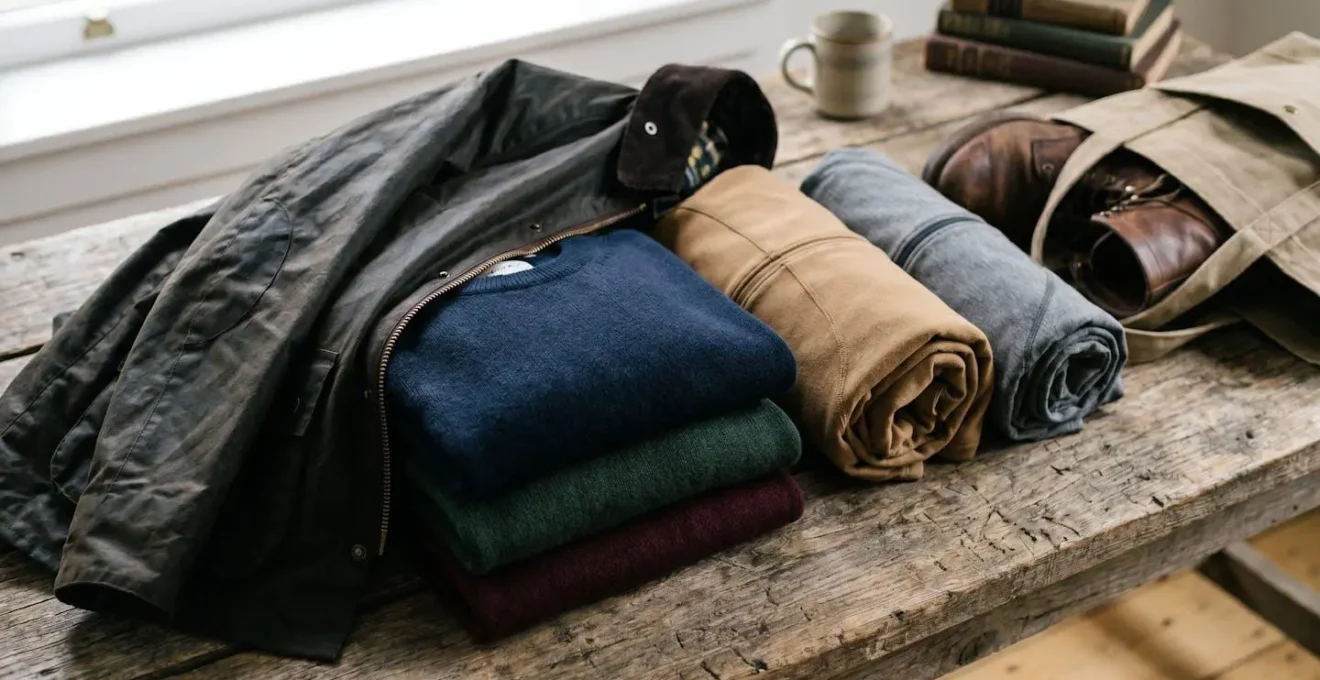
Building a functional UK capsule wardrobe isn’t about finding the perfect trench coat; it’s about implementing a strategic system to eliminate decision fatigue.
- Focus on high-performance, trans-seasonal fabrics that can handle the UK’s unpredictable weather.
- Adopt behavioural tricks like the ‘Hanger Trick’ and ‘One-Touch Rule’ to manage your items effortlessly.
- Calculate the ‘Cost Per Wear’ instead of the purchase price to make smarter, more sustainable investments.
Recommendation: Treat your wardrobe like a personal organisation project, not a fashion challenge, to reclaim mental clarity every morning.
Standing in front of a closet packed with clothes, yet feeling you have “nothing to wear,” is a familiar frustration. For professionals in the UK, this daily challenge is amplified by a climate that can offer four seasons in a single day. The mental drain of deciding what to wear, whether it will be warm enough, or if it will survive a sudden downpour contributes significantly to decision fatigue, draining your cognitive resources before the workday has even begun.
Common advice often revolves around generic checklists: buy a beige trench coat, own five neutral t-shirts, and invest in one good pair of jeans. While not incorrect, this advice only scratches the surface. It treats the wardrobe as a collection of items, not as an integrated system designed for performance and peace of mind. These tips fail to address the core problem: the overwhelming number of choices and the lack of a clear framework for making them.
But what if the key wasn’t simply owning fewer items, but owning the *right* system? This guide re-frames the capsule wardrobe from a minimalist aesthetic to a powerful tool for personal organisation. We will explore a systematic approach that focuses on technical fabrics, behavioural psychology, and practical maintenance routines. The goal is to engineer a wardrobe that works for you, freeing up precious mental real estate and giving you back control over your mornings.
This article provides a complete framework for building and maintaining this system. From choosing the right materials to implementing daily habits, you’ll discover how to create a wardrobe that is not only stylish but also a source of calm and efficiency.
Summary: A Strategic Guide to a UK-Proof Capsule Wardrobe
- The Rule of 3: Which Recent UK Scientific Breakthroughs Offer Immediate Commercial Potential?
- Trans-seasonal Dressing: How to Layer for 4 Seasons with 1 Wardrobe?
- The Hanger Trick: How to Identify Clothes You Never Wear in 6 Months?
- The Daily Uniform: Why Successful CEOs Wear the Same Thing Every Day?
- The 30-Wears Test: What Question Should You Ask Before Buying Anything?
- Digital Detox Retreats: Where to Go in Scotland to Escape the Signal?
- The “One Touch” Rule: How to Keep Kitchen Counters Clear Permanently?
- How to Apply Minimalist Aesthetics to a Cluttered Family Home?
The Rule of 3: Which Recent UK Scientific Breakthroughs Offer Immediate Commercial Potential?
Building a robust capsule wardrobe for the UK climate isn’t about fashion; it’s about material science. Forget brand names and focus on performance. We can adapt the “Rule of 3” to assess any potential garment’s suitability. For the UK, a truly versatile fabric must excel in three key areas: water-resistance, breathability, and layering capability. This isn’t about chasing futuristic breakthroughs but about leveraging proven fabric technologies that offer immediate, practical benefits for your daily life.
The consumer mindset is already shifting in this direction. A recent report highlights that 57% of Britons see sustainability as important for fashion, aligning perfectly with the capsule principle of “buy less, buy better.” Investing in high-performance fabrics that last is a core tenet of this philosophy. A garment that meets the Rule of 3 is one that you won’t need to replace season after season, reducing waste and long-term cost.
Case Study: Ventile® Fabric – A UK Heritage Solution
A prime example of this principle is Ventile®, a fabric with a rich UK heritage. Originally developed in Manchester for RAF pilots, this densely woven 100% cotton material is a masterclass in performance. It passes the 3-point climate test with flying colours: its fibres swell when wet to become highly water-resistant (achieving a hydrostatic head of 400-850mm without coatings), it remains highly breathable due to its natural composition, and its non-coated structure makes it an ideal outer layer that works in harmony with other materials. It represents a timeless, effective solution born from British necessity.
When you assess new purchases through this triple-filter, you move from being a passive consumer to a strategic wardrobe architect. You start building a collection of tools, not just clothes. This systematic approach is the first step to eliminating guesswork from your morning routine.
Trans-seasonal Dressing: How to Layer for 4 Seasons with 1 Wardrobe?
The secret to a single wardrobe that can handle the UK’s notoriously fickle weather is not having more clothes, but having a smarter, modular system. This is trans-seasonal dressing: a strategy built on layering high-performance, complementary pieces. The goal is to create outfits that can be adapted in seconds, whether you’re facing a damp, mild morning in Bristol or a sunny but windy afternoon in Edinburgh. A successful system relies on each layer having a distinct function: a base layer for moisture management, a mid-layer for insulation, and an outer shell for weather protection.
This modular approach allows for a vast number of combinations from a minimal number of items. For instance, a breathable merino base layer works just as well on its own on a mild day as it does under a fleece and waterproof jacket in the cold. Below is a practical layering system designed for typical UK weather scenarios:
- Damp and Mild (10-15°C): Combine a breathable base layer (like a cotton or merino tee) with a lightweight knit or shacket, and a water-resistant outer shell. The focus is on breathability to manage humidity.
- Cold and Wet (2-8°C): Start with a thermal base layer, add an insulating mid-layer (fleece or a thick knit), and finish with a fully waterproof jacket with a hood. Windproofing is key here.
- Sunny but Windy (12-18°C): A single breathable layer paired with a windproof gilet is perfect. The vest keeps your core warm without adding bulk, ideal for active commutes.
- Indoor/Outdoor Temperature Shock: Employ a packable layer like a lightweight down gilet. It can be easily removed and stowed when you enter heated buildings or public transport, preventing overheating while ensuring you’re protected outside.
By thinking of your clothes in terms of a functional, interoperable system, you move beyond “what outfit should I wear?” to “what combination of layers does today’s weather require?” This dramatically reduces the mental effort required each morning.
The Hanger Trick: How to Identify Clothes You Never Wear in 6 Months?
Before you can build an effective system, you must first conduct an honest audit of what you currently own. The “Hanger Trick” is a brilliantly simple behavioural tool for this. At the start of a six-month period (e.g., January 1st), turn all the hangers in your wardrobe to face the same direction. As you wear an item and return it to the closet, turn its hanger the other way. On July 1st, you have an undeniable visual record: any hanger still facing the original direction holds an item you haven’t touched in half a year.
This trick bypasses emotional justifications and “someday” fantasies, providing you with cold, hard data on your actual habits. The items on the unturned hangers are not part of your active life; they are merely occupying valuable physical and mental space. The next step is not to simply discard them, but to process them through a clear, circular system. This is a common practice in the UK, where research shows 38% of consumers bought from a resale platform in the past year. Your unworn items have potential value, either financially or for someone else.
Once you’ve identified the unworn items, the real work of decluttering begins. Follow this action plan to process them responsibly:
- Step 1 – Repair Assessment: First, check for fixable damage like loose seams or buttons. Quality items are worth repairing. Services across the UK, like The Seam, can give a garment a second life.
- Step 2 – Resale Optimisation: For items in good condition, list them on platforms like Vinted (popular for everyday wear) or Depop (for unique or vintage pieces). Use natural light for photos and provide accurate measurements.
- Step 3 – Donation Routing: For items that don’t sell, choose a charity that aligns with the item type. For example, formal wear can go to a dress-for-success programme, while general textiles can go to organisations like TRAID.
- Step 4 – Emotional Release: Take a moment to understand why you held onto these items. Was it a gift? An aspirational purchase for a lifestyle you don’t have? Acknowledging this helps release any guilt and informs more intentional future purchases.
This process is about more than just clearing space. It’s a crucial diagnostic tool that reveals your true style and lifestyle, providing a solid foundation for building a wardrobe that genuinely serves you.
The Daily Uniform: Why Successful CEOs Wear the Same Thing Every Day?
The concept of a “daily uniform,” famously adopted by figures like Steve Jobs and Barack Obama, is not about a lack of creativity. It’s a strategic defence against decision fatigue. Every choice we make, no matter how small, consumes mental energy. As a professional, your cognitive resources are finite and best spent on high-stakes business decisions, not on what-to-wear dilemmas. Astonishingly, studies on clothing-related decision fatigue reveal that women make approximately 34 decisions about what to wear each day. Adopting a personal uniform is a way to reclaim that wasted energy.
A personal uniform doesn’t mean wearing the exact same outfit. It means creating a core template of silhouettes and a harmonious colour palette that you know works for you. This could be a combination of tailored trousers, silk blouses, and a specific style of blazer, all in a complementary range of colours like navy, forest green, burgundy, and camel. Everything goes with everything, making outfit creation almost automatic.
The psychological benefit is profound. By pre-making these low-impact decisions, you start your day with more clarity and focus. This isn’t about restricting your style; it’s about defining it so thoroughly that it becomes effortless. The goal is to develop a signature look that feels authentic and requires zero thought on a busy Tuesday morning. The impact of this approach is backed by data, confirming its effectiveness in reducing mental load.
Consumers report experiencing 60% less decision fatigue when their wardrobes consist of fewer, high-quality items.
– Consumer wardrobe research findings, Best Colorful Socks clothing choice statistics compilation
This strategy transforms your wardrobe from a source of stress into a source of stability. It’s a deliberate act of personal organisation that pays dividends in mental clarity throughout the day.
The 30-Wears Test: What Question Should You Ask Before Buying Anything?
In a world of impulse buys and fleeting trends, the “30-Wears Test” is a powerful mental filter. Popularized by Livia Firth, the co-founder of Eco-Age, the concept is simple yet transformative. Before purchasing any new item, you must ask yourself: “Will I wear this a minimum of 30 times?” This single question forces a crucial shift in perspective from short-term desire to long-term value. It encourages you to think of clothing not as disposable but as a durable good, an investment in your personal style and functionality.
This test is particularly effective for a capsule wardrobe because it automatically prioritizes quality, versatility, and timelessness over trendiness. A fast-fashion top might seem cheap, but if you only wear it twice, its cost-per-wear is high. Conversely, a well-made, more expensive coat worn hundreds of times has an exceptionally low cost-per-wear. This calculation—Price of Item / Number of Wears = True Cost—is the fundamental economic principle of a successful capsule system.
The 30-wears mindset doesn’t mean you can’t have new things; it means the things you acquire must earn their place in your life. It pushes you towards items that align with your personal uniform, fit perfectly, and are made from materials that will endure. It also makes the second-hand market more appealing, as data from Vinted’s 2025 Impact Report shows members pay on average 72% less than original retail prices, allowing you to acquire high-quality pieces with a much lower initial investment, making it even easier to achieve a low cost-per-wear.
Adopting this test as a non-negotiable step in your purchasing process is one of the most effective ways to build a wardrobe that is both financially and stylistically sustainable. It’s your best defence against the clutter of regrettable purchases.
Digital Detox Retreats: Where to Go in Scotland to Escape the Signal?
A successful capsule wardrobe system is as much about what you keep out as what you put in. In this context, a “digital detox” isn’t about escaping to the Scottish Highlands; it’s about intentionally unplugging from the relentless stream of fashion marketing that fuels impulse consumption. Fast fashion brands and influencers are masters of creating “manufactured urgency” through flash sales, limited drops, and trend cycles, all designed to make you feel like you are missing out. This constant digital noise is the primary saboteur of a thoughtful, long-term wardrobe strategy.
To protect your system, you must curate your digital environment as carefully as you curate your closet. This involves actively replacing the noise of consumption with sources of genuine, timeless inspiration. Instead of following accounts that push new products weekly, follow feeds dedicated to architecture, art, or nature. Train your eye to appreciate form, colour, and texture in contexts that aren’t trying to sell you something. This recalibrates your sense of style, grounding it in enduring aesthetics rather than fleeting trends.
Here is a step-by-step guide to achieving a “wardrobe marketing detox”:
- Week 1 – Email Detox: Unsubscribe from all fashion brand newsletters. Use a service like unroll.me to do this in bulk. This single action eliminates a major source of manufactured urgency.
- Week 2 – Social Media Curation: Mute or unfollow fast fashion brands and any accounts that trigger a desire to shop impulsively. Replace them with accounts focused on clothing repair, sustainable fashion education, or UK circular economy initiatives.
- Week 3 – Replace Input Sources: Actively seek new inspiration. Subscribe to newsletters from UK art galleries like the Tate or V&A. Follow nature photography accounts from the National Trust or feeds dedicated to classic British architecture.
- Week 4 – Physical Wardrobe Organisation: Reinforce this mental shift in your physical space. Use uniform hangers and create visual space in your closet. A visually quiet wardrobe promotes a sense of calm and makes choosing an outfit an effortless, signal-free experience.
This detox is a powerful act of reclaiming your attention. By controlling the information you consume, you gain control over your purchasing habits and, ultimately, the contents of your wardrobe.
The “One Touch” Rule: How to Keep Kitchen Counters Clear Permanently?
The “One-Touch Rule” is a cornerstone of personal organisation, and it’s brutally effective when applied to wardrobe management. The rule is simple: deal with an item once and put it where it belongs immediately. For clothing, this means decisively ending the life cycle of the “floordrobe”—that dreaded pile of clothes on a chair or at the foot of the bed. Every item you take off must be processed instantly, with one touch guiding it to its correct destination: laundry basket, airing rail, mending pile, or back in the wardrobe.
This isn’t about being obsessively tidy; it’s about preventing small decisions from accumulating. The floordrobe is a monument to procrastination, a physical manifestation of deferred choices. Each item in the pile represents a micro-decision you have to make later, adding to your cognitive load. By implementing the One-Touch Rule, you handle this decision in the moment, when the context is fresh, and the effort is minimal. This prevents the build-up of clutter and the corresponding mental stress.
A well-maintained capsule wardrobe is one that is always ready for use. If half your clothes are in a crumpled heap, the system has failed. The following ritual, performed at the end of each day, takes less than five minutes but is the key to maintaining your system’s integrity and ensuring your mornings remain stress-free.
Your 5-Minute End-of-Day Wardrobe Reset:
- Minute 1 – Decision Point: As you undress, touch each item only once to decide its immediate fate. No putting it on a chair “for now.”
- Minute 2 – Dirty Route: Items that need washing go directly into the laundry basket. Ensure the basket is easily accessible to remove any friction.
- Minute 3 – Clean Route: Items worn once but still clean (common with layers in the UK) go on a designated “airing rail” or hook, not back in the wardrobe yet.
- Minute 4 – Mending Pile: Any item with a loose button or small tear goes into a visible mending basket. This creates a clear to-do list for a scheduled repair session.
- Minute 5 – Wardrobe Return: Clean items that won’t be re-worn the next day are immediately put back on their hangers and returned to their designated zone in the wardrobe.
This small habit has a disproportionately large impact. It keeps your curated system in a constant state of readiness and is a practical expression of respect for the time and effort you’ve invested in your clothes.
Key Takeaways
- A capsule wardrobe is a strategic system for reducing decision fatigue, not just a collection of clothes.
- Behavioural tricks like the ‘Hanger Trick’ and ‘One-Touch Rule’ are as important as the items themselves.
- Shift your mindset from purchase price to ‘Cost Per Wear’ to make smarter, more sustainable investments.
How to Apply Minimalist Aesthetics to a Cluttered Family Home?
Ultimately, applying the principles of a capsule wardrobe extends far beyond the closet. It’s about exporting a minimalist mindset of intentionality and efficiency into the rest of your life. The clarity you gain from an organised wardrobe—knowing that every item has a purpose, fits you perfectly, and is ready to wear—is a feeling that can be replicated in other areas of a busy, cluttered life. It’s not about achieving a sterile, minimalist aesthetic, but about reducing the “noise” of unnecessary choices to focus on what truly matters.
The financial implications alone are significant. The average UK household allocates 4% of its annual budget, or around £1,308 per year, to clothing and footwear. By implementing a capsule system, you are not only likely to reduce this expenditure but also to ensure that the money you do spend delivers maximum value in terms of utility and longevity. This is a tangible return on your investment of time and effort.
The skills you develop—auditing, curating, system-building, and maintenance—are transferable. The same logic that helps you build a functional wardrobe can help you organise a chaotic kitchen, streamline a digital filing system, or manage a busy family schedule. It begins with the understanding that simplifying your environment simplifies your mind.
Building a capsule wardrobe isn’t just about clothes—it’s about simplifying your life, saving money, reducing waste, and developing your personal style.
– A Considered Life, How to Create a Capsule Wardrobe for 2025
The capsule wardrobe is, therefore, a training ground. It’s a manageable, personal project that proves you can bring order to chaos and create systems that support your goals, giving you the confidence to apply that powerful lesson everywhere.
Start today by applying just one of these principles—whether it’s the ‘One-Touch Rule’ tonight or asking the ’30-Wears’ question on your next shopping trip. Begin your journey toward reclaiming your mental energy, one organised hanger at a time.