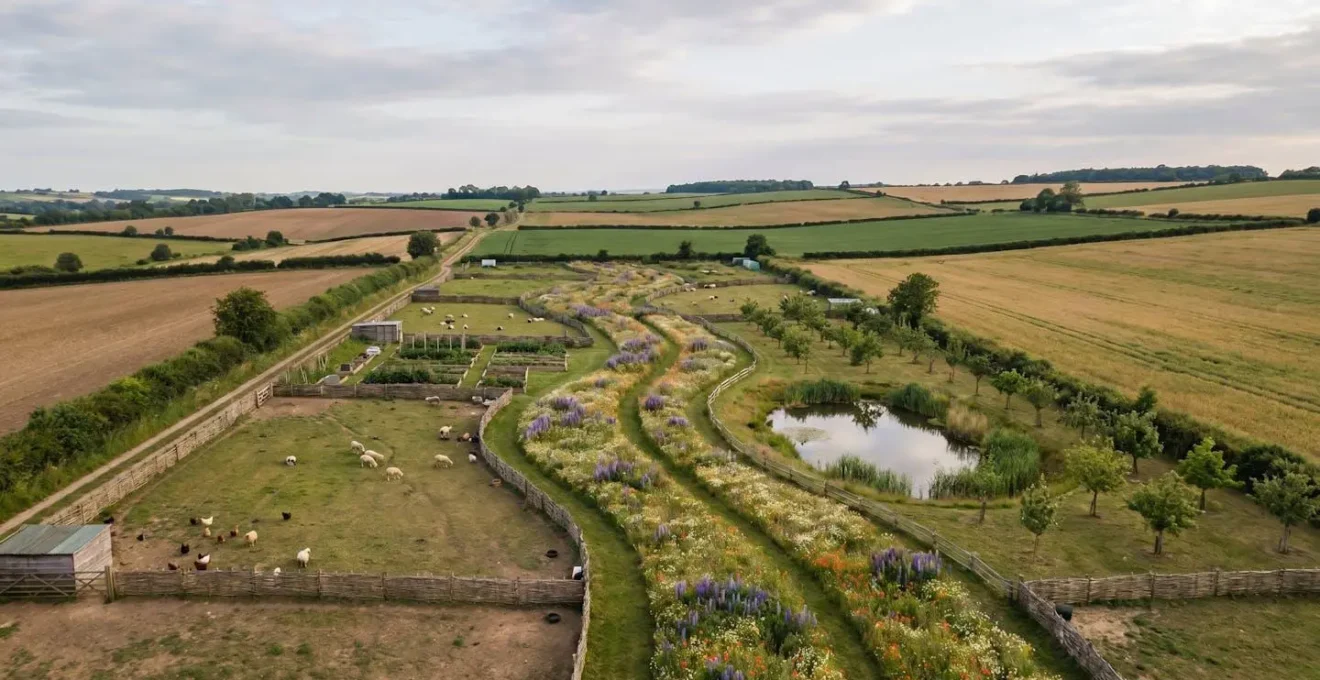
The key to successful ecological stewardship isn’t a long list of tasks, but a fundamental shift in mindset: manage your land as an interconnected system where profitability is a direct outcome of ecological health.
- Mimicking natural processes like herd movement and beaver activity builds resilience and reduces costs.
- Measuring biodiversity and soil health provides concrete feedback for better management and economic decisions.
Recommendation: Start by implementing one small change, like a no-till bed or a wildflower strip, and observe the system-wide effects it produces.
As a landowner, you stand at a challenging crossroads. You feel a deep responsibility to be a good steward of your land, to see nature flourish. Yet, the economic realities of farming and land management are unrelenting. The pressure to stay solvent often feels at odds with the desire to go green, pushing you towards a constant, exhausting trade-off between ecology and economy.
The common advice often feels like a disconnected checklist: plant some trees, stop using certain chemicals, maybe dig a pond. While well-intentioned, these actions in isolation rarely create the profound, resilient, and self-regulating system you’re truly aiming for. They can feel like costly additions rather than integrated solutions. This approach often misses the most powerful strategy available: systems thinking.
But what if the entire premise of “profit versus planet” was flawed? What if the most effective way to build a financially viable holding was to create a thriving, complex, and wild ecosystem? This guide is built on that principle. We will move beyond the platitudes to explore how you can become an orchestrator of natural processes. By understanding and applying principles like ecological mimicry, productive disturbance, and feedback loops, you can turn your land into a system where ecological health directly drives economic resilience.
This article will walk you through the core components of this holistic approach, from rewilding a small patch of ground to revolutionizing your business model. Each section builds upon the last, providing a practical framework for turning your land into a testament that what is good for nature is ultimately good for business.
Summary: A Guide to Holistic Ecological Stewardship
- Micro-Rewilding: Can You Rewild a Garden or Just a 5-Acre Field?
- No-Till Farming: How to sequester Carbon by Not Ploughing?
- Natural Flood Management: How Beavers and Leaky Dams Stop Flooding Downstream?
- Mob Grazing: Why Moving Cows Daily Mimics Nature and Saves Grass?
- Biodiversity Net Gain: How to Calculate If Your Land Is Getting Healthier?
- Farm to Fork: How to Prove Your Coffee Is Truly Fair Trade Using Blockchain?
- Community Supported Agriculture: Is a Veg Box Subscription Worth the Risk?
- Why Is Safeguarding Biodiversity as Critical as Fighting Climate Change?
Micro-Rewilding: Can You Rewild a Garden or Just a 5-Acre Field?
The concept of “rewilding” often conjures images of vast, sweeping landscapes. But the principles of restoring natural processes can be applied at any scale, even in a backyard garden or a small 5-acre field. This is the essence of micro-rewilding. It’s not about reintroducing wolves; it’s about reintroducing natural processes like soil disturbance, plant succession, and habitat complexity. The goal is to move away from the static, high-maintenance model of conservation and towards a dynamic, process-led approach where nature is allowed to find its own way, with a little help.
This means letting some areas grow “messy,” creating log piles for insects, or digging a small pond. These actions are forms of productive disturbance that create new niches for life to colonize. For a landowner, the effect can be profound and surprisingly rapid. As demonstrated in a detailed case study from Somerset, a 3.5-acre field was transformed from a simple pasture into a thriving habitat with ponds and trees in just two years, creating a cost-effective and replicable model.
This image of a beetle bank perfectly illustrates the synergy. A strip of wild, native plants isn’t just “un-mowed grass”; it’s a bustling habitat for predatory insects that will naturally manage pests in your adjacent vegetable beds, reducing or eliminating the need for chemical intervention. It’s a living example of an ecological feedback loop where investing in a small wild space pays dividends in the cultivated area.
Gardens cover about a quarter of many cities, and rows of gardens can form a habitat corridor, potentially linking up wider green spaces like parks.
– Siân Moxon, The Revelator – Urban Microrewilding Article
Even the smallest efforts, when connected, contribute to a larger ecological network, enhancing resilience across the entire landscape. Your smallholding doesn’t exist in a vacuum; it can be a vital node in a wider web of life.
No-Till Farming: How to sequester Carbon by Not Ploughing?
At the heart of any resilient land-based enterprise is healthy soil. For centuries, the plough has been the symbol of agriculture, but we now understand that this intensive turning of the soil is a major disturbance. It breaks up vital fungal networks, releases stored carbon into the atmosphere, and damages soil structure, leading to erosion and water loss. No-till farming is a direct response to this, focusing on minimizing soil disturbance to the greatest extent possible.
By not ploughing, you allow a complex subterranean ecosystem to establish itself. Mycelial networks, the “internet of the soil,” can grow unbroken, transporting nutrients and water between plants. Earthworms and microorganisms thrive, creating channels that improve aeration and water infiltration. This living soil acts like a sponge, holding onto water during dry spells and absorbing it during heavy rains. The result is a dramatic increase in soil organic matter, which is primarily composed of carbon sequestered from the atmosphere.
The benefits extend far beyond carbon storage. This practice directly impacts your bottom line by reducing operational costs. By abandoning the plough, you are also abandoning its significant fuel and labor requirements. In the U.S., for instance, analysis showed that in a single year, 812.4 million gallons of fuel were saved by farmers practicing no-till and other conservation tillage methods. This is a clear, quantifiable economic win that aligns perfectly with ecological restoration.
Ultimately, no-till farming is a foundational practice in holistic stewardship. It transforms the soil from a simple growing medium into a living, functioning ecosystem partner that actively works to improve your land’s resilience and reduce your expenses.
Natural Flood Management: How Beavers and Leaky Dams Stop Flooding Downstream?
Once you begin restoring your soil’s capacity to hold water, the next logical step is to manage the flow of water across your entire property. Here, we can learn from one of nature’s master engineers: the beaver. Beavers build dams that are not impermeable walls but “leaky” structures. They slow down the flow of water, storing it in ponds and wetlands during wet periods and releasing it slowly during dry spells. This creates incredibly rich, biodiverse habitats and mitigates both floods and droughts.
On a smallholding, you can mimic this process through Natural Flood Management (NFM) techniques, even without beavers. The most common method is the construction of “leaky dams” or woody debris dams in ditches, streams, or gullies. These are simple, low-cost structures made from logs and branches that are designed to slow, not stop, the water. During a storm, they fill up, taking the “peak” off the floodwater and allowing it to soak into the ground, recharging aquifers rather than rushing downstream to cause flooding.
Implementing this form of ecological mimicry can be surprisingly straightforward and provides a valuable service to the wider community. Here are some best practices for building them:
- Construct leaky barriers by securing timber supports across the channel with slats that allow partial water passage.
- Set the height of the lowest timber to allow normal flows underneath and permit fish passage.
- Create a series of at least three leaky barriers to maximize flood attenuation impact.
- Use locally sourced wood where possible to reduce costs and environmental impact.
- Conduct periodic checking to ensure logs remain wedged in position and clear accumulated debris.
By implementing NFM, you are not just protecting your own land from erosion and water loss; you are becoming an active part of a landscape-scale solution to flooding, a tangible benefit that may even lead to future economic opportunities through payments for ecosystem services.
Mob Grazing: Why Moving Cows Daily Mimics Nature and Saves Grass?
If your holding includes livestock, they can be either a degenerative force or one of your most powerful regenerative tools. The difference lies in how you manage them. Traditional set-stocking, where animals are left in a large pasture for an entire season, often leads to overgrazing of preferred plants, soil compaction, and degradation of the sward. Mob grazing, also known as rotational or adaptive grazing, turns this on its head.
This technique involves concentrating a group of animals on a small patch of pasture for a very short period—often just a day or even hours—before moving them to the next patch. This intensive, short-duration grazing is a direct mimicry of how large wild herds of herbivores behave. They graze, trample, and dung an area intensively and then move on, not returning for a long time. This has several profound effects:
- Prevents Overgrazing: Plants are bitten once and then given a long rest period to fully recover their root systems.
- Improves Soil Health: The “hoof action” of the concentrated herd tramples old plant matter and manure into the soil surface, feeding the soil biology.
- Increases Forage Utilization: The animals eat a much wider variety of plants, not just their favorites, leading to a more balanced diet and less wasted forage. Research has shown that mob grazing can result in greater than 75% forage utilization, a significant increase in efficiency.
As this image shows, the landscape becomes a mosaic of different recovery stages. This visual contrast is the hallmark of a healthy, productive grazing system. It’s the cycle of intense disturbance followed by long rest that drives the health of the entire ecosystem, creating more grass, better soil, and healthier animals from the same piece of land.
By shifting from being a simple livestock owner to a “grass farmer,” you transform your animals from a potential liability into the primary engine of landscape regeneration and profitability.
Biodiversity Net Gain: How to Calculate If Your Land Is Getting Healthier?
After implementing practices like micro-rewilding, no-till, and mob grazing, a critical question arises: how do you know if it’s working? In holistic management, success isn’t just measured in yield or profit; it’s also measured in life. Biodiversity Net Gain (BNG) is a concept—and increasingly, a legal requirement in some areas—that aims to quantify this. The core idea is that any activity should leave the natural environment in a measurably better state than it was before.
While official BNG calculations can be complex and require ecologists, you as a landowner can adopt the principle by conducting your own simple biodiversity audits. This isn’t about complex formulas; it’s about paying attention and creating a baseline to track progress. Are you seeing more bird species? Are the earthworms returning? Are different wildflowers appearing in your pasture? These are all powerful indicators of ecosystem health. A healthy, biodiverse system is inherently more resilient and productive.
Creating a feedback loop by regularly monitoring your land is essential. It allows you to see what’s working, what isn’t, and adapt your management accordingly. It’s the “A” in the “Plan, Do, Check, Act” cycle of good management. You don’t need expensive equipment, just a notebook, a pair of binoculars, and a little time.
Your DIY Biodiversity Audit Checklist:
- Points of contact: Conduct a 1-hour bird count at dawn to establish baseline avian diversity and abundance.
- Collecte: Perform earthworm density counts per shovel-full of soil in multiple locations across the holding.
- Cohérence: Identify and record key indicator plant species such as native wildflowers, clover, and diverse grass species.
- Mémorabilité/émotion: Monitor beneficial insect populations including pollinators (bees, butterflies) and predatory species (ladybugs, ground beetles).
- Plan d’intégration: Document changes in soil health indicators including organic matter visibility, soil structure, and moisture retention capacity.
By regularly measuring the life on your land, you move from guessing to knowing. You gather the data that proves the value of your stewardship, not just to yourself, but potentially to markets that will pay a premium for food grown in a truly regenerative way.
Farm to Fork: How to Prove Your Coffee Is Truly Fair Trade Using Blockchain?
The value you create through holistic stewardship—healthier soil, cleaner water, and more nutritious food—is often invisible to the end consumer. A carrot grown in living soil looks much like one grown with synthetic inputs. The “farm-to-fork” movement aims to close this gap, but traditional labels like “organic” or “fair trade” can sometimes be opaque. How can you truly prove the story behind your product?
This is where emerging technologies like blockchain can play a revolutionary role. At its simplest, a blockchain is a shared, unchangeable digital ledger. Think of it as a public notebook where every transaction or event is recorded in a “block” and added to a “chain,” which is then copied and distributed across many computers. Once a block is added, it cannot be altered without altering all subsequent blocks, which requires the consensus of the network. This makes it incredibly secure and transparent.
In the context of a coffee bean, for example, a blockchain could track its entire journey. The farmer could record the harvest date and their sustainable practices. The cooperative could record the price paid. The shipper could record transit details, and the roaster could record the roasting profile. At the point of sale, a consumer could simply scan a QR code on the bag and see this entire, verified history. It provides an unprecedented level of traceability and transparency, turning a generic commodity into a product with a proven story and provenance.
While it may seem futuristic, this technology offers a tangible way to translate your hard work in the field into a verifiable, premium attribute in the market, allowing you to capture the full value of your holistic practices.
Community Supported Agriculture: Is a Veg Box Subscription Worth the Risk?
Perhaps the most powerful tool for ensuring the economic viability of a small, regenerative holding is to change the business model itself. The traditional model—grow a product, then hope to sell it at a fluctuating market price—is fraught with risk. The financial reality for many farmers is stark; in 2017, the USDA’s census found that fewer than half of US farms had positive net cash income. This is where the Community Supported Agriculture (CSA) model offers a profound alternative.
In a CSA, customers (or “members”) pay the farm upfront for a “share” of the upcoming harvest. In return, they receive a regular box of produce throughout the season. This simple shift has radical implications. It provides the farmer with crucial working capital at the beginning of the season when costs are highest. More importantly, it shares the inherent risks of farming—a crop failure due to bad weather, for example—across the entire community, rather than placing them solely on the farmer’s shoulders.
This model creates a direct, personal relationship between the people who grow the food and the people who eat it. It fosters loyalty and provides a guaranteed market, insulating the farm from price volatility. The power of this model is best illustrated by real-world examples of resilience.
Case Study: The Vermont Duck Farmer’s Financial Survival
Vermont duck farmer Morgan Gold directly credits his farm’s survival to the CSA model. During a severe agricultural downturn when US farm debt hit a record $415 billion and bankruptcies soared, Gold’s upfront CSA income provided the stability he needed. While many neighbouring farms went into the red, his model allowed him to end the year with a net profit, demonstrating the immense financial resilience that a strong community connection can provide.
By inviting your customers to become partners in the farm, you transform your business from a high-risk solo venture into a collaborative, resilient, and community-embedded enterprise.
Key takeaways
- Holistic stewardship is about managing interconnected systems, not just completing isolated tasks.
- Mimicking natural processes—like herd migration or beaver dams—is the most efficient way to build ecological and economic resilience.
- The ultimate success of your holding depends on creating direct feedback loops, both in nature (monitoring biodiversity) and in business (connecting with your community).
Why Is Safeguarding Biodiversity as Critical as Fighting Climate Change?
The conversation around environmental issues has been dominated by climate change, and for good reason. But focusing on carbon alone is like a doctor focusing only on a patient’s temperature while ignoring their other vital signs. Safeguarding biodiversity is not a separate, lesser issue; it is the other side of the same coin. The two are inextricably linked, and a failure in one guarantees a failure in the other.
A biologically diverse system is inherently a carbon-rich system. Complex ecosystems with a wide variety of plants, animals, and soil microbes are far more effective at capturing and storing atmospheric carbon than simplified, monoculture systems. The intricate web of life in a healthy forest or a thriving grassland soil creates countless feedback loops that enhance carbon sequestration, improve water cycles, and build resilience. Conversely, a loss of biodiversity weakens these systems, making them more brittle and prone to collapse in the face of climate shocks like drought or floods.
This understanding is moving from the fringe to the mainstream. Public and political will is coalescing around the idea that restoring nature is a primary strategy for climate mitigation. For example, a poll in the UK found overwhelming public support for rewilding, with 81% of Britons supporting the initiative. This has led to direct political action, with mayors and governments commissioning experts to create new nature reserves and community green spaces. The recognition is dawning that we cannot solve the climate crisis without solving the biodiversity crisis.
For you as a landowner, this convergence is an opportunity. By focusing on rebuilding biodiversity on your holding, you are not only creating a more beautiful, resilient, and productive landscape; you are also engaging in one of the most vital and effective forms of climate action available today.