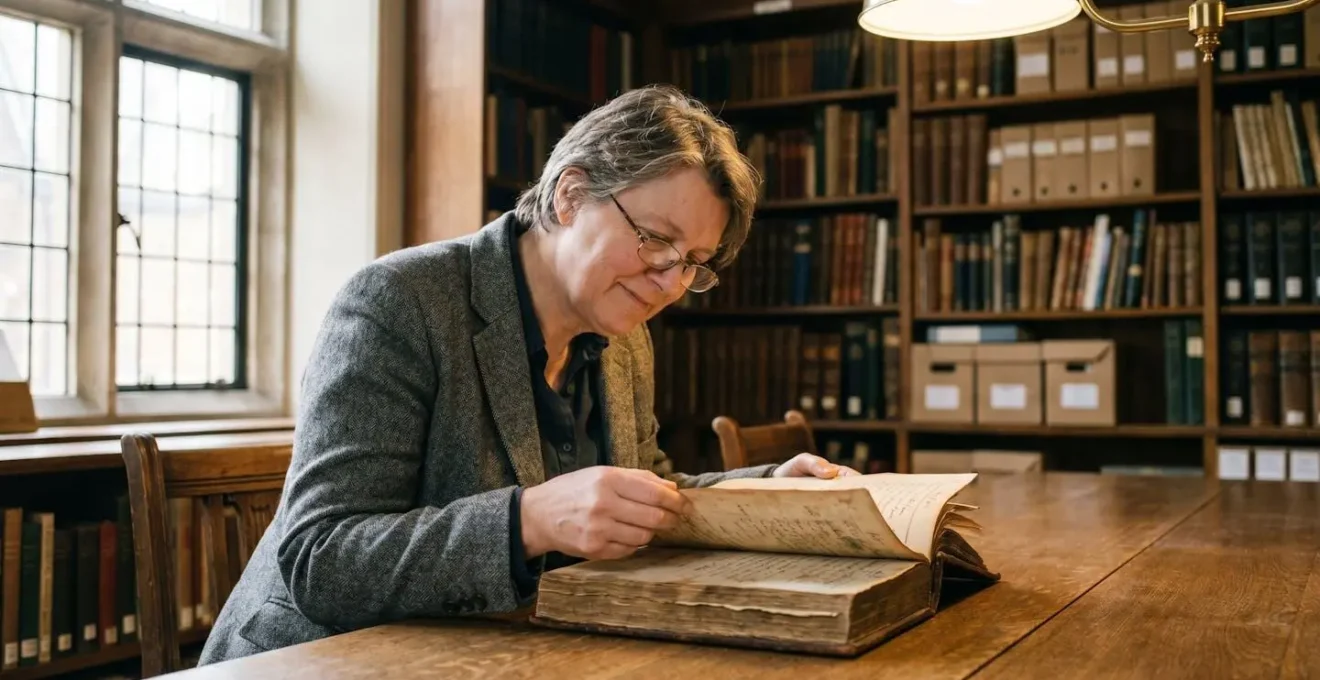
Tracing your British ancestry is less about finding a single document and more about mastering the art of detective work.
- Combine DNA insights with paper trails from local UK record offices for a complete picture.
- Preserve physical heirlooms (photos, letters) and oral histories methodically to secure your family’s legacy.
Recommendation: Start by mapping what you know, then systematically target one type of record—like pre-1837 parish registers—to fill a specific gap.
For many, the desire to build a family tree for the next generation is a powerful calling. It’s a project of the heart, a way to connect your grandchildren to the long line of individuals who came before them. The immediate temptation is often to jump onto a major genealogy website or order a DNA test, hoping for a complete family history to unfold automatically. While these are valuable tools, they are only single pieces of a much larger and more rewarding puzzle.
The true art of genealogy, especially within the rich and complex tapestry of British history, isn’t about finding one magic bullet. It’s about becoming a historical detective. It requires learning how to weigh different types of evidence, understanding their strengths and weaknesses, and knowing where to look when the digital trail goes cold. This is the core of ancestral preservation: not just collecting names and dates, but reconstructing lives and stories with accuracy and context.
This guide is designed to equip you with the foundational mindset of a professional genealogist. We will move beyond the basics and explore the crucial interplay between genetic clues and paper trails. We will cover how to handle the physical legacy of your family—from fragile, century-old photographs to the very headstones that mark their final resting places. By adopting a methodical, evidence-based approach, you can turn a simple hobby into a deeply meaningful legacy project.
This article provides a structured path to begin your investigation into your family’s British roots. The following summary outlines the key areas we will explore, guiding you from modern genetic tools to the irreplaceable records held in local UK archives.
Summary: How to Start Your Ancestral Preservation Journey Using UK Archives?
- DNA Tests vs Paper Trails: Which Is More Reliable for British Ancestry?
- Parish Registers: Why You Must Visit Local Record Offices for Pre-1837 Data?
- Digitizing Heirlooms: How to Scan and Store Century-Old Photos Safely?
- Interviewing Elders: What Questions Should You Ask Before It’s Too Late?
- Grave Maintenance: How to Clean a Headstone Without Damaging the Stone?
- CRISPR-Cas9 vs Prime Editing: Which Technique Is Safer for Human Therapy?
- Immutable Records: Why Can’t Hackers Change History on a Blockchain?
- How to Manage the Risk of Hereditary Pathologies in Your Family?
DNA Tests vs Paper Trails: Which Is More Reliable for British Ancestry?
The central question for any modern genealogist is not whether to choose DNA or documents, but how to make them work together. Think of them as two different kinds of witnesses to the past. A commercial DNA test provides a biological blueprint, connecting you to distant cousins and outlining broad ethnic origins with incredible accuracy. It answers the “who” and “where from” on a genetic level. However, DNA alone cannot tell you the story of *how* your family lived, what they believed, or the social context of their time. It’s a powerful signpost, but it doesn’t describe the journey.
This is where the paper trail excels. Census records, birth certificates, and military files provide the narrative layer. They place your ancestors in a specific time and place, revealing their occupations, their neighbors, and the structure of their household. The true breakthrough in genealogical research occurs when you use a DNA match to guide your search in the archives, or conversely, when a document provides the missing link that explains a genetic connection. The most reliable family history is built upon this evidence triangulation, where a fact is confirmed by both biological and documentary sources.
Choosing the right DNA service can significantly impact your ability to connect with UK relatives and records. Each service has a different database size and regional focus, which is a critical factor for British ancestry research. The following table provides a comparison of major providers to help you decide which tool best aligns with your research goals, especially in connecting genetic data to the vast UK paper trail.
| DNA Service | UK Database Size | Regional Breakdown | UK Record Integration | Best For |
|---|---|---|---|---|
| AncestryDNA | Largest UK user base | 146 global populations with detailed UK regions | Direct links to UK census, parish records | Finding UK relatives & building family trees |
| Living DNA | Specialized UK focus | 21 British Isles sub-regions (Devon, Cornwall, Yorkshire, etc.) | Limited | Pinpointing specific UK regional origins |
| 23andMe | Large international database | 4,500+ locations worldwide, down to 0.1% | No direct UK record access | Comprehensive ancestry with health insights |
| MyHeritage | Growing UK presence | Regional British Isles breakdown | Family tree building tools | Affordable option with tree features |
Ultimately, the synthesis of these two source types is where the magic happens. A DNA test might tell you that you have ancestors from Yorkshire, but only the parish registers and census records can help you discover their names, watch them move from farm to factory during the Industrial Revolution, and truly understand their lives.
Parish Registers: Why You Must Visit Local Record Offices for Pre-1837 Data?
For anyone researching British ancestry, the year 1837 represents a significant dividing line. This is when civil registration—the government-mandated recording of births, marriages, and deaths—began in England and Wales. While online databases have made post-1837 records widely accessible, pushing your family tree back further requires stepping into the world of parish registers. For centuries, the Church of England was the de facto record-keeper of life’s key events. These registers are the single most important source for pre-civil registration genealogy.
While many parish records have been digitized, a substantial number, particularly from smaller or more remote parishes, remain exclusively in physical form. These invaluable documents are housed in local County Record Offices or city archives across the UK. Visiting these archives is not merely a nostalgic exercise; it is often a research necessity. Holding a 200-year-old register, you may find annotations, witness signatures of other family members, or even your ancestor’s own mark (an ‘X’) that provide texture and clues unavailable in a simple digital transcription. These physical details can be the key to breaking down a brick wall.
The tactile experience of archival research connects you to your ancestors in a profound way. The fragile paper and faded ink are a direct link to the past. A visit to a local record office requires preparation, but the potential rewards are immense. It is often in these quiet, climate-controlled rooms that the most significant discoveries are made, pushing a family line back another generation and adding rich detail to your family’s story. Your first visit can seem daunting, but a methodical approach will make it a productive and memorable experience.
Your Action Plan: First Visit to a UK Record Office
- Points of contact: Identify the correct County or City Record Office for your ancestor’s location using online resources like the FamilySearch Wiki to check their specific holdings.
- Collecte: Before you go, prepare your research notes with specific names and dates, and check if you need to obtain a CARN (County Archive Research Network) reader’s ticket in advance.
- Cohérence: Book your appointment well ahead of time, as many archives have limited slots, and confirm their specific rules, such as the common “pencils only” policy for handling original documents.
- Mémorabilité/émotion: On arrival, ask staff for a brief tutorial on handling fragile documents; proper technique with clean hands and gentle page-turning is essential to preserve these shared historical treasures.
- Plan d’intégration: Always have a backup research target. If your primary record is unavailable or too fragile, be prepared to investigate siblings, neighbours, or other associated records.
Digitizing Heirlooms: How to Scan and Store Century-Old Photos Safely?
Your family’s history is not just found in official archives; it lives in dusty shoeboxes, forgotten albums, and fading letters stored in attics. These physical heirlooms—photographs, postcards, diaries, and certificates—are an irreplaceable part of your material legacy. They are also incredibly vulnerable to fire, flood, and the simple passage of time. Digitizing these items is a critical act of preservation, creating a permanent, shareable record for future generations.
However, scanning a photo is only the first step. To do it properly, you must think like an archivist. The goal is to capture the highest possible quality and ensure the digital file itself can stand the test of time. For long-term preservation, professionals advocate a specific standard. The use of a 600 dpi TIFF format is recommended by preservation specialists for long-term archival quality. A TIFF file is “lossless,” meaning no data is compressed or discarded, preserving every detail. From this master file, you can create smaller JPEG copies for emailing or posting online, without ever compromising the original scan.
Equally important is how you store these digital files. Hard drives fail, and cloud services can change. The industry-standard approach for protecting your digital assets is the 3-2-1 backup strategy. This simple but powerful methodology ensures that no single event can wipe out your entire digital archive. By embedding metadata (names, dates, places) directly into the files, you also ensure that the context of these precious images is never lost, transforming a collection of digital files into a true family archive.
- The 3-2-1 Rule: Maintain at least three copies of your data.
- The 2-Media Rule: Store the copies on two different types of media (e.g., your computer’s internal drive and an external hard drive).
- The 1-Off-Site Rule: Keep one copy off-site (e.g., in a cloud storage service like Dropbox or Google Drive, or an external drive at a relative’s house).
By adopting these professional practices, you are not just scanning old photos; you are curating a digital museum of your family’s life, ensuring that the faces and stories of your ancestors are preserved with the care they deserve.
Interviewing Elders: What Questions Should You Ask Before It’s Too Late?
The most precious and perishable archives you have are not made of paper or pixels, but of memory. Your older relatives are living libraries, holding stories, details, and connections that exist nowhere else. Conducting a formal interview to capture their oral history is one of the most urgent and rewarding tasks in ancestral preservation. The key is to approach it not as a simple Q&A, but as a guided conversation designed to unlock a lifetime of experiences.
The biggest mistake is waiting. The second is not being prepared. A well-structured interview can gently guide an elder through their memories, making the experience enjoyable rather than stressful. Instead of asking broad questions like “What do you remember?”, use specific prompts that act as keys to open doors to the past. “What was the name of your first schoolteacher?” or “What games did you play in the street as a child?” can trigger a cascade of associated memories about friends, family, and daily life. It is in these small, sensory details that the true texture of a bygone era is found.
Preparing for the interview is an act of respect. Let your relative know the topics you’d like to discuss beforehand, giving them time to reflect. On the day, choose a quiet, comfortable setting. Use a reliable audio recorder (a smartphone works well) as a backup, but focus on making eye contact and listening actively. Your role is not just to ask questions, but to be a rapt audience. Often, the best stories emerge from a moment of shared silence or a follow-up question that shows you are truly engaged: “That sounds fascinating. Can you tell me more about that?”
Case Study: Chronological Interview Structure for Family History
A proven approach structures interviews chronologically: beginning with childhood memories, progressing through schooling, early employment, family formation, career development, retirement, and present experiences. This framework naturally guides elders through their life story while allowing flexibility to explore rich memories in each period. One successful application, highlighted in a guide on creating an oral history for your family, involved sharing question lists beforehand, enabling the interviewee to reflect and gather relevant photographs or memorabilia. This preparation transformed what might have been a simple Q&A into detailed storytelling sessions where sensory details and forgotten connections naturally emerged. The chronological approach particularly helps when dealing with memory challenges, as sequential prompts can trigger associative memories.
These recorded conversations become a priceless heirloom. They are a direct voice from the past that your grandchildren can listen to, preserving not just the facts of a life, but the personality, accent, and emotion of the person who lived it.
Grave Maintenance: How to Clean a Headstone Without Damaging the Stone?
Cemeteries and churchyards are outdoor archives, with each headstone serving as a vital historical document carved in stone. For the family historian, a legible gravestone can provide definitive birth and death dates, reveal family relationships, and sometimes even hint at an occupation or military service. However, centuries of exposure to weather, pollution, and biological growth can render these inscriptions unreadable. The natural impulse is to want to clean them, but this is a task where good intentions can cause irreversible harm.
The cardinal rule of headstone maintenance is: first, do no harm. Many common cleaning materials are catastrophic for old stone. Bleach, household cleaners, and wire brushes cause flaking, erosion, and staining, permanently destroying the stone’s surface and the inscription it holds. Similarly, pressure washers can literally blast away the delicate face of an aged marble or sandstone marker. Professional conservators use a very limited set of tools and materials, prioritizing the long-term health of the monument above all else.
Before you even touch a headstone in the UK, you must understand the legal context. Cleaning a gravestone without permission can be considered criminal damage. For a churchyard belonging to the Church of England, you may legally require a “faculty” (formal permission from the diocese) before undertaking any work. The first step is always to identify who owns the cemetery and seek their guidance and permission. A gentle, methodical approach using only approved materials is the only responsible way to care for these final testaments to your ancestors’ lives.
Your Action Plan: Safe Headstone Cleaning Protocol
- Legal First Step: Determine cemetery ownership. For Church of England sites, you must inquire about needing a ‘faculty’ (permission from the diocese) to avoid illegal damage.
- Approved Materials Only: Gather your tools: only soft, natural bristle brushes, wooden or nylon scrapers, and plenty of clean water. Never use wire brushes, bleach, or pressure washers.
- Test & Document: Before starting, photograph the stone in raking light (early morning/late afternoon) to capture faint inscriptions, then test your cleaning method on a small, inconspicuous corner.
- Gentle Technique: Always work from the bottom up to prevent streak stains. Use gentle, circular motions with soft brushes and water. Only use an approved biocide like D/2 if heavy biological growth persists and you have permission.
- Contribute to the Community: After cleaning, transcribe the inscription and upload your photos and data to a community project like Find a Grave to help other researchers.
CRISPR-Cas9 vs Prime Editing: Which Technique Is Safer for Human Therapy?
While genealogical research delves into the records of our past, genetic science is focused on rewriting our future. At the forefront of this revolution are gene-editing technologies like CRISPR-Cas9 and its more recent refinement, Prime Editing. Both offer the potential to correct genetic defects that cause hereditary diseases, but they operate in fundamentally different ways, which has significant implications for their safety in human therapy.
The original breakthrough, CRISPR-Cas9, acts like a pair of molecular scissors. It uses a guide RNA to find a specific sequence in the DNA and the Cas9 enzyme to make a clean cut across both strands of the DNA helix. The cell’s natural repair mechanisms then patch the break. While powerful, this process can be imprecise. The repair can sometimes introduce unintended mutations, or the scissors can cut at the wrong location in the genome (“off-target effects”). These potential errors are a major safety concern for therapeutic use.
Prime Editing, developed as a next-generation alternative, is more like a “search and replace” function in a word processor. It uses a modified Cas9 enzyme that only “nicks” one strand of the DNA, rather than making a full double-strand break. It is paired with another enzyme, a reverse transcriptase, which directly writes the new, corrected genetic information into the targeted site. This process avoids the unpredictable double-strand break repair mechanism, making it significantly more precise and reducing the risk of off-target mutations. While still an emerging technology, Prime Editing’s higher fidelity suggests it is a much safer and more controllable technique for future human gene therapies.
The evolution from the blunt force of CRISPR-Cas9 to the precision of Prime Editing demonstrates the rapid advancement in the field. For therapeutic applications, where the mantra is “first, do no harm,” the technique that offers the most control and the fewest unintended consequences will always be the preferred path forward.
Key Takeaways
- Effective UK genealogy requires combining DNA evidence with traditional paper trails from archives.
- For pre-1837 research, physical parish registers found in local County Record Offices are essential and often not digitized.
- A systematic approach to interviewing elders, digitizing heirlooms using the 3-2-1 backup rule, and safely maintaining gravesites are crucial acts of preservation.
Immutable Records: Why Can’t Hackers Change History on a Blockchain?
Just as a genealogist seeks the most stable and unalterable records from the past, modern technology has created a new form of immutable record-keeping: the blockchain. At its core, a blockchain is a digital ledger, but it has unique properties that make it exceptionally difficult to tamper with, which is why hackers cannot simply go back and change its history.
The security of a blockchain rests on three key pillars: cryptographic hashing, the chain structure, and decentralization. First, every block of transactions is run through a mathematical function to create a unique digital fingerprint called a hash. This hash is then included in the next block in the sequence. This creates the “chain”: each block is cryptographically linked to the one before it, all the way back to the very first block.
This chain structure is what makes it so secure. If a hacker were to alter a transaction in a past block, it would change that block’s hash. Because that original hash is part of the next block, the link would be broken, and every subsequent block in the chain would become instantly invalid. To successfully change history, a hacker would need to not only alter the target block but also re-calculate the hash for every single block that has been added since. This is computationally intensive, but it’s the third pillar—decentralization—that makes it nearly impossible.
Instead of being stored on a single server, the blockchain ledger is copied and distributed across a vast network of computers. For a fraudulent change to be accepted, a hacker would need to convince the majority (over 51%) of the network that their altered version of history is the correct one. This would require an astronomical amount of computing power, far more than any single entity typically possesses, effectively securing the ledger against unauthorized changes and making it, for all practical purposes, immutable.
How to Manage the Risk of Hereditary Pathologies in Your Family?
Your genealogical research is more than a collection of names and dates; it is a health record written by history. As you trace your family tree, you will uncover not just stories of long lives and happy families, but also patterns of hardship, illness, and early death. Understanding how to “read between the lines” of historical documents can provide invaluable clues about the health challenges your ancestors faced, some of which may have hereditary components. This is the point where genealogy becomes a proactive tool for understanding your own family’s health risks.
Death certificates, particularly from the Victorian era, are a prime example. The listed cause of death often uses archaic terms that, when decoded, point to specific modern diseases. Recognizing a pattern of “consumption” or “phthisis” across multiple family members is a strong indicator of a vulnerability to tuberculosis, influenced by both environmental and potentially genetic factors. These documents are a narrative of your family’s interaction with the diseases of their time.
Case Study: Using Infant Mortality to Trace Hardship
The Brown family of Stepney, London, provides a stark example. The 1881 census lists Elizabeth Brown, 35, with four living children. However, parish burial registers reveal she gave birth to nine children between 1868-1880, with five dying before age two—a 56% infant mortality rate. Cross-referencing census addresses shows the family in one of London’s worst slums, and the father’s occupation declining from “dock labourer” to “casual labourer.” This pattern, visible only by combining census, parish, and social records, reveals a family’s descent into poverty and the devastating impact it had on their children’s survival, a story completely invisible from any single document.
While you are not a medical professional, as a family historian, you are in a unique position to spot these patterns. A high rate of infant mortality might indicate not just poverty, but a potential genetic condition. A cluster of deaths from “dropsy” could suggest a family history of heart or kidney disease. The table below helps decode some of these historical terms, allowing you to see the health stories hidden in your ancestors’ records.
| Archaic Term | Modern Understanding | Social Context Revealed |
|---|---|---|
| Phthisis / Consumption | Pulmonary tuberculosis | Common in overcrowded urban slums, poor ventilation, malnutrition |
| Dropsy | Edema / fluid retention (heart or kidney failure) | Often indicated chronic untreated disease, lack of medical care |
| Marasmus | Severe malnutrition / wasting in infants | Sign of poverty, inability to afford food, poor maternal health |
| Cholera Morbus | Cholera (infectious disease) | Contaminated water supply, poor sanitation, epidemic periods |
| Childbed Fever / Puerperal Fever | Postpartum infection | Before antiseptic practices (pre-1870s), high maternal mortality |
| Debility / General Debility | Weakness / vague diagnosis | Often masked true cause, indicated doctor uncertainty |
| King’s Evil | Scrofula (tuberculous lymphadenitis) | Historical term, poverty-related disease |
Documenting these findings methodically and sharing them with your family and your physician transforms your hobby into a vital act of care. It provides a long-term perspective on your family’s health, offering context that can inform modern medical conversations and genetic counseling. Your work becomes a bridge between past and future well-being.
By undertaking this journey of ancestral preservation, you are giving a profound gift. You are not only honouring those who came before but also providing your grandchildren with a deep and tangible connection to their own identity. Begin today to piece together the incredible story that is uniquely yours.