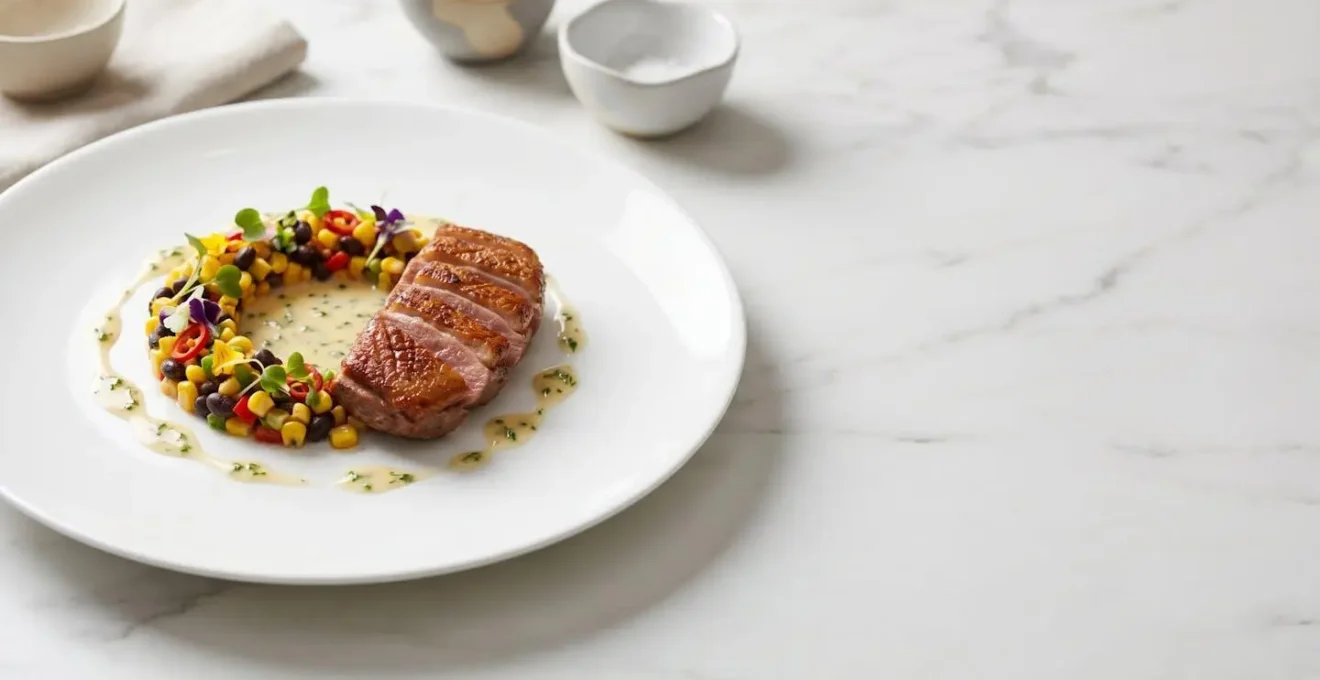
True culinary fusion isn’t about clashing ingredients; it’s about building a new, coherent culinary language based on a deep understanding of structure, technique, and narrative.
- Successful pairings are often rooted in shared chemical compounds (“flavor bridges”) that connect disparate cuisines.
- Applying a classic technique from one culture to the ingredients of another (“technical transposition”) creates innovation without sacrificing integrity.
Recommendation: Instead of asking “what ingredients can I mix?”, start by asking “what structural principle or story can I tell by bringing these worlds together?”.
As a chef, I see countless home cooks and professionals alike fall into the same trap. They hear “fusion,” grab a bottle of sriracha and a lime, and throw it at a classic Italian dish, hoping for magic. More often than not, the result is a plate of confusion—a cacophony of flavors at war with each other. The common advice to “balance flavors” or “be creative” is well-intentioned but ultimately useless, because it misses the fundamental point. The internet is filled with lists of “daring” combinations that lead to culinary dead ends.
The assumption is that fusion is an act of simple addition. But what if the secret wasn’t about adding, but about translating? What if mastering fusion had less to do with a pantry of exotic ingredients and more to do with understanding the underlying grammar of each cuisine? True gastronomic fusion isn’t about randomly mixing ingredients; it’s about understanding the underlying chemical, technical, and narrative structures of cuisines to create something new and coherent. It’s about becoming fluent in multiple culinary languages so you can write your own poetry.
This guide is designed to shift your perspective. We will move beyond the superficial to explore the structural principles that govern successful fusion. We’ll deconstruct flavor pairings at a chemical level, learn how to transpose techniques across cultures, navigate the fine line between appreciation and appropriation, and ultimately, understand how to build a menu that tells a cohesive story. Prepare to stop mixing and start composing.
This article will guide you through the essential pillars of creating meaningful fusion cuisine, from the science of spice pairing to the art of crafting an avant-garde menu. Explore the sections below to build your framework for culinary innovation.
Summary: How to Master Gastronomic Fusion Without Creating Confusion on the Plate?
- The Spice Wheel: How to Pair Indian Spices with Mexican Chilies?
- French Technique, Asian Flavor: How to Apply Classic Skills to Miso Soup?
- Cultural Appreciation vs Appropriation: Where Is the Line in Food?
- Coffee and Meat: Why Does Espresso Work in a BBQ Rub?
- Menu Flow: How to Sequence Dishes from Different Continents?
- Medieval Banquets: How Authentic Are They and Where to Find the Real Deal?
- Koji Rice: How to Grow the Magic Mold That Makes Miso and Sake?
- What Defines an Avant-Garde Menu in the Post-El Bulli Era?
The Spice Wheel: How to Pair Indian Spices with Mexican Chilies?
The foundation of any cuisine is its flavor base, and in many cultures, that means spices. But simply throwing garam masala into a mole recipe is a recipe for disaster. Why? Because spices operate with their own complex grammar. In fact, a computational study on Indian cuisine revealed that, unlike Western cooking which pairs ingredients with similar flavor compounds, Indian dishes often succeed by using spices that have no chemical overlap, creating contrast. This shows that successful pairing is not intuitive; it follows unwritten rules.
The key to bridging these worlds is to identify a “flavor bridge”—an ingredient or compound that has a foot in both cuisines. Cumin is a perfect example. Its warm, earthy profile is essential in both Indian dals and Mexican chili. This isn’t a coincidence. Cumin’s primary chemical compound, cuminaldehyde, shares aromatic characteristics with compounds found in ingredients as diverse as pine and thyme. This chemical versatility allows it to connect different flavor families. The technique then modifies its expression: toasting it longer for the deep, robust needs of Mexican cooking, or lightly frying it to provide a subtler, complementary note in Indian dishes.
As the image above showcases, the textures and forms of spices hint at their distinct properties. Understanding these physical nuances is as important as knowing their flavor. The goal isn’t to make one cuisine taste like another but to use these bridges to create a new, coherent dialogue on the plate. Start by identifying a shared spice, analyze its role in each tradition, and use it as your anchor to introduce new, complementary flavors from the other.
French Technique, Asian Flavor: How to Apply Classic Skills to Miso Soup?
If ingredients are the nouns of a cuisine, techniques are the verbs. One of the most powerful and respectful ways to create fusion is through technical transposition: applying a classic technique from one culinary tradition to the core ingredients of another. This moves beyond simple ingredient mixing and into a deeper, structural fusion. Imagine applying the classic French technique of clarification, typically used to create a crystal-clear consommé, to a dashi and miso base. The result would be a dish with the soul and umami of Japan but the refined texture and presentation of French haute cuisine.
This approach respects the integrity of the original ingredients while elevating them into a new context. You aren’t masking the miso; you’re reinterpreting its form. This can be applied in countless ways. Consider using the Italian risotto method with Japanese short-grain rice and a dashi-kombu broth instead of chicken stock. Or using the French sous-vide technique to perfectly cook a piece of pork belly before glazing it with Korean gochujang. The technique becomes a tool for translation, allowing you to express a familiar flavor in a completely new sentence.
The beauty of technical transposition is that it requires a deep understanding of *both* cuisines. You must master the “why” behind a French sauce reduction to know how to apply it to a base of coconut milk and Thai curry paste. It’s an approach built on skill and knowledge, not just on a whim. This method creates dishes that are both innovative and deeply rooted in culinary principles, resulting in a fusion that feels intentional and harmonious, not accidental.
Cultural Appreciation vs Appropriation: Where Is the Line in Food?
The moment you step into fusion, you step into a conversation about culture. There is a fine but critical line between appreciation, which honors a culture, and appropriation, which exploits it. Appreciation involves learning, crediting, and understanding the context and history of the food you are working with. Appropriation is taking elements from a marginalized culture without credit or understanding, often for profit, reducing it to a caricature. The philosopher bell hooks powerfully described this when she wrote about how, in a consumerist society, “ethnicity becomes spice, seasoning that can liven up the dull dish that is mainstream white culture.”
Within commodity culture, ethnicity becomes spice, seasoning that can liven up the dull dish that is mainstream white culture.
– bell hooks, in her essay ‘Eating the Other’
The story behind the dish is everything. Consider the case of Korean BBQ tacos. Initially, some critics labeled them as appropriation. However, as the story of its creator, Roy Choi, became known—a Korean-American chef growing up in the multicultural landscape of Los Angeles surrounded by Mexican culinary traditions—the dish was recontextualized. It became a story of authentic cultural exchange and personal history. It was his story to tell. In contrast, a non-Indian restaurant chain serving a “curry bowl” that reduces the vast, complex culinary traditions of a subcontinent to a generic, inauthentic dish is a clear example of exploitation.
As a chef, your responsibility is to be a storyteller, not a thief. This means doing the work: research the origins of the dishes, learn the correct names of ingredients, and understand their cultural significance. When you create a fusion dish, be transparent about your inspiration and your process. Are you honoring the source, or are you just “spicing up” your menu? True appreciation leads to a richer, more meaningful cuisine that celebrates connection, as shown by the collaborative spirit in the image above. Appropriation, on the other hand, leaves a bad taste in everyone’s mouth.
Coffee and Meat: Why Does Espresso Work in a BBQ Rub?
Some of the most successful fusions seem counterintuitive at first, like adding finely ground espresso to a rub for grilled steak. This pairing works not because of a cultural connection, but because of a deep chemical one. The magic lies in a process every chef knows and loves: the Maillard reaction. This is the chemical transformation between amino acids and reducing sugars under heat that gives browned food its distinctive flavor. When you grill a steak, hundreds of flavor compounds are created, resulting in that irresistible crust.
Coffee roasting is also a masterclass in the Maillard reaction. As the beans are heated, their amino acids and sugars interact to create a symphony of aromatic compounds. Critically, both roasted coffee and grilled meat produce a significant amount of the same class of compounds: pyrazines. These are responsible for the nutty, toasty, and roasted notes we associate with both. When you put a coffee rub on meat, you are not just adding “coffee flavor”; you are pre-loading the surface with the very same smoky, roasted pyrazine compounds that the grilling process is designed to create.
This creates a natural chemical synergy. The coffee doesn’t just sit on top; it integrates into the crust, amplifying the flavors of the Maillard reaction on the meat itself. It’s a perfect example of how understanding the science behind ingredients can unlock unexpected yet perfectly logical pairings. The bitter notes of the coffee also cut through the richness of the fat, creating balance. This isn’t random fusion; it’s chemically-informed cooking, proving that sometimes the best flavor bridges are found not on a map, but in a textbook.
Menu Flow: How to Sequence Dishes from Different Continents?
Creating a single great fusion dish is a challenge. Creating a whole menu of them that flows logically is a masterstroke. A menu is a story, and each dish is a chapter. Without a clear narrative thread, even a collection of brilliant dishes can feel disjointed and overwhelming to the diner. The key is to establish structural coherence that guides the palate from one course to the next.
There are several strategies for achieving this flow. The most classic is a progression of intensity. Start with lighter, cleaner flavors and build towards richer, more complex ones. For example, a delicate Japanese-inspired crudo with yuzu and shiso could be followed by a slightly heartier Thai-style grilled shrimp with lemongrass, leading into a main course of French-braised short rib with a mole-inspired sauce. The textures and flavor weights increase logically, preventing palate fatigue.
Another powerful approach is to create a narrative arc. The menu could follow a historical trade route, like the Silk Road, starting with Mediterranean flavors, moving through Persian influences, and ending in China. Or, it could tell a personal story, reflecting a chef’s own journey and heritage. For instance, a chef with an Italian-Peruvian background might start with a tiradito that uses olive oil instead of lime, followed by a gnocchi dish made with purple potatoes and served in an aji amarillo cream sauce. The fusion feels authentic because it’s rooted in a genuine story. Plating also plays a role; maintaining a consistent aesthetic, whether minimalist or rustic, can visually tie the menu together even if the flavors span the globe.
Medieval Banquets: How Authentic Are They and Where to Find the Real Deal?
The idea of “fusion cuisine” might seem like a modern invention, a product of globalization and jet-setting chefs. But in reality, it’s a process as old as human migration and trade. As culinary historians point out, historical trade routes like the Silk Road were the original engines of fusion, facilitating a massive exchange of ingredients, techniques, and culinary ideas across continents. What we consider “traditional” cuisine today is often the result of centuries of this slow, organic fusion.
The European medieval banquet is a fantastic case study. We have a romanticized image of plain roasted meats, but the reality for the wealthy was far more complex and heavily spiced. Spices like cinnamon, clove, nutmeg, and black pepper, imported from Asia and Africa, were not just flavorings; they were potent symbols of wealth and status. Their use was extravagant and pervasive. Furthermore, these spices were integrated into local foodways based on contemporary beliefs. Archaeological evidence from ancient Indus civilizations shows the use of turmeric and garlic, which were later incorporated into European dishes not just for taste but also for their perceived medicinal properties, as described in Ayurvedic texts.
This historical fusion was driven by necessity, status, and belief—not just creative whim. A medieval chef adding cinnamon to a meat pie wasn’t thinking about “fusion”; he was using a precious, high-status ingredient to honor a guest and perhaps balance the body’s humors. Understanding this historical context is crucial. It teaches us that cuisines are not static, monolithic entities. They are living, evolving systems that have always absorbed outside influences. This perspective frees us from the tyranny of a rigid, often imaginary, definition of “authenticity.”
Koji Rice: How to Grow the Magic Mold That Makes Miso and Sake?
Some of the most profound tools for fusion cooking aren’t exotic spices or rare vegetables, but the agents of fermentation. At the forefront of this is Koji (Aspergillus oryzae), the “magic mold” that is the foundation of Japanese staples like soy sauce, miso, and sake. Understanding Koji isn’t just about learning to make these products; it’s about understanding a universal tool for flavor creation. Koji’s power comes from the potent enzymes it produces: proteases that break down proteins into savory amino acids (umami), and amylases that break down starches into sugars.
The breakthrough for a fusion chef is realizing these enzymes are not ingredient-specific. They will work their magic on any suitable substrate, not just soybeans or rice. This turns Koji into a key for unlocking new culinary possibilities through technical transposition. You can grow Koji on barley to make a “char-siu” marinade for pork, creating unparalleled depth. You can apply it to Italian salumi during the curing process, amplifying its savory notes. You can even use it to age French cheeses, adding a profound layer of umami that complements their natural funk.
The most direct application is creating shio koji, a simple mash of koji, salt, and water. This slurry can be used as a marinade for virtually anything. On a steak, it tenderizes the meat while imbuing it with a complex, savory flavor far beyond what salt alone could achieve. On roasted vegetables, it brings out their natural sweetness while adding a delicious savory backbone. Koji is a living ingredient that allows you to build flavor from the inside out, creating a fusion that is deeply integrated at a molecular level.
Action Plan: Applying Koji in Fusion Cooking
- Understand the Tools: First, grasp that koji’s enzymes (protease, amylase) are universal protein and starch converters, not limited to Japanese ingredients.
- Cross-Cultural Application: Experiment by applying koji to non-traditional proteins. Consider using it in the curing process for Western charcuterie or to accelerate the aging of hard cheeses.
- Create the Marinade: Master the preparation of shio koji (a simple mash of koji, salt, and water). This will be your primary tool for tenderizing and boosting umami.
- Tenderize and Flavor: Use your shio koji as a marinade on Western staples. Try it on a thick-cut steak before grilling, a whole chicken before roasting, or even on root vegetables to deepen their flavor.
- Document and Refine: Keep detailed notes on marination times and results. Koji is powerful, and learning to control its effects on different ingredients is key to repeatable success.
Key Takeaways
- True fusion is a synthesis of culinary structures, not a random mix of ingredients.
- Successful pairings often rely on “flavor bridges”—shared chemical compounds that link different cuisines.
- The most respectful and innovative fusion comes from “technical transposition,” applying a technique from one culture to the ingredients of another.
What Defines an Avant-Garde Menu in the Post-El Bulli Era?
For a time, “avant-garde” cooking was synonymous with the deconstructionist, technique-driven molecular gastronomy of restaurants like elBulli. It was about foams, spheres, and surprising textures. But the culinary world has moved on. Today, technique is a given, not the main event. The new avant-garde is defined by narrative fusion. According to recent culinary industry data, an incredible 68% of 2024’s Michelin-starred newcomers feature hybrid taste profiles, proving that fusion is the dominant language of modern fine dining.
What sets these new leaders apart is that their fusion dishes are not just clever combinations; they are elements of a larger, cohesive story. The menu becomes a vehicle for a powerful narrative, whether it’s the chef’s personal history, a commentary on sustainability, or a deep dive into a forgotten trade route. A dish might combine Nordic preservation techniques with Amazonian ingredients, not for shock value, but to tell a story about scarcity and biodiversity. The fusion has a purpose beyond just tasting good.
The new avant-garde is narrative fusion. It’s no longer about technique for technique’s sake but about creating a cohesive menu that tells a powerful story—be it a chef’s personal history, a historical trade route, or a commentary on sustainability.
– Contemporary culinary analysts, Delivisor fusion food movement report
This marks a shift from a purely technical to a deeply personal and intellectual form of cooking. As a chef, this means your most important tool is no longer just your knife or your sous-vide machine, but your point of view. What story do you want to tell? How can you use the grammar of different cuisines—their flavors, techniques, and histories—to tell that story in a way that is unique, coherent, and emotionally resonant? The future of fusion, and indeed of avant-garde cuisine, lies in crafting these compelling narratives, one plate at a time.
Now that you have the framework—from understanding the grammar of spices to the ethics of culture and the art of narrative—the next logical step is to start experimenting in your own kitchen. Begin by deconstructing a dish you love and identifying a single element, whether an ingredient or a technique, that you can thoughtfully translate.