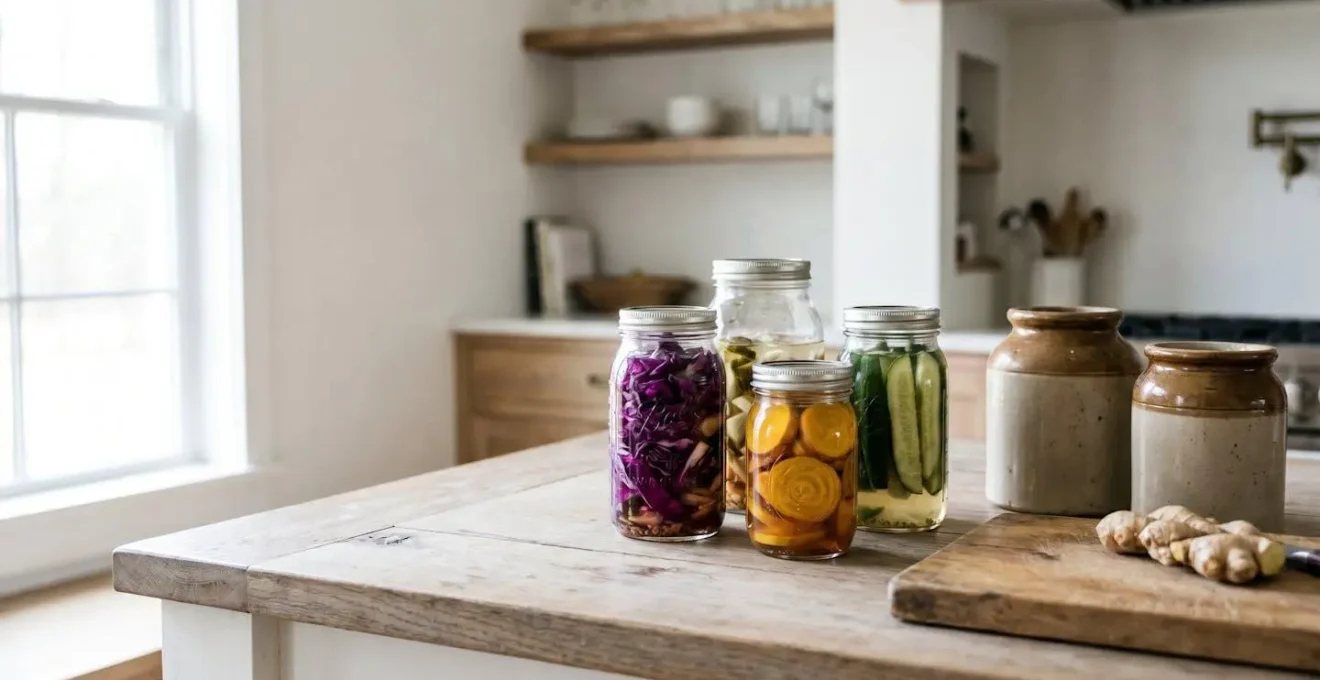
The secret to successful home fermentation isn’t a perfect recipe; it’s understanding you’re managing a living microbial ecosystem.
- Safety and consistency come from precise measurements (like weighing salt) and sensory diagnostics, not guesswork.
- Distinguishing beneficial growths (like Kahm yeast) from harmful mold is a learnable skill that prevents unnecessary waste.
Recommendation: Shift your mindset from a cook following instructions to a “fermentation revivalist” guiding a natural process. This guide provides the principles to do it safely and creatively.
You see the beautiful jars of vibrant kimchi on social media, you hear friends raving about their homemade kombucha, and you’re ready to dive into the world of artisanal fermentation. You buy the cabbage, find a jar, and follow a recipe. A week later, a strange film covers the surface. Is it a triumph of microbial magic or a toxic disaster? This moment of uncertainty is where many budding fermenters give up, intimidated by the processes they can’t see.
The common advice—”just add salt,” “if it’s fuzzy, throw it out”—treats fermentation like a simple cooking step. But this oversimplification is a disservice. It ignores the vibrant, microscopic world you’re actually trying to cultivate. Artisanal fermentation is less like baking a cake from a mix and more like gardening. It’s about creating the right conditions for beneficial microorganisms to thrive while keeping the unwanted ones at bay. To do this successfully, you need to move beyond being a recipe follower and become a manager of this tiny ecosystem.
But what if the key wasn’t in the recipe, but in understanding the “why” behind it? This guide is built on that principle. We’re not just going to tell you what to do; we’re going to explain the science behind safe and successful fermentation. You’ll learn to diagnose problems, understand the role of salt and temperature, and cultivate the specific microbes that create everything from tangy sauerkraut to effervescent sodas. By the end, you won’t just have a few new recipes; you’ll have the confidence and knowledge to improvise, experiment, and truly master the art of microbial magic.
This comprehensive guide will walk you through the core principles and techniques that form the foundation of safe home fermentation. We’ll explore everything from identifying growths and mastering salinity to creating your own starters and understanding how fermentation fits into a sustainable, local food philosophy.
Summary: Your Path to Becoming a Fermentation Revivalist
- Kahm Yeast vs Mold: How to Tell Good Growth from Bad?
- Salinity Percentages: Why Weighing Salt Is Better Than Using Spoons?
- Ginger Bug: How to Make Natural Soda Carbonation from Scratch?
- Koji Rice: How to Grow the Magic Mold That Makes Miso and Sake?
- Scratch Vinegar: How to Turn Leftover Wine into Artisan Vinegar?
- Edible Walls: How to Grow Strawberries and Lettuce Vertically?
- Canning and Pickling: How to Store Summer Glut for Winter Eating?
- How to Adopt Locavore Standards in a UK City in Winter?
Kahm Yeast vs Mold: How to Tell Good Growth from Bad?
Opening your fermentation jar to find a new layer of growth on the surface is a rite of passage. But it can be terrifying. Is it the harmless, film-like Kahm yeast, or is it dangerous, fuzzy mold? Learning to distinguish between the two is the most critical safety skill for any home fermenter. This isn’t just about avoiding food waste; it’s about building the confidence to trust your process. Mold is a deal-breaker that means the entire batch must be discarded, as its root-like structures (mycelia) can penetrate deep into the ferment, releasing toxins. Kahm yeast, on the other hand, is an unsightly but generally harmless collection of wild yeasts that can simply be skimmed off.
The difference lies in texture, color, and smell. Kahm yeast typically presents as a flat, white or cream-colored film that can look wrinkled or like a delicate web across the brine’s surface. It might trap gas bubbles underneath, but it is not fuzzy. Mold, conversely, is almost always characterized by fuzziness. It can appear as distinct, circular colonies and may be white, green, blue, or black. If you see any texture resembling fine hairs or velvet, you are looking at mold.
Your nose is another powerful diagnostic tool. A ferment with Kahm yeast will still smell pleasantly sour and tangy, characteristic of lactic acid fermentation. A moldy ferment will have a distinctly “off” odor—think musty, like a damp basement, or reminiscent of blue cheese. Trust your senses; if it smells wrong, it probably is. The best defense is a good offense: prevention. Ensuring a proper salt concentration, keeping your vegetables submerged, and maintaining a cool environment are key. A recent study confirms that a salt concentration between 2-3% is optimal for inhibiting undesirable microbes while favoring beneficial lactic acid bacteria.
Your 5-Step Diagnostic Guide for Surface Growth
- Visual Inspection: Check if the growth is flat and white/cream (likely Kahm yeast) versus fuzzy and colored (definitely mold). Even the thinnest layer of fuzz indicates mold.
- Smell Test: Sniff the ferment. Kahm yeast will allow the clean, sour aroma to dominate. Mold will introduce a musty, earthy, or foul odor.
- Texture Assessment: Observe the structure. Kahm yeast often forms a complete, wrinkled layer that can trap bubbles. Mold appears as distinct, fuzzy patches that may not cover the entire surface unless advanced.
- Safety Action: If you identify Kahm yeast, carefully skim it off with a clean spoon and ensure all vegetables are back under the brine. If you see any sign of mold, however small, discard the entire batch and thoroughly sanitize your equipment.
- Prevention Protocol: For future batches, use a precise 2% salt brine by weight, maintain a fermentation temperature below 75°F (24°C), use fermentation weights to ensure complete submersion, and minimize oxygen exposure at the surface.
Salinity Percentages: Why Weighing Salt Is Better Than Using Spoons?
In the world of fermentation, salt is not just for flavor; it’s a critical control mechanism. The right salinity creates an environment where beneficial Lactic Acid Bacteria (LAB) can thrive, while inhibiting the growth of pathogenic spoilage microbes. Think of it as a bouncer at a club, letting in the good guys and keeping the troublemakers out. This is why achieving the correct salt percentage is non-negotiable for safety and success. The common advice to use “a tablespoon of salt per quart of water” is a dangerously inaccurate shortcut. Why? Because not all salts are created equal.
A tablespoon of fine sea salt can weigh almost twice as much as a tablespoon of flaky kosher salt. Even different brands of kosher salt have wildly different densities. Relying on volume measurements (spoons) instead of weight (grams) is a gamble. You might be creating a 1.5% brine (too low, risking spoilage) or a 4% brine (too high, inhibiting beneficial bacteria) without even knowing it. Using a digital kitchen scale to weigh both your water and your salt is the only way to guarantee a consistent, safe, and repeatable outcome. The standard formula is simple: (grams of salt / (grams of vegetables + grams of water)) x 100 = salt percentage.
This precision allows you to move beyond a one-size-fits-all approach and tailor your salinity to the specific vegetable you’re fermenting. Different vegetables require different salt concentrations to achieve the perfect texture and flavor, a concept clearly illustrated in comparative guides.
| Ferment Type | Salt % | Fermentation Speed | Texture Result | Storage Duration |
|---|---|---|---|---|
| Sauerkraut/Kimchi | 2% | Fast (7-14 days) | Tender, crisp | 2-3 months |
| Cucumber Pickles | 3-3.5% | Medium (10-21 days) | Very crisp, firm | 4-6 months |
| Whole Vegetables | 3-5% | Slow (14-30 days) | Firm, crunchy | 6-9 months |
| Olives/Capers | 8-10% | Very slow (30-90 days) | Dense, meaty | 12+ months |
| Note: Lower salt (1-2%) requires starter culture below 2% to prevent pathogen contamination. Never go below 1% salt even with starter. | ||||
As this comprehensive salt guide for fermenting vegetables shows, a 2% brine is perfect for shredded cabbage in sauerkraut, but firm cucumber pickles benefit from a higher 3.5% brine to maintain their crunch. By weighing your salt, you take control of the most important variable in lacto-fermentation, transforming your craft from a game of chance into a predictable science.
Ginger Bug: How to Make Natural Soda Carbonation from Scratch?
If the soul of fermentation is microbial alchemy, then the ginger bug is its most enchanting expression. A ginger bug is a wild-fermented starter culture, similar to a sourdough starter, but made from fresh ginger, sugar, and water. It’s a slurry teeming with a symbiotic culture of wild yeasts and bacteria (primarily Lactic Acid Bacteria) that are naturally present on the ginger skin and in your environment. By feeding this microbial colony daily with more ginger and sugar, you create a potent, fizzy liquid that can be used to carbonate any sweetened beverage, turning fruit juice or herbal tea into a naturally sparkling soda.
The process is a beautiful illustration of microbial collaboration. The wild yeasts feast on the sugar, converting it into carbon dioxide (the bubbles) and a negligible amount of alcohol. Simultaneously, the bacteria also consume sugar, producing lactic acid, which adds a characteristic tangy flavor and lowers the pH, making the environment inhospitable to spoilage microbes. The result is a beverage that is not only delightfully effervescent but also rich in probiotics. It’s a living drink, a world away from the sterile, high-fructose corn syrup-laden commercial sodas.
Creating and maintaining a ginger bug is surprisingly simple and deeply rewarding. Once established, it can be kept alive indefinitely in the refrigerator with minimal feeding, ready to be activated whenever you wish to create a new batch of natural soda. Here is a simple guide to its lifecycle:
- Initial Build (Day 1-7): In a jar, combine 2 tablespoons of grated or finely chopped organic ginger (unpeeled), 2 tablespoons of sugar, and 2 cups of non-chlorinated water. Each day for the next week, feed it with 1 tablespoon of ginger and 1 tablespoon of sugar. Keep it covered with a cloth at room temperature. You’ll know it’s active when it’s bubbly and smells yeasty.
- Making Soda: To make soda, strain about 1/4 cup of the ginger bug liquid (leaving the sediment behind) into a quart of sweetened juice or tea. Pour this into airtight, fermentation-grade bottles (like Grolsch-style swing-tops).
- Secondary Fermentation: Leave the bottles at room temperature for 1-3 days to carbonate. “Burp” them daily to release excess pressure. Once you reach the desired fizziness, transfer them to the refrigerator to halt fermentation and prevent explosions.
- Maintenance: After using some of your bug, replenish it with an equal amount of water and feed it with a tablespoon of ginger and sugar. If storing in the fridge, feed it a spoonful of sugar once a week.
Koji Rice: How to Grow the Magic Mold That Makes Miso and Sake?
If lacto-fermentation is the foundational pillar of the fermenter’s craft, then growing koji is ascending to a higher plane. Koji, or Aspergillus oryzae, is a specific, domesticated mold—a “good” mold—that is the cornerstone of many of Japanese cuisine’s most iconic flavors, including soy sauce, miso, and sake. Unlike the wild microbes we wrangle in sauerkraut, koji is a cultivated organism. Growing it involves inoculating a substrate, typically steamed rice or barley, with koji spores and incubating it under precise temperature and humidity conditions. The result is a block of grains beautifully enveloped in a fragrant, fuzzy white mycelium.
What makes koji so magical? Its job is to produce a vast arsenal of enzymes. While the yeasts in bread make gas and the bacteria in yogurt make acid, koji’s enzymes act as microscopic chefs, breaking down complex starches into simpler sugars and proteins into amino acids. This enzymatic power is what unlocks the deep, savory flavor known as umami. When you mix koji-fermented rice with soybeans to make miso, the koji’s enzymes get to work on the beans, transforming them over months into a complex, profoundly flavorful paste. Without koji, there is no miso.
Growing koji at home seems daunting, but it’s achievable with a DIY incubator, often called a “muro.” The key is maintaining a consistent environment. According to traditional parameters, koji cultivation requires holding the inoculated rice at a temperature of 30-32°C (86-91°F) for roughly 48 hours, with high humidity. After about 24 hours, the koji will begin to generate its own heat, and the challenge shifts to preventing it from overheating. A successful batch of koji smells sweet and fruity, like apricots or chestnuts, and looks like a perfect blanket of fresh white snow.
Setting up a basic incubator is simpler than it sounds and is the first step to unlocking a whole new universe of flavor. You’ll need an insulated container, a heat source, and a way to manage humidity.
- Container: A simple styrofoam cooler or a large plastic storage tub works well.
- Heat Source: A seedling heat mat or a submersible aquarium heater placed in a tray of water at the bottom provides gentle, consistent heat.
- Humidity Control: The tray of water for the aquarium heater often provides enough humidity. A small dish of water works with a heat mat. Aim for 70-75% humidity.
- Monitoring: A digital thermometer with a probe is essential to track the temperature of the rice itself.
- Substrate Setup: Spread the steamed, inoculated rice on a cloth-lined tray suspended above the heat/water source.
Scratch Vinegar: How to Turn Leftover Wine into Artisan Vinegar?
Every time you pour that last half-inch of an open bottle of wine down the drain, you’re discarding the potential for liquid gold. That leftover wine is the perfect starting point for creating your own artisanal vinegar, a condiment with more complexity and character than anything you can buy at the store. Making vinegar from scratch is a two-stage fermentation process, and in the case of starting with wine, you get to skip the first stage. It’s a perfect example of the revivalist ethos: transforming would-be waste into something delicious and valuable.
Vinegar production involves two distinct microbial acts. First, yeasts perform alcoholic fermentation, converting sugars (from fruit, grain, or honey) into alcohol. This is how grape juice becomes wine. The second act belongs to a group of bacteria called Acetobacter. These microbes perform acetic acid fermentation: they consume the alcohol and, in the presence of oxygen, convert it into acetic acid—the compound that gives vinegar its characteristic sharp taste and preservative qualities. When you start with leftover wine, the yeasts have already done their job. Your task is simply to introduce Acetobacter and provide the right conditions for it to work.
Acetobacter is present in the air all around us, but to ensure a strong and speedy fermentation, it’s best to introduce it via a “mother of vinegar.” A mother is a gelatinous, rubbery disc of cellulose that houses a thriving colony of Acetobacter. You can obtain a mother from an unfiltered, unpasteurized “live” commercial vinegar (like Bragg’s Apple Cider Vinegar) or from another home vinegar-maker. Simply add your leftover wine and a piece of the mother to a wide-mouthed jar, cover it with a cheesecloth to allow oxygen in while keeping insects out, and wait. The process is a lesson in patience and observation:
- Combine Ingredients: In a wide-mouthed glass jar, combine your leftover red or white wine with a live vinegar mother or a splash of raw vinegar. It’s good practice to dilute wine to about 6-7% alcohol, as high-alcohol environments can inhibit the bacteria. A 1:1 ratio of wine to water is a safe bet.
- Provide Oxygen: Cover the jar’s opening with a tightly woven cloth or a coffee filter secured with a rubber band. This is crucial—Acetobacter needs oxygen to work.
- Wait and Watch: Store the jar in a warm, dark place (60-80°F or 15-27°C is ideal). Over several weeks to a few months, the smell will change from alcoholic to sharply acidic. A new mother may form on the surface.
- Taste and Harvest: When the vinegar has reached a flavor you enjoy (typically after 3-6 weeks), you can harvest it. The finished vinegar should have a pH between 2.5 and 3.5. You can now use this mother to start your next batch.
Edible Walls: How to Grow Strawberries and Lettuce Vertically?
A true fermentation revivalist eventually looks beyond the jar and asks: where do my ingredients come from? The ultimate expression of artisanal craft is to control the process from seed to finished ferment. While not a fermentation technique itself, vertical gardening, or creating “edible walls,” is a powerful allied practice. It allows those in urban environments with limited space to grow their own high-quality produce. Growing your own strawberries for a future fruit vinegar or your own chili peppers for a fiery hot sauce connects you to the entire life cycle of your food.
The principle of vertical gardening is simple: if you can’t build out, build up. This method uses vertical space on walls, balconies, or fences to cultivate plants. There are numerous systems available, from simple stacked planters and hanging pockets to more complex hydroponic and aeroponic setups. For a beginner, a pocket planter system is an excellent starting point. These are felt or fabric panels with multiple pockets that can be hung on a sunny wall. You simply fill each pocket with soil and a plant start.
What can you grow for your fermentation projects?
- Herbs: Dill for pickles, basil for fermented pesto, and cilantro for salsa are all perfect candidates for a vertical garden. They are relatively compact and enjoy the good drainage these systems provide.
- Lettuces and Greens: Loose-leaf lettuces, spinach, and kale can be harvested leaf-by-leaf, providing a continuous supply for salads to accompany your fermented foods.
- Strawberries: Alpine strawberries and other small varieties do exceptionally well in vertical planters. Their runners will cascade down, creating a beautiful and productive edible wall. Imagine fermenting your own homegrown strawberries with a ginger bug for a truly unique soda.
- Peppers: Smaller varieties of hot peppers for hot sauce or sweet peppers for relishes can thrive in larger pockets with adequate sunlight.
The key to a successful edible wall is understanding the basics of any garden: sunlight, water, and soil. Most edible plants need at least six hours of direct sunlight per day, so a south- or west-facing wall is ideal. Soil in vertical planters can dry out quickly, so consistent watering is crucial. Using a high-quality potting mix amended with compost will provide the nutrients your plants need to thrive. By embracing this practice, you’re not just growing food; you’re cultivating a deeper connection to your ingredients and taking a significant step toward food sovereignty, even on a small urban footprint.
Canning and Pickling: How to Store Summer Glut for Winter Eating?
When the summer harvest is in full swing, you’re often faced with a wonderful problem: a glut of produce. How do you preserve this bounty for the leaner winter months? The two primary methods are canning and fermentation. While both fall under the general umbrella of “pickling,” they operate on fundamentally different principles. Understanding their differences is key to choosing the right method for your goals, whether you prioritize shelf-stability, flavor complexity, or nutritional value. Canning is about sterilization; fermentation is about cultivation.
Canning (or heat processing) uses heat to destroy all microorganisms—both good and bad—in the food and create a vacuum seal in the jar. This makes the food shelf-stable at room temperature for years. It’s a method of creating a sterile, static environment. Fermentation, in contrast, is the art of creating a selective environment where beneficial microbes thrive and produce acids or alcohol that preserve the food. This creates a living, dynamic product that must be refrigerated for long-term storage but offers a world of benefits that canning destroys.
The choice between them often comes down to a trade-off between convenience and vitality. Canned foods are convenient for storage, but the high heat destroys delicate probiotics, enzymes, and many heat-sensitive vitamins like Vitamin C. Fermentation, on the other hand, not only preserves nutrients but can even enhance them, increasing the bioavailability of vitamins and creating new ones. The flavor profiles also diverge significantly. Canning preserves a snapshot of the fresh vegetable’s taste, while fermentation develops deep, complex, and evolving tangy or umami flavors over time.
This table breaks down the key distinctions between these two powerful preservation techniques, offering a clearer picture of their respective strengths and weaknesses.
| Characteristic | Fermentation | Canning (Heat Processing) |
|---|---|---|
| Flavor Profile | Complex, evolving, tangy, umami-rich, develops over time | One-dimensional, static, preserves fresh taste but no development |
| Nutritional Value | Increases bioavailability, adds probiotics, preserves enzymes, enhances B vitamins | Destroys heat-sensitive vitamins (C, B), no probiotics, some nutrient loss |
| Texture | Maintains crisp texture through osmosis and lactic acid | Often softer due to heat breaking down cell walls |
| Storage | Requires refrigeration after desired fermentation, 2-12 months shelf life | Shelf-stable at room temp, 1-5 years unopened |
| Equipment Needed | Minimal: jars, weights, salt, time | Specialized: pressure canner or water bath, jars, lids, processing time |
| Safety Mechanism | Acid production (pH below 4.6) + salt inhibits pathogens | Heat sterilization kills all microorganisms |
| Energy Use | Zero (room temperature process) | High (requires sustained heat for processing) |
| Hybrid Option: Ferment first to develop flavor and probiotics, then heat-can for shelf stability (note: canning kills probiotics but preserves developed flavor complexity). | ||
Key Takeaways
- Successful fermentation relies on understanding microbial principles, not just following recipes.
- Precision is key: weighing salt and monitoring temperature are critical for safety and consistency.
- Fermentation is a versatile tool for creating flavor, preserving nutrients, and reducing food waste, connecting you deeply to your food.
How to Adopt Locavore Standards in a UK City in Winter?
The ethos of a fermentation revivalist often aligns with that of a locavore: a commitment to eating food that is locally sourced and in season. But what does that look like in a UK city during the bleak winter months of January and February? This is where fermentation transforms from a simple preservation technique into a profound philosophical practice. It becomes the bridge that allows you to eat locally and seasonally, even when nothing fresh seems to be growing. It is the tool that lets you capture the fleeting abundance of a British summer and autumn and carry it through the winter.
The key is to shift your perspective. Instead of lamenting the lack of fresh tomatoes, you celebrate the complex flavors of the fermented green tomato chutney you made in September. Wild fermentation, which relies on the indigenous yeasts and bacteria present on the produce and in your local environment, offers a powerful way to achieve this. By fermenting locally sourced UK produce, you are essentially creating a “flavor library” of your region’s specific microbial terroir. The sauerkraut made from a January King cabbage grown in Kent and fermented in a London kitchen will have a unique microbial signature and flavor profile that cannot be replicated anywhere else.
This approach turns the limitations of winter into a creative opportunity. The pantry becomes a treasure chest of preserved summer sun and autumnal earth. Here are some practical projects for a UK-based urban locavore to embrace the winter through fermentation:
- Winter Cabbage Sauerkraut: Utilize peak-season winter cabbages like January King or Savoy. Their robust leaves produce a wonderfully crisp and flavorful sauerkraut that is perfect for cold-weather meals. Simply shred, salt at 2% by weight, and ferment for 2-4 weeks.
- Fermented Root Vegetables: Parsnips, carrots, and beetroot are winter staples in the UK. Fermenting them—either shredded or in sticks—with spices like juniper berries (for parsnips) or caraway seeds (for carrots) creates tangy, probiotic-rich pickles to brighten up heavy winter dishes.
- Beet Kvass: This traditional Eastern European tonic is a superb way to use British beetroot. Simply dice beets, cover with a 2% salt brine, and ferment for 5-7 days. The resulting earthy, slightly salty, and vibrantly purple liquid is a fantastic probiotic drink.
- Rose Hip Syrup: Forage for rose hips in late autumn from UK hedgerows. Fermenting them with a light sugar solution and a splash of ginger bug creates a potent, probiotic, and vitamin C-rich syrup to help ward off winter colds.
Your journey into artisanal fermentation is an ongoing exploration. Start with one simple project, observe it closely, and trust your senses. With each bubbling jar, you’re not just preserving food; you’re reviving an ancient craft, deepening your connection to your food, and becoming a confident master of the microbial world in your own kitchen.