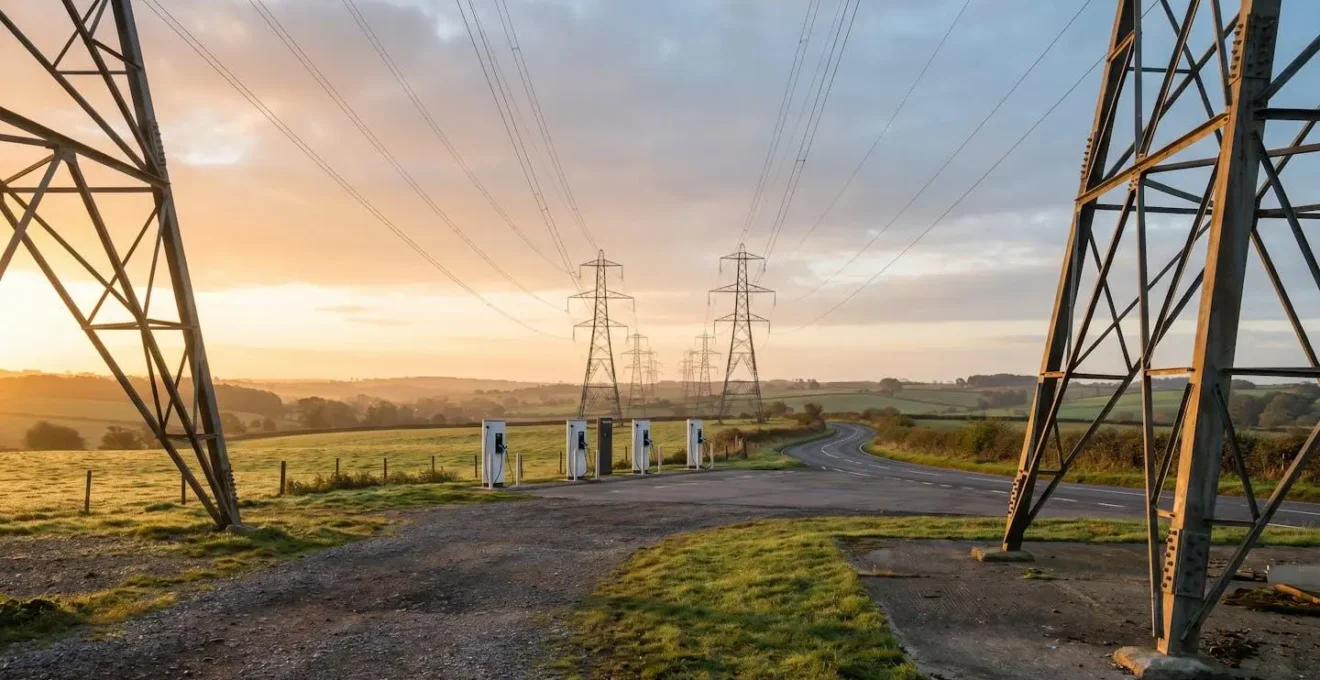
The mass adoption of Electric Vehicles represents not a threat to the UK National Grid, but a significant, manageable opportunity to build a more resilient and responsive energy system.
- Vehicle-to-Grid (V2G) technology transforms EVs from passive loads into active, revenue-generating grid assets.
- Dynamic time-of-use tariffs are a powerful price signal that aligns charging demand with periods of low-cost, low-carbon energy generation.
- Targeted “last mile” infrastructure upgrades are a more cost-effective solution than overbuilding generation capacity.
Recommendation: Policy and investment must shift from a supply-centric mindset to prioritising demand-side response mechanisms, system flexibility, and grid-edge intelligence to unlock the full potential of electric mobility.
The transition to electric mobility is one of the most significant shifts in the UK’s energy landscape in a century. A common narrative paints a picture of imminent grid collapse, with millions of EVs plugging in simultaneously and overwhelming our national infrastructure. This perspective, however, fundamentally misunderstands the nature of the challenge. The problem isn’t a simple lack of generation capacity; it is a complex systems-modelling puzzle centered on managing demand and supply in real-time.
For policy makers and utility managers, viewing EVs as purely a “load” is a critical error. The reality is far more nuanced and opportunistic. An EV is, in essence, a multi-kilowatt-hour battery on wheels, an asset that is idle for over 90% of its life. The key to integrating millions of these assets onto the grid without catastrophic failure lies not in building more power stations, but in deploying intelligent systems that can influence charging behaviour and leverage the inherent storage capacity of the vehicles themselves. This requires a strategic focus on the mechanisms of control: dynamic pricing, smart charging protocols, and vehicle-to-grid capabilities.
This analysis moves beyond the simplistic “can the grid cope?” question to answer the more salient one: “How can we architect a system where EVs become a cornerstone of grid stability?” We will explore the economic and technical levers available, from the hardware in the home to the software platforms that orchestrate energy flow, to build a robust framework for the UK’s electrified future.
This article provides a systematic analysis of the key components and challenges involved in managing the impact of EV adoption on the UK’s energy infrastructure. The following sections break down each element of this complex system, from economic incentives to hardware standards.
Summary: The UK Grid’s Path to EV Integration
- V2G (Vehicle-to-Grid): Can Your Car Battery Power Your House During Peak Hours?
- The Last Mile: Who Pays for Upgrading Street Cables for Home Chargers?
- Dynamic Pricing: How to Charge Your Car for 2p/kWh Overnight?
- CCS vs CHAdeMO: Why Has Europe Settled on CCS for Rapid Charging?
- Second-Life Batteries: What Happens to EV Batteries When They Can’t Drive Cars?
- Smart Meters vs CT Clamps: How to Monitor Real-Time Electricity Usage?
- DAC (Direct Air Capture): Is Sucking CO2 from the Air Energy Efficient?
- How to Prepare Your Household for Powertrain Electrification and EV Ownership?
V2G (Vehicle-to-Grid): Can Your Car Battery Power Your House During Peak Hours?
Vehicle-to-Grid (V2G) technology transforms an electric vehicle from a passive consumer of electricity into an active participant in the energy market. In essence, it enables bidirectional energy flow, allowing the car’s battery not only to draw power from the grid but also to discharge it back. This capability is a cornerstone of Demand-Side Response (DSR), enabling the EV fleet to function as a vast, distributed energy storage system. During periods of high demand and high prices (typically 4-7 PM), V2G-enabled vehicles can export power to the grid, helping to balance load and reduce the need for expensive, carbon-intensive peaker plants. In return, the vehicle owner is compensated for providing this valuable grid service.
The primary function is not necessarily to power an individual house directly (though Vehicle-to-Home or V2H is a subset of this), but to provide ancillary services to the grid operator. This includes frequency regulation, peak shaving, and providing reserve capacity. The financial viability of V2G is a critical factor for mass adoption. While the potential for revenue exists, it must be weighed against the initial hardware costs and potential impacts on battery degradation, although studies suggest modern battery management systems mitigate this risk significantly.
V2G charger hardware costs remain a barrier at £3,700–£6,000+, but the cost is expected to decrease rapidly with mass production. A cost of around £1,000 would mean the payback period for V2G could comfortably be below five years.
– Ofgem V2G Case Study, UK Electric Vehicle-to-Grid Charging Case Study
From a systems modelling perspective, the aggregate capacity of millions of EV batteries represents a multi-gigawatt virtual power plant. By monetizing this idle capacity, V2G provides a powerful economic incentive for consumers to participate in grid stabilisation, turning a potential liability into a fundamental asset for a flexible, modernised energy system.
The Last Mile: Who Pays for Upgrading Street Cables for Home Chargers?
While national grid capacity is a frequent topic of discussion, the most immediate bottleneck in the electric transition often lies in the “last mile” of the distribution network. This refers to the local low-voltage cables running under residential streets that connect individual homes to the nearest substation. These networks, many of which are decades old, were not designed to support the sustained high load of multiple 7kW home EV chargers operating simultaneously. A single home charger can draw as much power as an entire house, and a street with several EVs charging at once can easily exceed the thermal limits of the existing cabling and local transformer capacity.
This is where the role of the Distribution Network Operator (DNO) becomes critical. The DNO is responsible for maintaining and upgrading this local infrastructure. When a homeowner applies to install an EV charger, the installer must notify the DNO, which assesses the potential impact on the local network. In many cases, particularly in older properties or areas with high EV density, the existing supply may be insufficient, triggering the need for an upgrade. This can range from a simple fuse upgrade at the property to the far more complex and expensive task of reinforcing the street’s main cable or upgrading the local substation.
The question of “who pays” is a significant challenge for policy makers. While standard installations are covered by the homeowner, costs for network reinforcement are often passed on, creating a postcode lottery of EV adoption costs. According to 2026 UK installer data, while standard installations are predictable, DNO upgrades can add £500-£2,000 to the bill, creating an unexpected financial barrier. Smart charging and load management are vital tools to mitigate this, by staggering charging times to reduce peak local demand and defer or avoid costly physical upgrades.
Dynamic Pricing: How to Charge Your Car for 2p/kWh Overnight?
Dynamic pricing is the most effective behavioural lever for managing EV charging demand. By moving away from flat-rate electricity tariffs, suppliers can create powerful price signals that incentivise consumers to shift their energy usage away from peak times. For EV owners, this manifests as specialised “time-of-use” or “agile” tariffs. These tariffs offer dramatically reduced electricity prices during off-peak hours, typically between midnight and 5 AM, when overall grid demand is at its lowest and renewable energy generation (particularly wind) is often abundant and cheap.
The economic incentive is substantial. As verified March 2026 supplier data shows, the best UK EV tariffs offer overnight rates as low as 7.9-8p/kWh compared to standard rates of 24.67p/kWh. This difference can save a typical EV driver hundreds of pounds per year, effectively turning their vehicle’s charging schedule into a direct financial benefit. This not only lowers the total cost of ownership for the consumer but also provides a crucial service to the grid. By concentrating charging demand in these off-peak troughs, it helps to flatten the overall demand curve, improving grid efficiency and making better use of baseline generation.
Advanced “Agile” tariffs take this a step further, with prices that can change every 30 minutes based on wholesale market prices. On windy nights, these prices can even drop to or below zero, meaning customers are effectively paid to consume electricity. The Kaluza V2G programme, which used AI to optimise charging against wholesale prices, demonstrated this potential clearly. In the trial, 330 participants across the UK earned as much as £725 per year by exporting energy, while the platform automatically charged vehicles when prices and carbon intensity were lowest. This proves that with the right tariff and smart technology, EV charging can become a net financial positive for the consumer and a stability tool for the grid.
CCS vs CHAdeMO: Why Has Europe Settled on CCS for Rapid Charging?
The standardisation of charging hardware is crucial for ensuring interoperability and confidence in public charging infrastructure. For years, the rapid charging landscape was divided between two main standards: CCS (Combined Charging System), favoured by European and North American automakers, and CHAdeMO, championed by Japanese manufacturers like Nissan and Mitsubishi. While both are DC fast-charging standards, they use physically incompatible connectors, creating a “format war” akin to VHS vs Betamax.
Europe, through legislation and market forces, has decisively settled on CCS as its standard for DC rapid charging. There are several technical and strategic reasons for this. The CCS connector is designed as a “combo” plug, integrating the slower AC Type 2 connector with two large DC pins below it. This allows for a single, more compact charging port on the vehicle that can handle both AC and DC charging. In contrast, vehicles with CHAdeMO require a separate AC port, adding complexity and cost. Furthermore, the CCS protocol was designed from the outset for higher power delivery and is more easily scalable to the ultra-rapid charging speeds (350kW and beyond) required for future EV models.
This standardisation has profound implications for infrastructure investment. By mandating CCS on all new public chargers, Europe has created a unified market, reducing consumer confusion and encouraging network operators to build out infrastructure with confidence. The data reflects this consolidation. According to Gireve’s Beyond EV Charging report, CHAdeMO connectors represent less than 30% of all fast-charging points in Europe, a number that is rapidly declining as new installations almost exclusively focus on CCS. This decision provides long-term certainty for automakers, network operators, and consumers, forming a stable foundation for the growth of the European EV market.
Second-Life Batteries: What Happens to EV Batteries When They Can’t Drive Cars?
A common misconception surrounding EVs is the idea that their batteries become useless waste after a few years of service. This overlooks the concept of “second-life” applications, a critical component of a circular economy for electric mobility. An EV battery is typically considered to have reached the end of its automotive life when its capacity drops to around 70-80% of its original state. While this reduced range may be unsuitable for driving, the battery retains a huge amount of its energy storage capability and is perfectly suited for less demanding, stationary applications.
As The Electric Car Scheme notes, this distinction is key: “A battery with 70% capacity is unfit for a car but perfect for decades of stationary storage.” These second-life batteries can be aggregated into large-scale Battery Energy Storage Systems (BESS). These systems are invaluable to the grid, providing services such as frequency regulation, peak shaving, and storing excess renewable energy. For example, a BESS can absorb cheap solar or wind power during the day or night and then discharge it during the evening peak, reducing reliance on fossil fuel peaker plants and improving the overall economics of renewables.
From a systems perspective, this creates a virtuous cycle. The residual value of the battery for second-life applications can be factored into the initial cost of the EV, potentially lowering the purchase price for consumers. It also provides a cost-effective source of grid-scale storage, a crucial element for a grid with high penetration of intermittent renewables. Rather than a disposal problem, end-of-life EV batteries are a valuable resource that will underpin the stability and sustainability of the future energy system, long after the vehicle they once powered has been retired.
Smart Meters vs CT Clamps: How to Monitor Real-Time Electricity Usage?
To participate in dynamic tariffs and smart charging schemes, both the user and the system need accurate data on household electricity consumption. Two primary technologies provide this data: smart meters and current-transformer (CT) clamps. While they both measure electricity flow, they operate in fundamentally different ways, with significant implications for data ownership, privacy, and utility.
A smart meter (specifically a SMETS2 meter in the UK) is the utility-sanctioned device, installed by the energy supplier. It measures total household consumption and reports this data back to the supplier, typically every 30 minutes. This communication is what enables time-of-use tariffs. As UK energy market analysis confirms, to unlock 7p/kWh overnight EV tariffs, a working SMETS2 smart meter is required. Without it, the supplier cannot bill for different time periods, and the customer is locked into a standard flat rate. The key characteristic is that the data is owned and controlled by the utility.
A CT clamp, by contrast, is a user-owned device. It clips around the main electricity incomer to the house and measures the current flow in real-time, often second-by-second. This data is typically sent to a local monitoring unit or app and is not shared with the energy supplier. CT clamps are essential for smart EV chargers to perform “load balancing”—dynamically adjusting the car’s charging rate to ensure the total household consumption does not exceed the main fuse limit. They provide a high-granularity, private view of energy usage that is ideal for real-time home energy management. The following table summarises the key differences:
| Feature | Smart Meters | CT Clamps |
|---|---|---|
| Data Ownership | Utility company controlled | User-owned, local network |
| Reporting Frequency | Every 30 minutes | Second-by-second real-time |
| Required for EV Tariffs | Yes (SMETS2 required) | No |
| Installation | Free from energy supplier | User installs or electrician |
| Privacy | Data shared with supplier | Completely private |
| Cost | Free | £50-£150 hardware cost |
In an optimal system, both are used. The smart meter enables the economic relationship with the supplier (the tariff), while the CT clamp provides the real-time data for the safe and efficient physical operation of high-power devices like an EV charger within the home’s electrical limits.
Key Takeaways
- The EV transition is a systems-modelling challenge focused on managing demand, not just increasing supply.
- Economic levers, such as dynamic time-of-use tariffs, are the most powerful tools to align consumer behaviour with grid needs.
- EV batteries are not just a load; they are a vast, distributed energy storage asset that can be monetized through technologies like V2G to enhance grid stability.
DAC (Direct Air Capture): Is Sucking CO2 from the Air Energy Efficient?
Direct Air Capture (DAC) is a technology that uses chemical or physical processes to remove CO2 directly from the ambient atmosphere. While often mentioned in the context of climate solutions, it is crucial for energy system modelers to understand its profound energy implications. The fundamental challenge of DAC lies in thermodynamics. CO2 in the atmosphere is highly diffuse, at a concentration of just over 400 parts per million. Capturing it is therefore an act of fighting entropy—it requires a significant amount of energy to isolate and concentrate a diffuse substance.
Current DAC technologies are extremely energy-intensive. The two main methods, liquid solvent and solid sorbent systems, both require substantial energy inputs, either in the form of high-temperature heat (800-900°C) or large amounts of electricity to power fans and chemical processes. The energy required to capture one tonne of CO2 can range from 1,500 to 2,500 kWh. To put this in perspective, capturing the CO2 emissions from a single gigawatt-scale gas power plant for a year would require the entire output of another large power plant, just to run the capture facility.
From a systems modelling standpoint, this makes DAC a “thermodynamic luxury.” It is an energy-consuming process, not an energy-producing one. While it may have a role in offsetting emissions from hard-to-abate sectors like aviation or cement, it is not a primary energy solution. Its deployment at scale would add a significant new load to the electricity grid, competing for the same low-carbon electricity needed to power EVs, heat pumps, and industry. Therefore, while technologically feasible, its overall energy efficiency and system-level impact must be carefully considered. It remains far more energy-efficient to avoid releasing a tonne of CO2 in the first place than it is to recapture it from the air later.
How to Prepare Your Household for Powertrain Electrification and EV Ownership?
Preparing a household for EV ownership goes beyond choosing a vehicle; it requires a strategic assessment of the home’s energy ecosystem. For policy makers and utilities, educating consumers on these steps is crucial for a smooth transition and for managing local grid impact. The goal is to view the home not as a collection of individual appliances, but as an integrated energy system. The addition of a 7kW EV charger, and potentially a heat pump, fundamentally changes a home’s load profile, demanding careful planning.
The first step is a home energy audit. This doesn’t need to be complex; using a simple CT clamp or monitoring smart meter data can reveal existing peak loads and daily consumption patterns. This information is vital to determine if the property’s main fuse (typically 60-100A) can handle the additional, sustained load of an EV charger. This audit informs whether a main fuse upgrade or, more intelligently, a smart charger with load-balancing capabilities is necessary. Furthermore, potential buyers should proactively contact their local DNO to check for wider network capacity, avoiding the surprise of significant upgrade costs post-purchase.
Switching to an appropriate tariff should be done *before* the EV arrives. This allows the household to adapt its routines—like running the dishwasher or washing machine overnight—to take advantage of off-peak rates, embedding energy-conscious habits. This proactive preparation not only saves the homeowner money but also pre-emptively reduces their impact on peak grid demand. The following checklist provides a practical framework for this preparation process.
Your Action Plan: Pre-EV Purchase Home Preparation
- Conduct a home energy audit: Use a CT clamp or check your meter to understand existing peak loads and determine if your main fuse needs upgrading before adding a 7kW car charger.
- Plan for heat pump integration: If switching from a gas boiler to a heat pump, the combined electrical load with an EV requires careful planning and potential grid connection upgrades.
- Switch to a time-of-use tariff early: Move to an EV or agile tariff well before getting an EV to understand price fluctuations and adapt habits like running the dishwasher overnight.
- Check DNO capacity: Contact your Distribution Network Operator to verify local substation capacity and avoid unexpected upgrade costs of £500-£2,000.
- Arrange a pre-installation survey: Book a survey with an OZEV-approved installer to identify cable runs, consumer unit upgrades, and potential complications before purchase.
Ultimately, a well-prepared household becomes an asset to the grid. By understanding their consumption, utilising smart technology, and responding to price signals, homeowners can minimise both their costs and their strain on the local infrastructure, ensuring the electrification of transport is both sustainable and efficient.
The next logical step for policy makers and utility managers is to design and implement regulatory frameworks and consumer education programmes that actively encourage this level of household preparation, transforming potential grid challenges into systemic opportunities.