In summary:
- Analyse your daily mileage to “right-size” your EV’s battery; a bigger battery isn’t always better or cheaper for city driving.
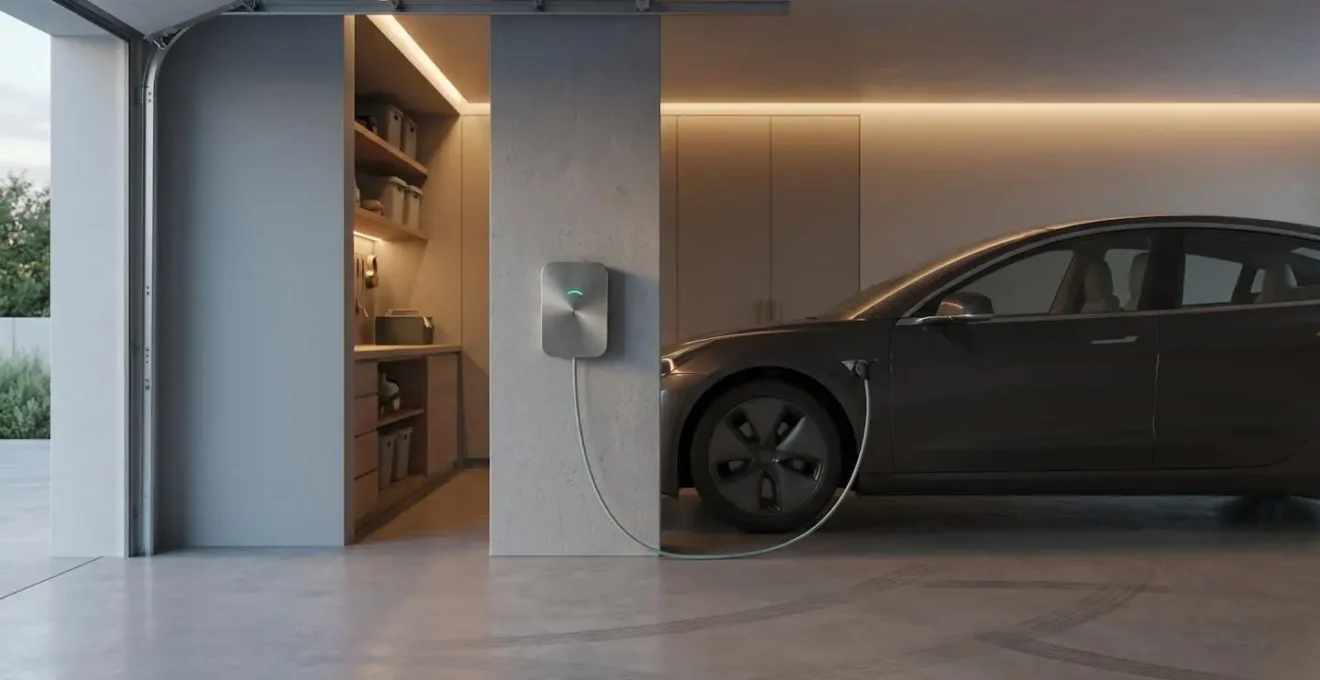
- For most households, a 7kW smart wallbox is the optimal choice for cost-effective overnight charging, making 22kW chargers unnecessary.
- Eliminate range anxiety on long trips by using dedicated route planning apps that show the extensive and growing public charging network.
- When buying a used EV, always perform a battery State of Health (SOH) check using an OBD2 dongle and a specific app for the vehicle.
- Focus on the Total Cost of Ownership (TCO), as lower running and maintenance costs often make EVs cheaper than diesel cars over five years.
For a family on the verge of their first electric vehicle purchase, the landscape can feel both exciting and overwhelming. The conversation is often dominated by big numbers and technical jargon: kilowatt-hours, charging speeds, and maximum range. It’s easy to fall into the trap of thinking that the “best” EV is simply the one with the biggest battery or the fastest charger, leading to unnecessary expense and inefficiency.
While these specifications are important, they are not the whole story. The real key to a successful and cost-effective transition to electric mobility lies in a more nuanced approach. It requires a shift in mindset—from simply buying a new type of car to re-engineering your family’s relationship with energy and transport. It’s about understanding your specific needs and optimising the vehicle and infrastructure to fit your life, not the other way around.
This guide, structured from the perspective of an automotive consultant, will walk you through the critical decisions you’ll face. We will move beyond the marketing hype to provide a clear framework for evaluating battery size, home charging, route planning, second-hand purchases, and the true total cost of ownership, ensuring your move to electric is as smooth and intelligent as possible.
This article will provide a structured approach to making these crucial decisions. Explore the summary below to navigate the key areas that will empower you to make the best choice for your family’s needs.
Summary: Your Guide to a Smart EV Transition
- kWh vs Range: Why a Bigger Battery Isn’t Always Better for City Driving?
- 7kW vs 22kW: Which Wallbox Do You Need for Overnight Charging?
- Route Planning: How to Avoid Range Anxiety on a Trip to Scotland?
- Battery Health Check: How to Test a Second-Hand EV Battery Before Buying?
- Total Cost of Ownership: Is an EV Really Cheaper Than a Diesel After 5 Years?
- Energy Density: Can Solid-State Batteries Really Double Your Driving Range?
- Dynamic Pricing: How to Charge Your Car for 2p/kWh Overnight?
- Why Are Solid-State Batteries the Holy Grail for Electric Vehicles?
kWh vs Range: Why a Bigger Battery Isn’t Always Better for City Driving?
The automotive industry has trained consumers to believe that “bigger is better,” and this mindset has carried over to electric vehicles. The kWh capacity of a battery is often seen as the single most important metric, a direct proxy for range and, therefore, utility. However, for the majority of families whose driving is primarily urban or suburban, opting for the largest possible battery is often a financially and ecologically suboptimal decision. The core principle should be right-sizing the battery to your actual usage pattern, not buying for the one-off longest journey you might take.
A larger battery is significantly heavier. This extra mass creates a permanent efficiency penalty, requiring more energy to move the vehicle at all times. A 2024 study by the International Council on Clean Transportation found that using a 116-kWh battery instead of a 28-kWh one increases energy consumption by 13.4% to 16.9% for typical city and rural drivers. This means you’re paying more for electricity on every single trip, just to carry around battery capacity you rarely use.
Case Study: The Real Cost of an Oversized Battery for Commuters
The same ICCT study provided a powerful real-world simulation. They found that for urban and rural commuters, upgrading from a small to a very large battery only saved them about 35 charging stops over an entire year, since their daily driving was easily covered by the smaller pack. However, this minor convenience came at a steep price: the total cost of ownership increased by 20-23%. This demonstrates that for most daily use, the higher purchase price and persistent energy penalty of a large battery far outweigh the minimal gains in charging convenience.
The consultant’s advice is clear: calculate your average daily and weekly mileage. If a smaller, more affordable battery pack covers 95% of your trips with a comfortable buffer, it is almost certainly the smarter financial choice. You can then rely on the public rapid charging network for the occasional long-distance journey.
7kW vs 22kW: Which Wallbox Do You Need for Overnight Charging?
Once you’ve chosen your vehicle, the next major decision is home charging. The market presents a confusing array of options, often boiling down to a choice between a 7kW and a 22kW wallbox charger. The higher number seems instinctively better, promising faster charging and “future-proofing.” However, for household use, this is a classic case where understanding the complete system reveals a different truth. For the vast majority of UK homes and EV owners, a 7kW charger is not only sufficient but is the most logical and cost-effective solution.
The critical limiting factor is often not the charger itself, but your vehicle’s onboard AC charger. Many popular EVs, including models from Tesla, VW, and Hyundai, can only accept a maximum of 7kW or 11kW from an AC source. Installing a 22kW charger for a car that can’t accept that speed is like fitting a fire hose to a garden sprinkler—the potential is wasted. Furthermore, 22kW chargers require a three-phase electrical supply, which is rare in residential properties and extremely expensive to install, whereas 7kW chargers work perfectly with the standard single-phase supply found in almost every home.
Consider the practical reality of overnight charging. A typical 60kWh EV battery will be fully replenished from nearly empty in about 8-9 hours with a 7kW charger. Since most cars are parked for 10-12 hours overnight, this provides more than enough time to start every day with a full battery, even if you arrive home with very low charge. The “need for speed” with a 22kW charger only becomes relevant if you have a very short turnaround time at home, a scenario that doesn’t apply to typical overnight charging patterns.
Instead of focusing on raw power, the smarter investment is in a 7kW smart charger. These devices offer features like scheduled charging to take advantage of cheaper off-peak electricity, solar integration, and load balancing for households with two EVs. These intelligent features deliver far more real-world value and cost savings than the largely theoretical speed benefit of a 22kW unit in a domestic setting.
Route Planning: How to Avoid Range Anxiety on a Trip to Scotland?
The fear of being stranded with a dead battery, or “range anxiety,” remains one of the biggest psychological barriers for families considering an EV. A long-distance trip, such as a holiday to the Scottish Highlands, often becomes the ultimate “what if” scenario. The perception is one of a sparse, unreliable charging network. However, this image is increasingly outdated. The key to a stress-free EV road trip is not necessarily a gigantic battery, but proactive and intelligent route planning using the excellent tools and infrastructure now available.
Scotland, in particular, has made a massive investment in its public charging network, making it a leader in the UK. Data from Transport Scotland shows the country’s rapid progress: Scotland reached 6,007 public charge points by October 2024, marking 49% growth in just over a year. This isn’t just about quantity; it’s about strategic placement.
Per head of population, Scotland has more public EV charge points than any other part of the UK, except London. We also benefit from more rapid public EV charge points than any other UK region.
– Transport Scotland, Scottish Government Electric Vehicle Infrastructure Investment Announcement
So, how do you leverage this? The solution is to use dedicated EV route-planning apps like Zap-Map or A Better Routeplanner (ABRP). Before you even leave, you input your car model, starting state of charge, and destination. The app calculates a complete route, including planned charging stops at appropriate rapid chargers. It tells you which chargers to use, for how long you’ll need to charge, and what your estimated battery level will be upon arrival. This turns the journey from a source of anxiety into a predictable and manageable series of driving segments punctuated by short breaks for charging—often perfectly timed for a coffee or lunch stop.
This planning-first approach reframes the road trip. Instead of driving until the warning light comes on, you drive to a planned stop. It builds confidence and demonstrates that with modern EVs and a mature charging network, even ambitious trips through scenic but seemingly remote areas are entirely feasible.
Battery Health Check: How to Test a Second-Hand EV Battery Before Buying?
Purchasing a second-hand electric vehicle offers a fantastic opportunity to enter the market at a lower price point. However, it introduces a significant variable that doesn’t exist with internal combustion cars: the health of the high-voltage battery. The battery is the single most expensive component, and its degradation directly impacts the car’s range and value. A simple mileage check is insufficient. As a consultant, I would insist that you should never buy a used EV without first verifying its battery State of Health (SOH).
SOH is a measurement, expressed as a percentage, of the battery’s current ability to hold a charge compared to its original capacity when new. A brand-new car has 100% SOH. Over time, due to charging cycles and age, this capacity slowly diminishes. While some degradation is normal—real-world data suggests a 1-2% loss of capacity per year is common—a vehicle with abnormally low SOH could indicate a faulty battery or a history of harsh use, such as excessive rapid charging.
Fortunately, you don’t need a dealer’s workshop to perform this vital check. A relatively simple and inexpensive method using an OBD2 (On-Board Diagnostics) dongle and a smartphone app can provide a reliable SOH reading. This small device plugs into the car’s diagnostic port and transmits vehicle data via Bluetooth to your phone. It empowers you to see beyond the dashboard’s range estimate (which can be misleading) and access the battery management system’s core data.
Your Action Plan: Verifying Second-Hand EV Battery Health
- Purchase a reputable Bluetooth OBD2 adapter (e.g., VEEPEAK, OBDLink); avoid cheap, unbranded dongles that can be unreliable.
- Download the model-specific diagnostic app for the target EV, such as LeafSpy Pro for a Nissan Leaf or Car Scanner for a wider range of models.
- Locate the vehicle’s OBD2 port (usually under the dashboard) and connect the adapter with the car in accessory or “on” mode.
- Launch the app and navigate to the battery health metrics. Focus on the SOH percentage (above 90% is great, below 80% warrants caution) and cell voltage balance (large differences between cells can indicate a problem).
- Review historical data if available, checking for cell temperature spreads or a high number of DC fast charging sessions, which can accelerate degradation.
Total Cost of Ownership: Is an EV Really Cheaper Than a Diesel After 5 Years?
One of the most compelling arguments for switching to an EV is the promise of lower running costs. However, families are often hesitant due to the higher initial purchase price compared to an equivalent petrol or diesel model. To make a sound financial decision, you must look beyond the sticker price and evaluate the Total Cost of Ownership (TCO) over a typical ownership period, such as five years. When all factors are considered, an EV is frequently the more economical choice.
TCO encompasses several key areas: the initial purchase price (minus any government grants), depreciation, insurance, energy costs (electricity vs. fuel), and maintenance. For EVs, the first two can be higher, but the savings in the latter two categories are substantial and consistent. The most immediate saving is on “fuel.” Charging an EV at home on an off-peak electricity tariff is dramatically cheaper than filling a tank with diesel. Even with fluctuating energy prices, analysis consistently shows that households save $500 to $1,000+ per year in fuel costs when they make the switch.
Maintenance is the other significant area of savings. An electric motor has very few moving parts compared to an internal combustion engine. This means there are no oil changes, spark plugs, exhaust systems, clutches, or complex gearboxes to service or replace. Maintenance is typically limited to tyres, brakes (which wear more slowly due to regenerative braking), suspension components, and cabin air filters. This simplicity translates directly into fewer and cheaper trips to the garage over the life of the vehicle.
When you combine [fuel savings] with lower maintenance costs and potential purchase incentives, the total cost of ownership for an EV can often beat that of a gas-powered vehicle despite a higher initial sticker price.
– Suntrup Volkswagen EV Ownership Research, First-Time Electric Vehicle Guide 2025
When you spreadsheet these costs over five years, the initial price premium of the EV is steadily eroded by the cumulative savings on fuel and maintenance. For high-mileage drivers, this break-even point can arrive in as little as two to three years, making the EV the clear financial winner long-term.
Energy Density: Can Solid-State Batteries Really Double Your Driving Range?
As you research EVs, you’ll inevitably encounter buzz about the next generation of battery technology, with “solid-state” being the most prominent. The promise is transformative: a battery that is safer, lighter, and possesses such high energy density that it could double an EV’s driving range without increasing the battery’s size. While this technology is genuinely exciting, it’s crucial for a family buying a car today to separate the future promise from the present reality.
Energy density refers to the amount of energy that can be stored in a given volume or mass. Today’s lithium-ion batteries use a liquid electrolyte to move ions between the anode and cathode. Solid-state batteries replace this liquid with a solid material, which allows for the use of more advanced, energy-rich materials like a lithium metal anode. In theory, this could lead to a dramatic leap in range. However, this technology is still in the late stages of research and development, facing significant manufacturing and cost challenges before it can be commercialised for mass-market vehicles.
It’s important to recognise how far current technology has already come. A decade ago, a 200-mile range was exceptional. Today, it’s commonplace. The pinnacle of current lithium-ion technology can be seen in models like the Lucid Air. The Grand Touring model, for example, achieves an EPA-estimated 516-mile range not just through its battery, but through a holistic obsession with efficiency across the entire vehicle—from aerodynamics to powertrain design. This demonstrates that massive range is already achievable with existing, proven technology.
Indeed, the progress has been rapid and consistent. Research shows that from 2015 to 2024, electric vehicles have experienced a 60% improvement in average range. For a family buying today, the takeaway is this: don’t delay a purchase waiting for a “perfect” future technology that is still years away. The EVs available now are more than capable, with ranges sufficient for almost any need, and they represent a huge leap forward from the cars of just a few years ago.
Dynamic Pricing: How to Charge Your Car for 2p/kWh Overnight?
One of the most overlooked but powerful advantages of EV ownership is the ability to engage in “energy arbitrage”—buying electricity when it’s abundant and cheap to use for driving when fuel would be expensive. This is made possible through a combination of a smart charger and a dynamic or “agile” electricity tariff. For families looking to maximise savings, this is the single most effective strategy, potentially reducing “fuel” costs to a fraction of the standard rate.
Standard electricity tariffs often have a single flat rate per kWh, or a slightly cheaper “Economy 7” rate for a fixed block of hours at night. Dynamic tariffs, offered by innovative energy suppliers like Octopus Energy with their “Agile” tariff, are completely different. The price of electricity changes every 30 minutes, based on real-time wholesale market prices and grid demand. When demand is low and renewable generation (like wind) is high overnight, the price can plummet, sometimes even going negative (meaning you get paid to use electricity).
This is where the system integration of your EV and home charger becomes brilliant. You can program your smart charger or vehicle to only charge when the electricity price drops below a threshold you set, for example, 5p/kWh. Your car will then sit idle after being plugged in, waiting. At 2:30 AM, when a gust of wind across the North Sea sends wind turbines spinning and floods the grid with cheap, green power, the price might drop to 2p/kWh. Your charger automatically kicks in, topping up your car with incredibly cheap energy. By the time you wake up, your car is fully charged, and you’ve paid a fraction of the standard daytime rate.
This approach does require a smart meter and a willingness to switch to a more volatile tariff. However, for a predictable, large-scale load like an EV charging overnight, the savings are immense. It transforms your car from a simple transport tool into an active, intelligent participant in the green energy transition, saving you a significant amount of money in the process.
Key Takeaways
- Your family’s unique usage pattern is the most important factor; always “right-size” your EV and charger to your needs, not to maximum specifications.
- A 7kW smart charger is the most cost-effective and practical solution for overnight charging for almost all UK households.
- For second-hand EVs, a battery State of Health (SOH) check using an OBD2 tool is an absolutely essential piece of due diligence.
Why Are Solid-State Batteries the Holy Grail for Electric Vehicles?
In the quest for the perfect electric vehicle, the battery is the undisputed centrepiece. While today’s lithium-ion technology is incredibly effective, the industry is constantly searching for a successor that can solve all of its remaining compromises. The term “holy grail” is often applied to solid-state batteries because they promise to deliver a combination of attributes that would represent a true paradigm shift: enhanced safety, longer lifespan, faster charging, and greater energy density.
The core advantage of a solid-state battery is its replacement of the flammable liquid electrolyte found in current batteries with a solid, often ceramic or polymer, material. This immediately offers a huge safety benefit by virtually eliminating the risk of thermal runaway and fire. This solid structure also helps to prevent the formation of dendrites—tiny, needle-like structures that can grow inside a battery, cause short circuits, and limit its lifespan. By solving this, solid-state batteries could potentially endure many more charge and discharge cycles than current technologies. For instance, a key benchmark today is set by Tesla’s Model 3 using LFP batteries, which achieves 3,000+ charge cycles; solid-state aims to far exceed this.
However, while solid-state holds immense promise, it is not the only path forward. The battery technology landscape is rich with innovation, and other chemistries are emerging as powerful contenders that could reach the market sooner and at lower cost. One of the most promising is sodium-ion.
Sodium-ion batteries are on the verge of transforming the EV industry. With costs projected to be 50% lower than lithium-ion batteries by 2030, this emerging technology could disrupt battery supply chains, drive EV affordability, and reduce dependency on scarce raw materials.
– PatentPC Battery Technology Research, EV Battery Trends Report 2024
This highlights a crucial point for any prospective EV owner: the future is not monolithic. While solid-state might be the long-term “holy grail,” more immediate and affordable breakthroughs from technologies like sodium-ion could have a bigger impact on the market in the medium term. This dynamic and competitive field ensures that the EVs of tomorrow will be continuously improving in cost, range, and durability.
Armed with this strategic framework, your family is now equipped to look past the marketing slogans and specification sheets. You can confidently analyse your own needs, ask the right questions of dealers, and build an EV ecosystem—car, charger, and tariff—that is not just environmentally conscious, but also perfectly and economically tailored to your life.