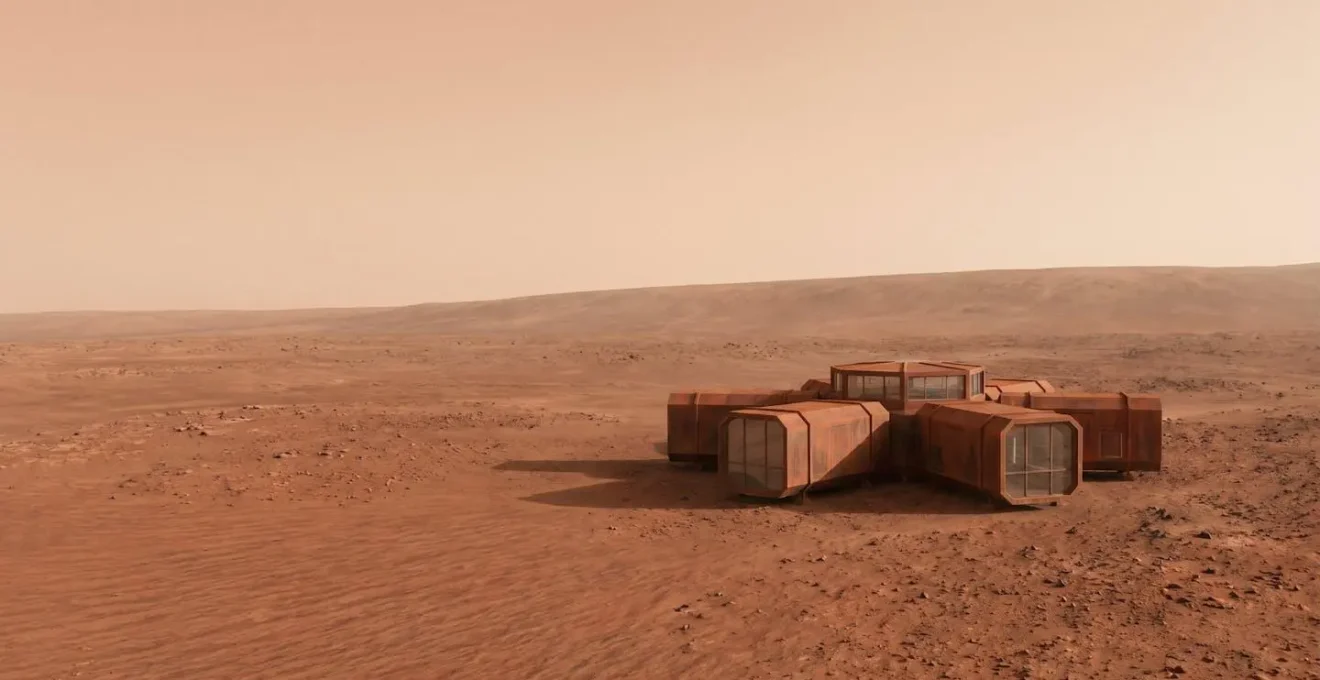
Establishing a permanent human presence on another planet is not a visionary quest but an extreme systems engineering problem. The primary challenge isn’t building bigger rockets, but solving a cascade of unglamorous, interconnected resource bottlenecks on-site. Success in the next 50 years depends entirely on our ability to master in-situ resource utilization (ISRU)—living off the land—to overcome the crushing mass penalty of launching everything from Earth, creating a truly closed-loop, sustainable habitat.
The dream of interplanetary colonization often conjures images of gleaming cities under Martian skies, a testament to human ambition. We are told stories of visionary leaders and revolutionary rockets that will carry us to the stars. This narrative, while inspiring, dangerously simplifies the task at hand. It glosses over the fundamental, non-negotiable constraints of physics, biology, and logistics that define survival beyond Earth.
From an engineering perspective, a Mars colony is the ultimate high-stakes project in systems integration. It’s not a single problem but a thousand interconnected ones. While we focus on the journey, the real challenge begins upon arrival. The romantic notion of “exploration” is misleading; this is about building a permanent, self-sustaining industrial and biological machine in the most hostile environment imaginable. It is an exercise in managing cascading failure points where the margin for error is zero.
But if the core challenge isn’t the rocket, what is it? The key lies in shifting our perspective from transportation to sustainability. The true measure of a viable colony is not its population, but the moment it achieves logistical break-even—producing more resources than it consumes from Earth. This article breaks down the pragmatic, non-negotiable engineering problems we must solve to make this happen, moving from basic survival to long-term viability.
This guide will deconstruct the critical technology and policy stacks, from generating breathable air to establishing property rights, that form the real foundation of any off-world settlement. We will explore the unglamorous but essential systems required to support human life in deep space.
Summary: Realistic Strategies for Interplanetary Colonization
- ISRU (In-Situ Resource Utilization): How to Make Oxygen from Martian Soil?
- Radiation Protection: Can We Live in Lava Tubes to Avoid Cosmic Rays?
- Space Agriculture: How to Grow Calories in Regolith Without Soil?
- Space Law: Who Owns the Land You Build On in Space?
- Starship Logistics: How Much Cargo Do You Need to Support 100 People?
- Nuclear Fusion: How Close Is the UK’s STEP Programme to Commercial Power?
- In Silico Design: How to Create New Batteries Without Physical Experiments?
- How to Prepare Your Cybersecurity for the Post-Quantum Cryptography Era?
ISRU (In-Situ Resource Utilization): How to Make Oxygen from Martian Soil?
The single greatest constraint in space exploration is the mass penalty. Every kilogram launched from Earth’s gravity well costs a fortune in energy and resources. A sustainable colony cannot rely on shipments of basic consumables like air and water. The solution is In-Situ Resource Utilization (ISRU), a term for living off the land. The most critical first step is manufacturing oxygen, not just for breathing, but for rocket propellant to enable a return journey.
The Martian atmosphere is 95% carbon dioxide (CO2). The Mars Oxygen In-Situ Resource Utilization Experiment (MOXIE) on the Perseverance rover proved that we can technologically solve this problem. MOXIE works like a mechanical tree, using high-temperature electrolysis to split CO2 molecules into oxygen and carbon monoxide. As a technology demonstrator, its success is a cornerstone of future mission planning. On 10 separate runs under various Martian conditions, NASA’s MOXIE experiment demonstrated that 122 grams of total oxygen could be produced, hitting a peak rate of 12 grams per hour—enough to keep a small dog alive.
While these numbers seem small, they represent a monumental engineering victory. As the research team led by Michael Hecht noted, a scaled-up system is the key to sustainability. Instead of launching hundreds of tons of equipment and propellant from Earth, a future colony would deploy a much larger, more robust MOXIE-like plant as part of a precursor robotic mission. This plant would spend years building up a multi-ton stockpile of liquid oxygen, waiting for the first human crew to arrive with their “return ticket” already manufactured for them on Mars.
This approach fundamentally changes the architecture of a Mars mission from a one-way gamble to a sustainable, two-way highway enabled by local manufacturing.
Radiation Protection: Can We Live in Lava Tubes to Avoid Cosmic Rays?
Even with a breathable atmosphere, colonists on Mars face an invisible, persistent threat: radiation. Unlike Earth, Mars has no global magnetic field and a very thin atmosphere, offering little protection from two primary sources of dangerous radiation: unpredictable Solar Proton Events (SPEs) from the sun and the constant, high-energy rain of Galactic Cosmic Rays (GCRs) from deep space. This constant exposure is not a trivial concern; it is a primary limiting factor for human health.
The numbers are sobering. Based on data from the Radiation Assessment Detector (RAD) on the Curiosity rover, it’s projected that astronauts would be exposed to a significant dose over a mission. For a complete Mars mission, NASA’s measurements indicate a total of approximately 1 sievert of radiation exposure. This dosage is near or exceeds the entire career limit for astronauts in Low Earth Orbit and is known to significantly increase lifetime cancer risk, damage the central nervous system, and cause a host of other degenerative issues.
Case Study: Artemis-I Radiation Validation
The uncrewed Artemis-I mission, which flew around the Moon, served as a crucial validation for our radiation models. By placing detectors in the Orion capsule, scientists confirmed that our predictive models for deep space radiation are highly accurate—to within 4%. This is both good and bad news. It means we understand the scale of the problem with terrifying precision, but it also confirms that without revolutionary shielding, astronauts on a Mars mission will face radiation levels that are currently considered unacceptable for a career. The study validates the problem, but does not yet offer a solution.
Surface habitats will require heavy shielding—likely several meters of packed regolith (Martian soil) or water—which is logistically challenging to construct. This has led engineers to a more elegant, natural solution: go underground. Mars, like Earth, has a volcanic past, and is believed to harbor extensive networks of lava tubes. These are massive, subterranean caverns left behind by ancient lava flows. A sufficiently deep lava tube could provide a pre-made, perfectly shielded environment, reducing GCR exposure by orders of magnitude and completely protecting against solar storms. Identifying, accessing, and sealing these tubes is now a primary objective for robotic precursor missions.
Simply put, the first Martian cities will almost certainly be built underground, not on the iconic red plains.
Space Agriculture: How to Grow Calories in Regolith Without Soil?
With air to breathe and shelter from radiation, the next bottleneck in the survival chain is food. The romantic image of a colonist tilling Martian fields is a scientific impossibility. Martian “soil,” or regolith, is fundamentally different from terrestrial soil. It is essentially crushed volcanic rock, devoid of organic matter and essential microbial life. Worse, it’s chemically hostile to plant life.
The most significant challenge is the presence of perchlorate salts, which are widespread in the Martian regolith. While a potential source for oxygen, perchlorates are highly toxic to humans and plants. As Associate Professor Andrew Palmer noted, these salts “will impede plant cultivation…jeopardizing food security and potentially causing health problems for humans, including cancer.” This isn’t a theoretical problem. Experiments confirm the toxicity; research found that Martian regolith simulant with perchlorate prevented germination entirely. Washing the regolith to remove these salts is a massive, water-intensive industrial process that is impractical for a fledgling colony.
The engineering solution is to bypass the regolith entirely. Instead of open-field farming, a Mars colony will depend on closed-loop agricultural systems. This means advanced hydroponics (growing plants in nutrient-rich water) or aeroponics (misting roots with nutrient vapor) inside pressurized, climate-controlled modules. These systems offer numerous advantages: they use 90% less water than traditional agriculture, eliminate soil-borne diseases, allow for vertical stacking to maximize yield per square meter, and enable precise control over nutrients to optimize growth. Initial missions will bring a “starter kit” of seeds and nutrient stocks, with the long-term goal of recycling all human and plant waste to create a self-sustaining nutrient cycle.
This turns the problem of agriculture from a geological challenge into a systems engineering one, focused on plumbing, lighting, and life support rather than plows and tractors.
Space Law: Who Owns the Land You Build On in Space?
Once a habitat is established and colonists are self-sufficient, a new category of problem emerges: governance and ownership. If a private company establishes a base inside a resource-rich lava tube, do they own that tube? Can they prevent others from using it? This is not just a philosophical question; it is a critical legal and economic challenge that directly impacts the feasibility of private investment in space.
The foundational legal framework is the 1967 Outer Space Treaty, which has been the bedrock of space law for over half a century. Its stance on ownership is clear and prohibitive. As stated in its most famous clause:
Outer space, including the moon and other celestial bodies, is not subject to national appropriation by claim of sovereignty, by means of use or occupation, or by any other means.
– United Nations, Outer Space Treaty Article II (1967)
This principle makes space a global commons, like the high seas. You can’t plant a flag and claim a piece of Mars for your country. However, the treaty is silent on whether a private entity can own the resources it extracts. This ambiguity is the central conflict in modern space law and the focus of new international agreements.
Case Study: The Artemis Accords Framework
The Artemis Accords, led by the United States and signed by over 40 nations, represent the first major attempt to interpret the Outer Space Treaty for a new era of resource utilization. The Accords posit that “the extraction of space resources does not inherently constitute national appropriation.” This creates a legal rationale for companies to mine asteroids or extract water ice on the Moon with the expectation that they can own and sell what they collect. However, this interpretation is not universally accepted. Major spacefaring nations like Russia and China have not signed, creating the potential for future geopolitical conflict over resource claims. The Accords are a framework for cooperation among signatories, but they also highlight the deep divisions in how humanity views the economic future of space.
Without clear, internationally recognized rules for resource extraction and ownership, securing the massive private investment needed for colonization remains a formidable challenge.
Starship Logistics: How Much Cargo Do You Need to Support 100 People?
A colony is a machine that requires a complex supply chain. The scale of the logistical challenge is immense, governed by the payload capacity of rockets like SpaceX’s Starship and the brutal realities of orbital mechanics, which only allow for a launch window to Mars every 26 months. Planning the cargo for a founding mission is an exercise in extreme prioritization.
The first principle of logistics is that you cannot ship everything. The mass penalty is simply too high. This is why ISRU is a non-negotiable prerequisite. For example, consider the fuel needed for the return trip. Research on Mars ISRU economics demonstrates that the 35 metric tons of propellant needed for a Mars Ascent Vehicle would require shipping roughly 400 metric tons of propellant and hardware from Earth. Manufacturing it on Mars is the only viable option. The initial cargo, therefore, isn’t consumables; it’s the factory to make consumables.
The cargo manifest for the first 100 colonists must be a carefully balanced “starter kit” of systems that bootstrap a local economy. It’s not about comfort; it’s about providing the minimum viable industrial base. Every system must be robust, repairable, and as autonomous as possible, likely deployed and tested by precursor robots years before the first humans arrive. A failure in any one of these core systems could lead to a cascading failure across the entire colony.
Your Colony Founding Checklist: Essential Cargo Manifest
- Habitat Infrastructure: Pressurized modules, airlocks, radiation shielding materials, and structural components for immediate shelter.
- Power Systems: Deployable solar arrays and compact nuclear fission reactors (e.g., NASA Kilopower) for continuous energy generation.
- ISRU/Industrial Plant: Oxygen production equipment (scaled-up MOXIE technology), water extraction systems, and chemical processing reactors.
- Life Support & Agriculture Starters: Closed-loop CO2 scrubbers, water recycling systems, hydroponic equipment, and initial seed stock.
- Human Consumables: Food supplies for initial period, medical equipment, spare parts inventory, and emergency reserves.
Ultimately, the goal is for the manifest of later missions to shift from shipping vital hardware to carrying only high-tech components and new colonists, as the bulk of manufacturing moves to Mars itself.
Nuclear Fusion: How Close Is the UK’s STEP Programme to Commercial Power?
A fledgling colony can survive on solar and compact fission reactors, but to truly thrive and achieve industrial self-sufficiency—the point of logistical break-even—it requires a source of abundant, continuous, high-density power. Solar power on Mars is significantly less effective than on Earth due to the greater distance from the sun, a thinner atmosphere, and planet-engulfing dust storms that can last for weeks. While essential for initial operations, solar alone cannot power large-scale mining, manufacturing, and propellant production.
This is where nuclear fusion enters the long-term strategic picture. Fusion, the process that powers the sun, promises a nearly limitless supply of clean, safe, and incredibly dense energy. A fusion reactor on Mars could provide the gigawatts of power necessary to run an entire industrial ecosystem, from smelting metals extracted from regolith to synthesizing complex polymers for 3D printing spare parts. It is the technological endgame for colonial power systems.
However, achieving practical fusion energy remains one of the greatest scientific and engineering challenges in history. Programs on Earth, such as the UK’s STEP (Spherical Tokamak for Energy Production), are working to bridge the gap from experimental reactors to commercially viable power plants. STEP aims to deliver a prototype plant in the 2040s, demonstrating net energy generation and laying the groundwork for a future fleet of fusion power stations. The progress of programs like STEP and its international counterpart, ITER, serves as a critical timeline indicator. The technologies being developed—from advanced superconducting magnets to materials that can withstand extreme heat—are directly applicable to the compact, robust designs that a space colony would require.
The first nation or entity to develop a deployable fusion reactor will not just revolutionize energy on Earth; they will hold the key to unlocking the industrialization of the solar system.
In Silico Design: How to Create New Batteries Without Physical Experiments?
The extreme environment of Mars pushes technology to its limits. A prime example is energy storage. Standard lithium-ion batteries perform poorly in the deep cold, where average temperatures hover around -63°C (-81°F). Developing new battery chemistries and materials that are efficient, durable, and safe in such conditions is critical. However, the traditional method of materials science—building and testing thousands of physical prototypes—is far too slow, expensive, and impractical for space colonization.
The solution lies in a paradigm shift towards in silico design, which means using computational simulation to invent and test new materials inside a computer. This approach allows scientists and engineers to model the quantum-mechanical and chemical properties of thousands of potential compounds and configurations before ever synthesizing a single one in the lab. It is a powerful accelerator for research and development.
Case Study: Computational Materials Design for Mars
In silico methods are already being applied to solve specific Mars mission challenges. By simulating how different material structures would behave under Martian conditions, researchers can rapidly screen for candidates with desirable properties. For batteries, this means finding electrode and electrolyte materials that maintain high conductivity in extreme cold. For habitats, it means designing new polymers for 3D printing that are resistant to UV radiation. Crucially, these simulations can also be constrained by the known resources available on Mars, guiding the design of materials that can eventually be manufactured entirely in-situ, further reducing the reliance on Earth.
This computational-first approach is not limited to batteries. It is used to design more efficient rocket engine nozzles, model the stresses on habitat structures, develop new catalysts for ISRU chemical reactors, and create alloys for mining equipment. By moving the costly and time-consuming process of trial and error from the physical world to the virtual one, in silico design radically shortens development cycles. It allows engineers to fail faster, cheaper, and more often in simulation, ensuring that the few designs that are physically prototyped have a much higher probability of success.
In essence, before we build factories on Mars, we must first build them in the cloud.
Key Takeaways
- Survival depends on ISRU (In-Situ Resource Utilization) to produce essentials like oxygen and fuel, overcoming the massive cost of launching them from Earth.
- Radiation from deep space is a primary, life-threatening danger, making underground habitats in natural formations like lava tubes a likely necessity.
- Colonization is a systems engineering challenge; success hinges on the reliable integration of power, life support, agriculture, and industrial systems.
How to Prepare Your Cybersecurity for the Post-Quantum Cryptography Era?
In any complex system, the connections are often the most vulnerable points. For a Mars colony, the most important connection is the communication link back to Earth. This link is essential for transmitting scientific data, receiving software updates, and maintaining a cultural connection. Securing this link, however, presents a unique set of cybersecurity challenges not seen in terrestrial networks.
The primary vulnerability is not bandwidth, but latency. Due to the vast distance and the speed of light, there is a one-way communication delay of up to 22 minutes between Earth and Mars. This extreme latency makes standard, “chatty” cybersecurity protocols that rely on rapid handshakes and acknowledgments completely unworkable. An attacker could potentially disrupt communications or inject malicious data in a way that would not be discovered for nearly an hour. This requires a new architecture for secure, delay-tolerant networking.
Furthermore, any data transmitted or stored—from scientific research to personal communications to the operational code for the colony’s reactor—is an incredibly high-value target. This data must be protected not just against today’s threats, but tomorrow’s as well. The most significant future threat comes from the development of large-scale quantum computers, which will be capable of breaking most of the public-key encryption algorithms we rely on today, such as RSA and ECC. An adversary could record encrypted Martian communications today and decrypt them years from now when a quantum computer becomes available.
To counter this, a Mars colony must be built from the ground up with post-quantum cryptography (PQC). These are new encryption algorithms, currently being standardized by organizations like NIST, that are designed to be secure against attacks from both classical and quantum computers. Implementing PQC is not a future upgrade; it must be part of the foundational architecture. The integrity of the colony’s software, the security of its autonomous systems, and the privacy of its inhabitants depend on it.
For a Mars colony, future-proofing the digital infrastructure is as critical as reinforcing the physical one, ensuring its long-term autonomy and resilience in a connected solar system.